
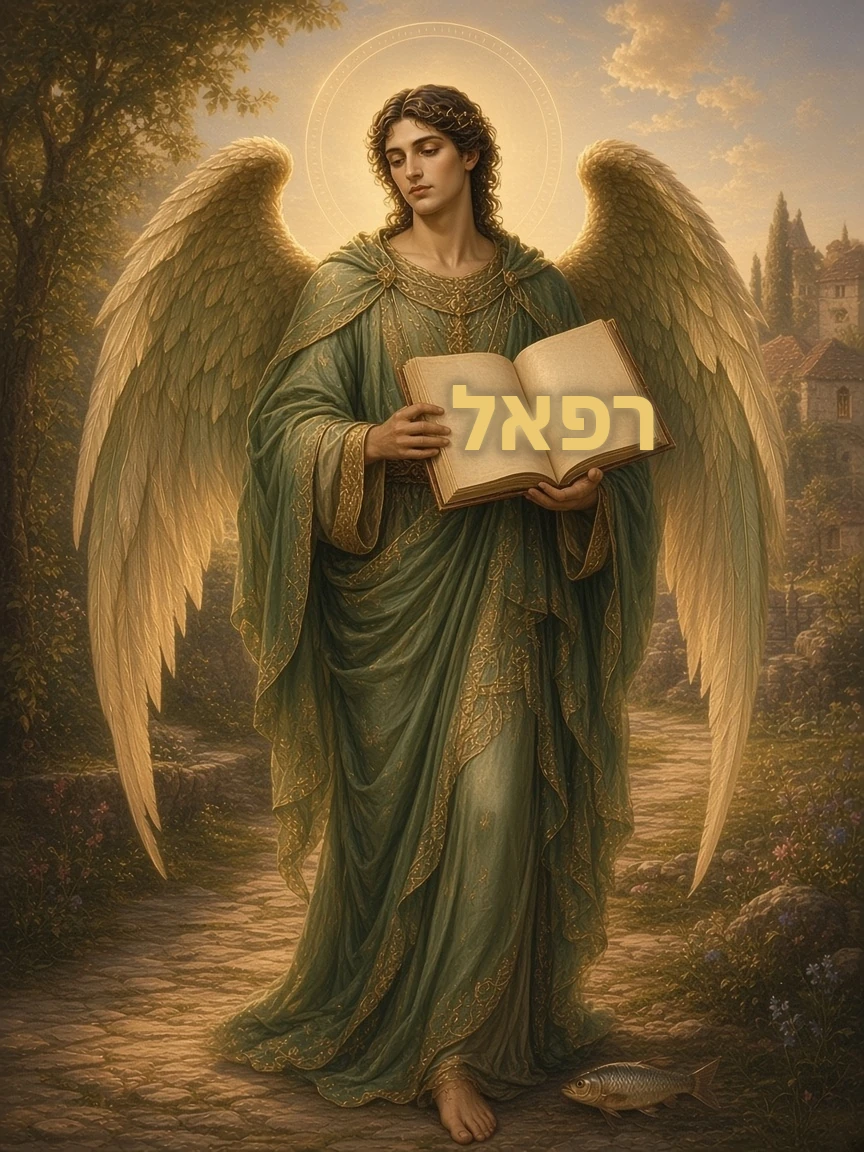
One of the ten archangels · 6 in Agrippa’s list (III.10)
Raphael רְפָאֵל
Also known as רְפָאֵל Rafa’el · Ῥαφαήλ · “Azarias, the son of Ananias the great” (the name he uses in disguise) (sources under “Also known as” below)
Name: “God heals”.
Tracing the name backward
We go backward from the newest source to the oldest dated one, and step back only where a dated text or a published scholarly link anchors the step. Unproven or second-hand links are drawn dashed and marked. Raziel’s full chart is on his page.
Rest the pointer on a section to open it; click to keep it open.Tap a section to open it; tap again to close.
Name originwhat the name means and how it was built
From the root r-p-ʾ “to heal” + El: “God heals”. The same name is borne by a man, Rephael, a gatekeeper (1 Chronicles 26:7), as the Jewish Encyclopedia, “Raphael” (1906) notes. In the Book of Tobit the name fits the story: Raphael heals Tobit’s blindness.
Earliest sourcesthe name traced backward, with dated anchors
Solid = a link anchored in a dated sourceDashed = unproven, second-hand or a later equationNewest at the top; each step goes back in time. Tap any box to open its anchor.
- c. 1st–5th c. CE (debated)
Ῥαφαήλ who binds a demonTestament of Solomon 18:8 (Greek, McCown 1922)Medium
A decan who sends throat diseases departs when he hears “Raphael, shut up Oropel”. Read Testament of Solomon 18: the thirty-six heavenly bodies (Library).
a century or two older
- c. 50 BCE–70 CE
Raphael, set over diseases and wounds1 Enoch 40:9 (Similitudes)High
“The second, who is set over all the diseases and all the wounds of the children of men, is Raphael” (Charles 1917, via the Library).
older
- 2nd–1st c. BCE
Raphael on the towers; “until Raphael arrives”War Scroll 1QM 9:15–16; Book of Giants 4Q203 frg. 8High
On the tower shields with Michael, Gabriel and Sariel; in the giants’ fragments Raphael comes in judgement. Read The archangels: names and duties (Library, web of references).
older, in Tobit
- c. 225–175 BCE (Fitzmyer); Aramaic and Hebrew copies at Qumran (4Q196–200)
“one of the seven holy angels”Tobit 12:15; 5:13High
Raphael travels with young Tobias disguised as “Azarias, the son of Ananias the great” (5:12–13, KJV; verse numbers vary), and at the end says he is “Raphael, one of the seven holy angels” (12:15).
- a folktale type scholars compare with Tobit (Simrock 1856; Deselaers 1982; doubted by Fitzmyer 2003)
the “Grateful Dead” helperfolktale type ATU 505Medium
In the tale a stranger helps the hero who buried a dead man, and is revealed as that dead man; in Tobit the helper is the angel Raphael, and Tobit is the man who buries the dead.
about as old, in Enoch
- a folktale type scholars compare with Tobit (Simrock 1856; Deselaers 1982; doubted by Fitzmyer 2003)
- 3rd c. BCE (composition); Qumran copies 2nd c. BCE
Raphael — the oldest secure witness1 Enoch 9:1; 10:4; 20:3 (Book of the Watchers)High
“Raphael, one of the holy angels, who is over the spirits of men” (1 Enoch 20:3, Charles 1917). In 10:4 he binds Azazel. Read 1 Enoch, Jubilees, Book of Giants and 2 Enoch (Library).
before this: a human name and a root
- date debated
Rephael, a gatekeeper1 Chronicles 26:7Medium
A man’s name. Same word, not an angel.
no anchor
- before the exile
The trail endsNo earlier source names an angel RaphaelNo anchor
Rabbinic tradition itself says that “the names of the angels were brought by the Jews from Babylon” (Simeon ben Lakish, Jerusalem Talmud, Rosh Hashanah 1:2 [JE: “Yer. R. H. 54d”]; Genesis Rabbah 48:9; wording of the Jewish Encyclopedia, “Michael”). No text from before the Babylonian exile names any angel.
Also known asother names the sources give
Also known as רְפָאֵל Rafa’el1 · Ῥαφαήλ2 · “Azarias, the son of Ananias the great” (the name he uses in disguise)3
Sources for these names
- Tobit (Aramaic/Hebrew fragments); 1 Enoch 20:3 (Aramaic copies)
- Tobit 12:15 (Greek); Testament of Solomon 18:8
- Tobit 5:12–13 (KJV numbering 5:12)
Kept off the line: Labiel (the late Midrash Konen says he was once called so; the Jewish Encyclopedia finds “no evidence”); Israfil (the Islamic angel of the trumpet; the equation with Raphael is popular, not anchored).
Comparisonssimilar figures, where scholars draw the link
- A folktale (scholars’ comparison). Tobit’s plot is compared with the “Grateful Dead” tale type (ATU 505) and the “monster in the bridal chamber” (Simrock 1856; Deselaers 1982). Raphael stands where the grateful dead man stands. Fitzmyer (2003) doubts direct dependence.
- Ahiqar. The Book of Tobit names Ahiqar, the wise courtier of an older Aramaic tale, as Tobit’s nephew (Tobit 1:21–22). This links the book, not the angel.
- Other cultures. The Hall has not found a scholar who identifies Raphael with a healing god such as Asclepius; any such parallel would be of role, not of name.
Comparisons are listed only where a scholar makes the link, or are marked as the Hall’s own note. A parallel of role is not a lineage of name.
Further readingbooks in Raziel’s Library and beyond
Unverified and sourceswhat is still to check, and every source
Checked No open unverified claims in this entry beyond those marked dashed in the chart.
Sources
- Jewish Encyclopedia, “Raphael” (1906)
- Fitzmyer, Tobit (CEJL, 2003)
- Simrock, Der gute Gerhard und die dankbaren Todten (1856)
- Deselaers, Das Buch Tobit (1982)
- Charles, The Book of Enoch (1917), in the Library
Hover or tap to turn the card.
- Name
- Raphael, רְפָאֵל, “God heals.” In Tobit he travels disguised as “Azarias, the son of Ananias the great.” AncientAs already on this page; Tobit 5:13; 12:15
- Letters
- רפאל (unpointed); the heading points it רְפָאֵל. Ancient
- Office (Tobit)
- “One of the seven holy angels” (Tobit 12:15). He heals Tobit’s blindness. Aramaic and Hebrew copies at Qumran (4Q196–200) are noted on this page. Ancient
- Office (1 Enoch)
- “Raphael, one of the holy angels, who is over the spirits of men” (1 Enoch 20:3, Charles 1917). In 10:4 he binds Azazel. In the Similitudes: “The second, who is set over all the diseases and all the wounds of the children of men, is Raphael” (1 Enoch 40:9, Charles 1917). Ancient
- Station
- The sixth name is Eloha; “his numeration is Tiphereth, that is apparel, beauty, glory, pleasure,” through the virtues / Malachim “into the sphere of the Sun”; “his particular intelligence is Raphael, who was the Ruler of Isaac and Toby the younger, and the Angel Peliel, ruler of Iacob [Jacob].” Peliel is a second angel at the same numeration, not another name for Raphael. RenaissanceJ.F., Three Books of Occult Philosophy, London 1651 (the edition the Hall holds and already cites). The Hall's English panel for III.10, as transcribed, is cut off after the third numeration; seats 4-10 are quoted from the remainder of that same 1651 English chapter.
- Planet
- Sun, in Agrippa III.10 and in III.24’s first list. The second III.24 list gives the Sun to Michael and Mercury to Raphael — the seats are swapped. Both lists are Agrippa’s. RenaissanceAgrippa III.24, 1651 English, Hall panel
- Winds
- West, in Agrippa III.24: “Raphael over the Western.” Renaissance
- Guided
- Tobias the younger (Agrippa III.47 and III.10); Isaac (III.10). RenaissanceAgrippa III.47, Hall panel; III.10 as above
- Colours
- None named for Raphael himself in Agrippa III.10. Later hour-tables (Mathers 1889), as already quoted on the Hall’s Michael page, give Sunday yellow/gold with Archangel Raphael — a later table, not written back into this entry as fact. HouseNot attested in the sources of this page
- Incense
- Not attested for Raphael himself in the sources already on this page. House
- Feast
- Not given in the sources already on this page. House
Persona: as the books describe him
His name is “God heals,” and the Book of Tobit fits the name to the story: Raphael travels with young Tobias as Azarias, “one of the seven holy angels,” and heals Tobit’s blindness. In 1 Enoch, Charles’s English (in the Library) gives two offices that sit side by side: “over the spirits of men” (20:3), and, in the Similitudes, “set over all the diseases and all the wounds of the children of men” (40:9). In 10:4 he is the one who binds Azazel. Ancient
Agrippa’s 1651 English of III.10 sets him at Tiphereth, through the Sun: “Raphael, who was the Ruler of Isaac and Toby the younger.” III.47 says “Tobias the younger with Raphael.” Inside Agrippa the planetary tables then divide: the first list of III.24 keeps him over the Sun; the second list, “by names somewhat differing,” gives the Sun to Michael and Mercury to Raphael. The two lists are cited, not chosen between. Renaissance
Still to find
Passages we know of but do not yet hold in a public-domain or open copy, or a Hall-held check still outstanding. They are on the Library's to-acquire list.
- The remainder of Agrippa III.10 in the Hall’s own English-panel transcription (cut off after the third numeration). Tiphereth / “ruler of Isaac and Toby” is quoted here from the same 1651 J.F. English the Hall already cites.