
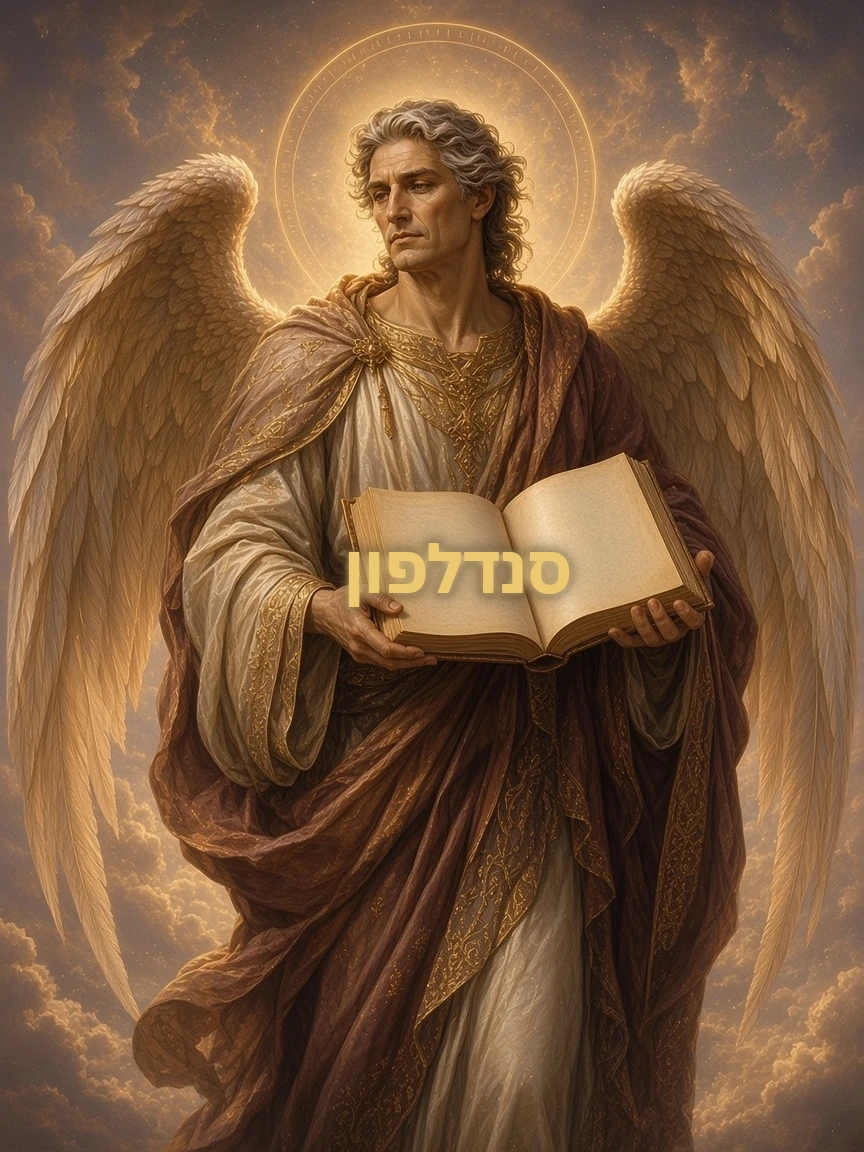
One of the ten archangels · 10 in Agrippa’s list (III.10)
Sandalphon סנדלפון
Also known as Sandalfon, Sandalphon (סנדלפון) · the ofan, “wheel”, of Ezekiel 1:15 · Elijah (a later identification) · “prince over the birds” (sar ha-ofot) (sources under “Also known as” below)
Name: “co-brother” (Greek synadelphos).
Tracing the name backward
We go backward from the newest source to the oldest dated one, and step back only where a dated text or a published scholarly link anchors the step. Unproven or second-hand links are drawn dashed and marked. Raziel’s full chart is on his page.
Rest the pointer on a section to open it; click to keep it open.Tap a section to open it; tap again to close.
Name originwhat the name means and how it was built
A Greek word in Hebrew letters: synadelphos, “co-brother, colleague”, that is, of Metatron. The Jewish Encyclopedia (“Sandalfon”, 1905) calls it “a Greek formation” and rejects Kohut’s Persian origin; the Encyclopaedia Judaica (Scholem) explains it so, “probably correctly”. Spanish kabbalists of the 13th century gave a second, mystical reading: sandal (an unformed embryo, or a shoe) + fon.
Earliest sourcesthe name traced backward, with dated anchors
Solid = a link anchored in a dated sourceDashed = unproven, second-hand or a later equationNewest at the top; each step goes back in time. Tap any box to open its anchor.
- 1858
“Sandalphon”poem by Henry Wadsworth LongfellowHigh
The angel of prayer enters English poetry.
three centuries older
- 16th c.
Sandalphon = the prophet ElijahMoses Cordovero, Hekhalot ch. 14 (via the Jewish Encyclopedia)Medium
A later identification, as Metatron had been identified with Enoch.
a later identification
- 13th c.
Sandalphon in the ZoharZohar II 58a, 246a; III 252b (cited by the Jewish Encyclopedia)Medium
He brings men’s prayers before God; later sources make him “prince over the birds”. Unverified in the Hall’s own copy.
- a book in the Library that names him (per the Jewish Encyclopedia)
Sandalphon over the month of AdarSefer Raziel, 41b (Amsterdam 1701)Medium
Unverified The Hall has not yet checked folio 41b in its copy. Sefer Raziel HaMalakh, Amsterdam 1701 (Library).
older
- a book in the Library that names him (per the Jewish Encyclopedia)
- 6th–9th c.
the fire of SandalphonPesikta Rabbati 20High
Hadarniel leads Moses until “the fire of Sandalphon”, then may go no further; God himself stands before Sandalphon until Moses passes (Sefaria).
older, in the Talmud
- Babylonian Talmud, redacted c. 6th c. CE (a baraita)
“Sandalfon is his name” — the oldest secure witnessHagigah 13bHigh
On Ezekiel 1:15, “one wheel upon the earth”: an angel stands on the earth with his head among the living creatures. “It was taught in a baraita: Sandalfon is his name; he is taller than his fellow by a journey of five hundred years, and he stands behind the Chariot and ties crowns for his Maker.” The Jewish Encyclopedia dates the baraita to the early 2nd century; that is its estimate.
before this: only the Greek word
- Greek, Hellenistic and Roman periods
synadelphos, “co-brother”philological derivation (Levy; Krauss; Jewish Encyclopedia; Encyclopaedia Judaica)Medium
A common Greek word; the step from word to angel’s name is a scholars’ derivation.
no anchor
The trail endsNot in the oldest lists of four or seven archangels, and found nowhere outside Jewish sources (Jewish Encyclopedia)No anchor
He is a figure of the Merkabah (throne-chariot) lore of late antiquity.
Also known asother names the sources give
Also known as Sandalfon, Sandalphon (סנדלפון)1 · the ofan, “wheel”, of Ezekiel 1:152 · Elijah (a later identification)3 · “prince over the birds” (sar ha-ofot)4
Sources for these names
- Hagigah 13b; Pesikta Rabbati 20
- Hagigah 13b
- Moses Cordovero, 16th c.; Yalkut Hadash (via Jewish Encyclopedia)
- Hasidei Ashkenaz and the Zohar (via Encyclopaedia Judaica)
Kept off the line: “twin of Metatron” in a literal sense; the sources call him Metatron’s companion or brother, which is what the Greek word means.
Comparisonssimilar figures, where scholars draw the link
- Metatron and Sandalphon. Later kabbalah pairs them as transfigured Enoch and transfigured Elijah (Encyclopaedia Judaica; Jewish Encyclopedia, “Angelology”).
- Other cultures. The Jewish Encyclopedia notes he is “nowhere found in non-Jewish sources”. The Hall found no scholar comparing him to a figure of another religion.
Comparisons are listed only where a scholar makes the link, or are marked as the Hall’s own note. A parallel of role is not a lineage of name.
Further readingbooks in Raziel’s Library and beyond
- Sefer Raziel HaMalakh, Amsterdam 1701 (Library) (folio 41b, per the Jewish Encyclopedia)
Unverified and sourceswhat is still to check, and every source
Unverified
- Unverified Sefer Raziel 41b (Sandalphon over Adar) not yet checked in the Hall’s copy
- Unverified Zohar folio references taken from the Jewish Encyclopedia
Sources
Hover or tap to turn the card.
- Name
- Sandalphon, also Sandalfon, סנדלפון. The name is commonly derived from Greek synadelphos, “co-brother” (Levy; Krauss; Jewish Encyclopedia; Encyclopaedia Judaica, as already on this page). Scholarship
- Letters
- סנדלפון (as in this page’s heading). Medieval
- Oldest witness
- Babylonian Talmud, Hagigah 13b, on Ezekiel 1:15, “one wheel upon the earth”: “It was taught in a baraita: Sandalfon is his name; he is taller than his fellow by a journey of five hundred years, and he stands behind the Chariot and ties crowns for his Maker.” MedievalAs already quoted on this page
- Pesikta
- Pesikta Rabbati 20: Hadarniel leads Moses until “the fire of Sandalphon,” then may go no further; God himself stands before Sandalphon until Moses passes (Sefaria, as already on this page). Medieval
- Agrippa’s tenth
- Agrippa III.10 does not name Sandalphon. The tenth numeration is Malchuth (Kingdom); “the soul of Messiah is president amongst them, or (as others say) the intelligence Metattron [Metatron] … and was the ruler of Moses.” Later lists, including the heading of this Hall page (“10 in Agrippa’s list”), put Sandalphon in that tenth seat. The 1651 chapter and the later heading are cited side by side, not merged. Renaissance HouseJ.F., Three Books of Occult Philosophy, London 1651 (the edition the Hall holds and already cites). The Hall's English panel for III.10, as transcribed, is cut off after the third numeration; seats 4-10 are quoted from the remainder of that same 1651 English chapter.
- Later identifications
- Elijah (Moses Cordovero; a later identification, as this page already marks); “prince over the birds” (sar ha-ofot), via Hasidei Ashkenaz and the Zohar as reported by Encyclopaedia Judaica — Zohar folio references on this page are not yet checked in a Hall copy. “Twin of Metatron” is kept off the line as a literal sense this page rejects; the sources call him Metatron’s companion or brother. Revival Unverified
- Sefer Raziel
- Sandalphon over the month of Adar, Sefer Raziel 41b (Amsterdam 1701), per the Jewish Encyclopedia: the Hall has not yet checked folio 41b in its copy. Unverified
- Colours
- None named for Sandalphon in the sources already on this page. HouseNot attested
- Incense
- Not attested in the sources already on this page. House
- Feast
- None in the sources already on this page. House
Persona: as the books describe him
The oldest secure witness on this page is a baraita in Hagigah 13b, read on Ezekiel’s “one wheel upon the earth”: “Sandalfon is his name; he is taller than his fellow by a journey of five hundred years, and he stands behind the Chariot and ties crowns for his Maker.” Pesikta Rabbati 20 then sets a fire of Sandalphon that even Hadarniel may not pass; God himself stands before him until Moses goes by. Those sentences are left as they are. Medieval
Agrippa’s III.10, in the 1651 English, does not speak this name. The tenth numeration, Malchuth, is given to “the soul of Messiah,” or, “as others say,” to Metatron, “the first Creature, or the soul of the world, and was the ruler of Moses.” Later lists — and the heading already printed on this Hall page — put Sandalphon in that tenth seat. The Hall does not write Agrippa’s tenth as Sandalphon, and does not erase the later heading. They stand side by side. Later identifications with Elijah, and the title “prince over the birds,” remain marked as later, or as not yet checked in a Hall-held Zohar or in Sefer Raziel 41b. Renaissance Unverified
Still to find
Passages we know of but do not yet hold in a public-domain or open copy, or a Hall-held check still outstanding. They are on the Library's to-acquire list.
- Sefer Raziel HaMalakh, Amsterdam 1701, folio 41b (Sandalphon over Adar), already marked unchecked in the Hall’s copy.
- Zohar II 58a, 246a; III 252b, cited from the Jewish Encyclopedia and marked unverified in the Hall’s own copy.
- The remainder of Agrippa III.10 in the Hall’s own English-panel transcription. The tenth numeration is quoted here from the same 1651 J.F. English the Hall already cites.