
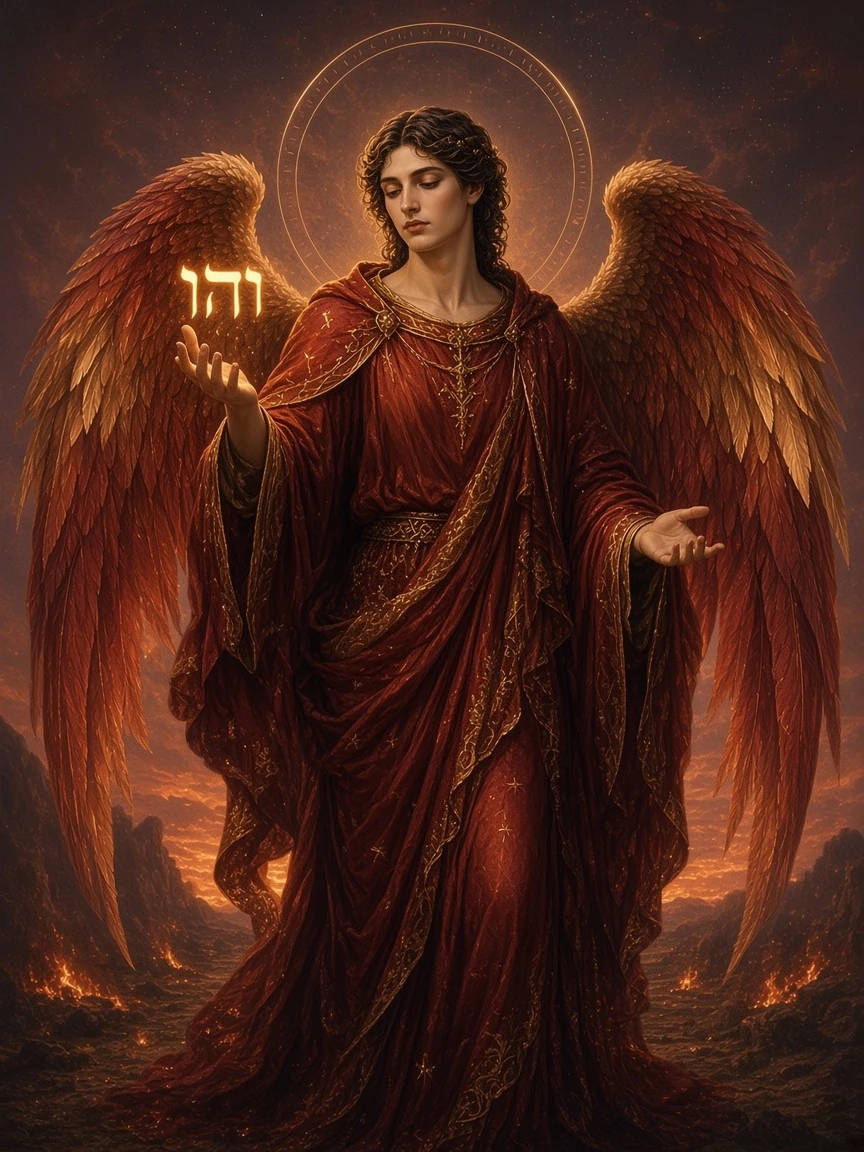
1st of the 72 · Choir of Seraphim
Vehuiah והו
Also known as Vehuiah · והו (the three letters) (sources under “Also known as” below)
Name: the triad והו with an angelic ending.
Tracing the name backward
We go backward from the newest source to the oldest dated one, and step back only where a dated text or a published scholarly link anchors the step. Unproven or second-hand links are drawn dashed and marked. Raziel’s full chart is on his page.
Rest the pointer on a section to open it; click to keep it open.Tap a section to open it; tap again to close.
Name originwhat the name means and how it was built
One of the 72 “names” read out of Exodus 14:19–21. The triad והו is taken letter by letter from the three verses; Renaissance Christian kabbalists (Reuchlin 1517; Agrippa 1533) turned each triad into an angel by adding -el or -iah.
- Choir Seraphim
- Degrees of the zodiac 1°–5°
- Psalm verse Ps 3:4 Vulg. Ps 3:4
From Lenain (1823), as set out in the Sanctuary’s table of the 72.
Earliest sourcesthe name traced backward, with dated anchors
Solid = a link anchored in a dated sourceDashed = unproven, second-hand or a later equationNewest at the top; each step goes back in time. Tap any box to open its anchor.
- 1823
VehuiahLenain, La Science cabalistique (Paris 1823; BIU Santé Ms 5365)Medium
Lenain gives each of the 72 a choir, five degrees of the zodiac and a psalm verse, as listed in the Sanctuary’s table of the 72.
older
- 1652–1654
the 72 in a circleKircher, Oedipus Aegyptiacus II.1Medium
Kircher draws the 72 names as a great circle. Unverified for this name until the Hall reads Kircher’s plate.
older
- 1533 (English 1651)
VehuiahAgrippa, Three Books of Occult Philosophy III.25, table of the 72High
The table of the 72 angels, each formed by adding -el or -iah to a triad of letters. Read Agrippa, De occulta philosophia, Cologne 1533 (Library).
older
- 1517
the triad becomes an angel’s nameJohannes Reuchlin, De arte cabalistica, Book IIIHigh
The oldest dated source the Hall relies on for the angel-names of the 72 (as on the Sanctuary’s Lauviah page). Before this there are only the letters.
the letters, not yet an angel
- 11th c.
והו as one of the 72 namesRashi on Sukkah 45aHigh
Rashi explains the 72 names as read from the three verses of Exodus 14:19–21, “each of 72 letters”: the first letter of the first verse, the last of the middle verse and the first of the last, “and so on in this order”; the first name is והו (Hall translation; Sefaria).
read out of three verses
- the verses themselves
Exodus 14:19–21three verses of 72 letters eachHigh
The first name: ו, the first letter of verse 19 (וַיִּסַּע); ה, the last letter of verse 20 (הַלָּיְלָה); ו, the first letter of verse 21 (וַיֵּט). Rashi gives exactly this example. Hall check Computed from the Hebrew consonantal text of Exodus 14:19–21 (Sefaria, “Tanach with Text Only”; 72 letters in each verse): letter 1 of verse 19 is ו, letter 1 from the end of verse 20 is ה, letter 1 of verse 21 is ו (final forms normalised). All 72 triads in the Sanctuary table match this count. Read Exodus in Gutenberg Bible: Exodus, Psalms and more (Library).
no anchor
The trail endsNo angel named Vehuiah before Reuchlin (1517)No anchor
Before the Renaissance there are the letters and the method, but no angel of this name.
Also known asother names the sources give
Also known as Vehuiah1 · והו (the three letters)2
Sources for these names
- Lenain 1823 (Sanctuary table of the 72)
- Exodus 14:19–21 by Rashi’s rule (on Sukkah 45a)
Comparisonssimilar figures, where scholars draw the link
- The decans (House note). Lenain gives each of the 72 five degrees of the zodiac (72 × 5 = 360), so two of them make one 10° decan, the old Egyptian star-division (Neugebauer & Parker). That is arithmetic and the Hall’s own note, not a scholar’s identification.
Comparisons are listed only where a scholar makes the link, or are marked as the Hall’s own note. A parallel of role is not a lineage of name.
Further readingbooks in Raziel’s Library and beyond
Unverified and sourceswhat is still to check, and every source
Unverified
- Unverified Kircher plate not yet read for this name
Sources
- Rashi on Sukkah 45a (Sefaria)
- Reuchlin, De arte cabalistica (1517), Book III
- Agrippa, Three Books of Occult Philosophy III.25 (1533; English 1651)
- Kircher, Oedipus Aegyptiacus (1652–54)
- Lenain, La Science cabalistique (1823)
Hover or tap to turn the card.
- Name
- Vehuiah, “God elevated and exalted above all things” (Dieu élevé et exalté au-dessus de toutes choses) Revival Lenain, La Science cabalistique (Amiens, chez l'Auteur, 1823), p. 46, printed edition (KB copy 3179 E 22). Agrippa 1651, III.25 table: Vehuiah
- Letters
- והו (Vav, He, Vav) → והויה Renaissance Exodus 14:19–21, first letter of v. 19, last of v. 20 read backward, first of v. 21 (the rule already cited on this page from Rashi on Sukkah 45a); Reuchlin 1517; Agrippa III.25. The same triad stands first in the list of seventy-two names in Sefer Raziel HaMalakh (Amsterdam 1701; Hall, pp. 93–100)
- Number
- 1 of 72 Renaissance Reuchlin 1517, Book III; Agrippa, Three Books of Occult Philosophy III.25 (English 1651): “the seventy two Angels, bearing the name of God, Schemhamphorse”
- Order
- Seraphim, the first choir (angels 1–8) Revival Lenain 1823, as set out in the Sanctuary’s table of the 72. For the choir’s name, Dionysius, Celestial Hierarchy VII (Hall translation): those who know Hebrew say that “Seraphim” shows them as “kindlers” or “warmers”; Parker 1894: “fiery or burning”
- Word (psalm)
- Psalm 3:4 (Vulg. Ps 3:4): “But thou, O Lord, art my protector, my glory, and the lifter up of my head.” Ancient Hebrew WLC; Reuchlin 1517 (Latin); Clementine Vulgate: Tu autem Domine, susceptor meus es, gloria mea, et exaltans caput meum. English: Douay-Rheims, as in the Hall’s Seventy-Two Names table. Lenain (p. 46) has the third verse of Psalm 3 recited at the hour below
- The three letters in Sefer Raziel
- “VHV [והו] points that the abundance comes down to the Temple, and from there comes down to the world.” A neighbouring sentence says its form ודיו points to the Name יהוה and to the hooks of the pillars. A longer entry: in its joining and form are four powers; “it is the crown of Tif'eret… the flow comes down into the Sanctuary of YHWH and from there comes down to all the world.” The book speaks of the letters of the Name, not of an angel called Vehuiah Medieval Sefer Raziel HaMalakh (Amsterdam 1701), Hall translation: pp. 65–72 and pp. 55–64; the seventy-two names listed on pp. 93–100
- Domain
- He rules over the Hebrews. He inhabits the region of fire; his sign is Aries Revival Lenain 1823, printed edition, p. 46: “Il domine sur les Hébreux.” “Il habite la région du feu; son signe est le bélier”
- Gifts
- The invocation is made “to obtain lights” (pour obtenir des lumières) Revival Lenain 1823, printed edition, p. 46, in the same sentence as the hour
- Heaven
- The region of fire; the sign is Aries, as under Domain. No source on the Hall shelf names a planet, decan or genie for Vehuiah Revival Lenain 1823, p. 46. Agrippa III.25’s table gives the name only
- Degrees
- 1°–5° of the zodiac Revival Lenain 1823, as set out in the Sanctuary’s table of the 72
- Days
- 20 March, 31 April, 11 August, 22 October and 2 January. “31 April” is as written in the 1823 print (April has no 31st); the manuscript copy has the same date Revival Lenain 1823, printed edition, p. 46: “il préside les cinq jours suivans: le 20 mars, 31 avril, 11 août, 22 octobre et 2 janvier”
- Hour
- Toward the East, from midnight exactly until twenty minutes past midnight Revival Lenain 1823, printed edition, p. 46: “l'invocation se fait vers l'Orient, depuis minuit précis jusqu'à minuit 20 minutes, pour obtenir des lumières.” The psalm verse is recited then, with “a talisman prepared according to the principles of the kabbalistic art”
- Seal
- His three letters והו, as printed by Reuchlin and listed in Agrippa’s Schemhamphorse table. The “seals” of the 72 sold today are modern. Kircher’s 72-names plate has not yet been read for this name on this page Renaissance Reuchlin 1517; Agrippa III.25 (1651). Kircher: see “Unverified” under Further reading on this page
- Feast
- None in any calendar; Lenain’s five days above Revival Lenain 1823, p. 46. No feast in the Shem 72 table
- Colours
- No source gives Vehuiah a colour House Not attested in Lenain, Agrippa III.25, Sefer Raziel’s והו entries, or the Solomonic books checked below
- Incense
- None named for Vehuiah himself. Agrippa I.44 and the Key of Solomon (Mathers 1889, Book II, ch. 10) give fumes by planet, but no source names a planet for this angel, so none is applied House Gap, not an inference from Aries or fire
Persona: as the books describe him
The books give Vehuiah no body and no face; this angel is known by a name and by what the books say he does. The three letters והו are the first of the seventy-two names read from Exodus 14:19–21. Sefer Raziel HaMalakh (Amsterdam 1701) prints that list and says of והו that “the abundance comes down to the Temple, and from there comes down to the world,” and that in its joining and form are four powers, “the crown of Tif'eret,” the flow coming down into the Sanctuary of YHWH (Hall translation, pp. 65–72 and pp. 55–64). The book speaks of the letters of the Name, not of an angel called Vehuiah. Medieval
Renaissance Christian kabbalists (Reuchlin 1517; Agrippa 1533, English 1651) turned each triad into an angel by adding -iah or -el. Agrippa’s table of “the seventy two Angels, bearing the name of God, Schemhamphorse” lists Vehuiah (III.25). Reuchlin gives the psalm verse: “But thou, O Lord, art my protector, my glory, and the lifter up of my head” (Psalm 3:4, Douay-Rheims, after the Vulgate and Reuchlin’s Latin). Renaissance
Lenain (1823, printed edition, p. 46) sets him among the Seraphim, in the first five degrees of the sphere, in the region of fire, with the sign of Aries, and says he rules over the Hebrews. Invocation is made toward the East, from midnight to twenty minutes past, to obtain lights, reciting the third verse of Psalm 3, with a talisman prepared according to the principles of the kabbalistic art. The 1823 print, like the manuscript copy, gives one of his days as “31 avril,” a date April does not have; it is Lenain’s own wording, not a copyist’s slip. The existing Hall cards honour him as “he”; Lenain writes “il,” because French génie is masculine. Revival
The Key of Solomon as printed by Mathers (1889), the Goetia, the Hygromanteia and the Testament of Solomon, in the copies on Raziel’s Library shelf, do not name Vehuiah. A Mathers fragment mentions the seventy-two names of the Schema Hamphorasch on talismans, without this angel’s name. Zohar and Bahir are not held as books in the Library; no passage from them naming Vehuiah has been checked here. No source checked for this page gives him a colour, an incense, a feast, a planet, or a contrary genius, and Lenain’s entry does not say what those born under him are like. House