
Chinese shelf · Pu Songling · 聊齋志異 · Giles VI · Tale 6
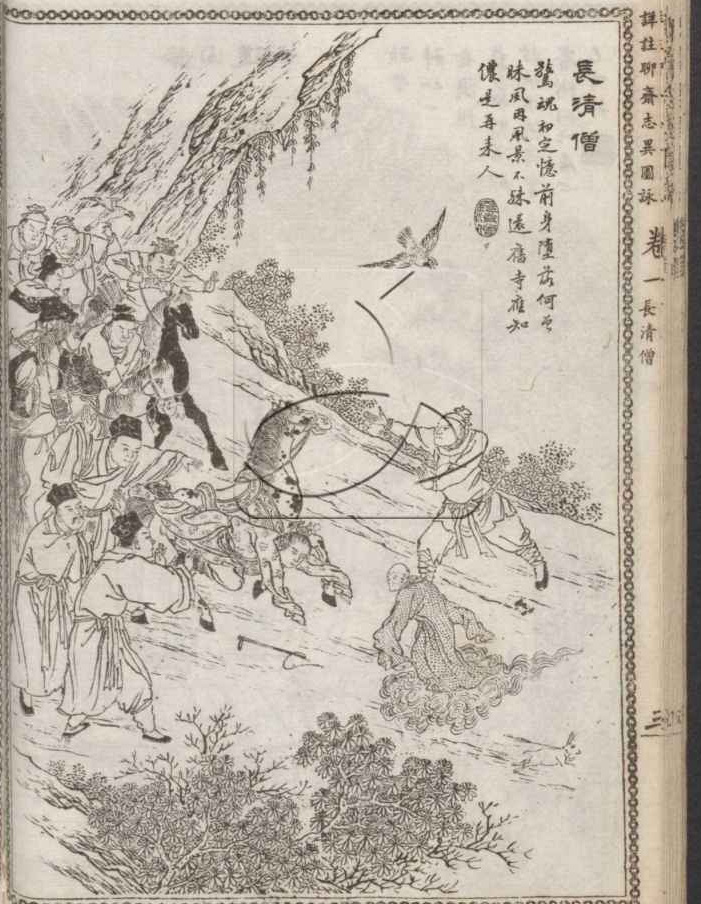
長清僧 · The Buddhist Priest of Ch‘ang-ch‘ingChangqing seng · Giles 1880, vol. 1, no. VI
Public domain. Pu Songling (1640–1715). Translated by Herbert A. Giles, 1880. Giles sometimes shortened or softened passages, so the two columns do not always match line for line.
Chinese 文言
長清僧,道行高潔。年八十餘猶健。一日,顛仆不起,寺僧奔救,已圓寂矣。僧不自知死,魂飄去,至河南界。河南有故紳子,率十餘騎,按鷹獵兔。馬逸,墮斃。魂適相值,翕然而合,遂漸蘇。廝仆環問之。張目曰:「胡至此!」眾扶歸。入門,則粉白黛綠者,紛集顧問。大駭曰:「我僧也,胡至此!」家人以為妄,共提耳悟之。僧亦不自申解,但閉目不復有言。餉以脫粟則食,酒肉則拒。夜獨宿,不受妻妾奉。
數日後,忽思少步。眾皆喜。既出,少定,即有諸仆紛來,錢簿谷籍,雜請會計。公子托以病倦,悉卸絕之。惟問:「山東長清縣,知之否?」共答:「知之。」曰:「我郁無聊賴,欲往游矚,宜即治任。」眾謂新瘳,未應遠涉。不聽,翼日遂發。抵長清,視風物如昨。無煩問途,竟至蘭若。弟子數人見貴客至,伏謁甚恭。乃問:「老僧焉往?」答云:「吾師曩已物化。」問墓所。群導以往,則三尺孤墳,荒草猶未合也。眾僧不知何意。既而戒馬欲歸,囑曰:「汝師戒行之僧,所遺手澤,宜恪守,勿俾損壞。」眾唯唯。乃行。既歸,灰心木坐,了不勾當家務。
居數月,出門自遁,直抵舊寺,謂弟子:「我即汝師。」眾疑其謬,相視而笑。乃述返魂之由,又言生平所為,悉符。眾乃信,居以故榻,事之如平日。後公子家屢以輿馬來,哀請之,略不顧瞻。又年余,夫人遣紀綱至,多所饋遺。金帛皆卻之,惟受布袍一襲而已。友人或至其鄉,敬造之。見其人默然誠篤;年僅而立,而輒道其八十餘年事。
異史氏曰:「人死則魂散,其千里而不散者,性定故耳。余于僧,不異之乎其再生,而異之乎其入紛華靡麗之鄉,而能絕人以逃世也。若眼睛一閃,而蘭麝熏心,有求死而不得者矣,況僧乎哉!」
English Giles 1880
At Ch‘ang-ch‘ing there lived a Buddhist priest of exceptional virtue and purity of conduct, who, though over eighty years of age, was still hale and hearty. One day he fell down and could not move; and when the other priests rushed to help him up, they found he was already gone. The old priest was himself unconscious of death, and his soul flew away to the borders of the province of Honan. Now it chanced that the scion of an old family residing in Honan, had gone out that very day with some ten or a dozen followers to hunt the hare with falcons;51 but his horse having run away with him he fell off and was killed. Just at that moment the soul of the priest came by and entered into the body, which thereupon gradually recovered consciousness. The servants crowded round to ask him how he felt, when opening his eyes wide, he cried out, “How did I get here?” They assisted him to rise, and led him into the house, where all his ladies came to see him and inquire how he did. In great amazement he said, “I am a Buddhist priest. How came I hither?” His servants thought he was wandering, and tried to recall him by pulling his ears. As for himself, he could make nothing of it, and closing his eyes refrained from saying anything further. For food, he would only eat rice, refusing all wine and meat; and avoided the society of his wives.52 After some days he felt inclined for a stroll, at which all his family were delighted; but no sooner had he got outside and stopped for a little rest than he was besieged by servants begging him to take their accounts as usual. However, he pleaded illness and want of strength, and no more was said. He then took occasion to ask if they knew the district of Ch‘ang-ch‘ing, and on being answered in the affirmative expressed his intention of going thither for a trip, as he felt dull and had nothing particular to do, bidding them at the same time look after his affairs at home. They tried to dissuade him from this on the ground of his having but recently risen from a sick bed; but he paid no heed to their remonstrances, and on the very next day set out. Arriving in the Ch‘ang-ch‘ing district, he found everything unchanged; and without being put to the necessity of asking the road, made his way straight to the monastery. His former disciples received him with every token of respect as an honoured visitor; and in reply to his question as to where the old priest was, they informed him that their worthy teacher had been dead for some time. On asking to be shewn his grave, they led him to a spot where there was a solitary mound some three feet high, over which the grass was not yet green. Not one of them knew his motives for visiting this place; and by-and-by he ordered his horse, saying to the disciples, “Your master was a virtuous priest. Carefully preserve whatever relics of him you may have, and keep them from injury.” They all promised to do this, and he then set off on his way home. When he arrived there, he fell into a listless state and took no interest in his family affairs. So much so, that after a few months he ran away and went straight to his former home at the monastery, telling the disciples that he was their old master. This they refused to believe, and laughed among themselves at his pretensions; but he told them the whole story, and recalled many incidents of his previous life among them, until at last they were convinced. He then occupied his old bed and went through the same daily routine as before, paying no attention to the repeated entreaties of his family, who came with carriages and horses to beg him to return.
About a year subsequently, his wife sent one of the servants with splendid presents of gold and silk, all of which he refused with the exception of a single linen robe. And whenever any of his old friends passed this monastery, they always went to pay him their respects, finding him quiet, dignified, and pure. He was then barely thirty, though he had been a priest for more than eighty years.53
Giles’s notes
- This form of sport may still be seen in the north of China. A hare being started, two Chinese greyhounds (which are very slow) are slipped from their leash in pursuit. But, as the hare would easily run straight away from them, a falcon is released almost simultaneously. The latter soars to a considerable height, and then swoops down on the hare, striking it a violent blow with the “pounce,” or claw. This partially stuns the hare, and allows the dogs to regain lost ground, by which time the hare is ready once more, and off they go again. The chase is ended by the hare getting to earth in a fox’s burrow, or being ultimately overtaken by the dogs. In the latter case the heart and liver are cut out on the spot, and given to the falcon; otherwise he would hunt no more that day. Two falcons are often released, one shortly after the other. They wear hoods, which are removed at the moment of flying, and are attached by a slip-string from one leg to the falconer’s wrist. During the night previous to a day’s hunting, they are not allowed to sleep. Each falconer lies down with one falcon on his left wrist, and keeps up an incessant tapping with the other on the bird’s head. This is done to make them fierce. Should the quarry escape, a hare’s skin is thrown down, by which means the falcons are secured, and made ready for a further flight. Occasionally, but rarely, the falcon misses its blow at the hare, with the result of a broken or injured “arm.” ↩
- Abstinence from wine and meat, and celibacy, are among the most important dogmas of the Buddhist church, as specially applied to its priesthood. At the door of every Buddhist monastery may be seen a notice that “No wine or meat may enter here!” Even the laity are not supposed to drink wine. ↩
- Having renewed his youth by assuming the body of the young man into which his soul had entered. ↩
English: Herbert A. Giles, Strange Stories from a Chinese Studio, vol. 1 (London: Thos. de la Rue, 1880), public domain, text via Project Gutenberg #43627. Footnotes are Giles’s. Chinese: 蒲松齡《聊齋志異》, public domain, text via Chinese Wikisource (modern editors’ glosses and the Qing commentaries are left out, and variant readings follow the first reading given).