
Celestial Hierarchy VII.1 — Seraphim, Cherubim, Thrones (House translation)
Witness: Basel, Universitätsbibliothek, O III 5, ff. 10r-10v (2nd half 12th c.; Latin translation of John Scottus Eriugena, c. 860; ex-Heisterbach). Rubric f.10r: 'Cap. VII. De seraphim, cherubim, thronis et de prima eorum ierarchia' [rubric read from thumbnail, uncertain].
Scan: https://www.e-codices.ch/en/ubb/O-III-0005/10r and /10v; IIIF https://media.e-codices.ch/iip/ubb/ubb-O-III-0005/ubb-O-III-0005_0010r.jp2 ; hi-0010r.jpg, hi-0010v.jpg
Licence: Images CC0 1.0 (e-codices manifest); text ancient, public domain.
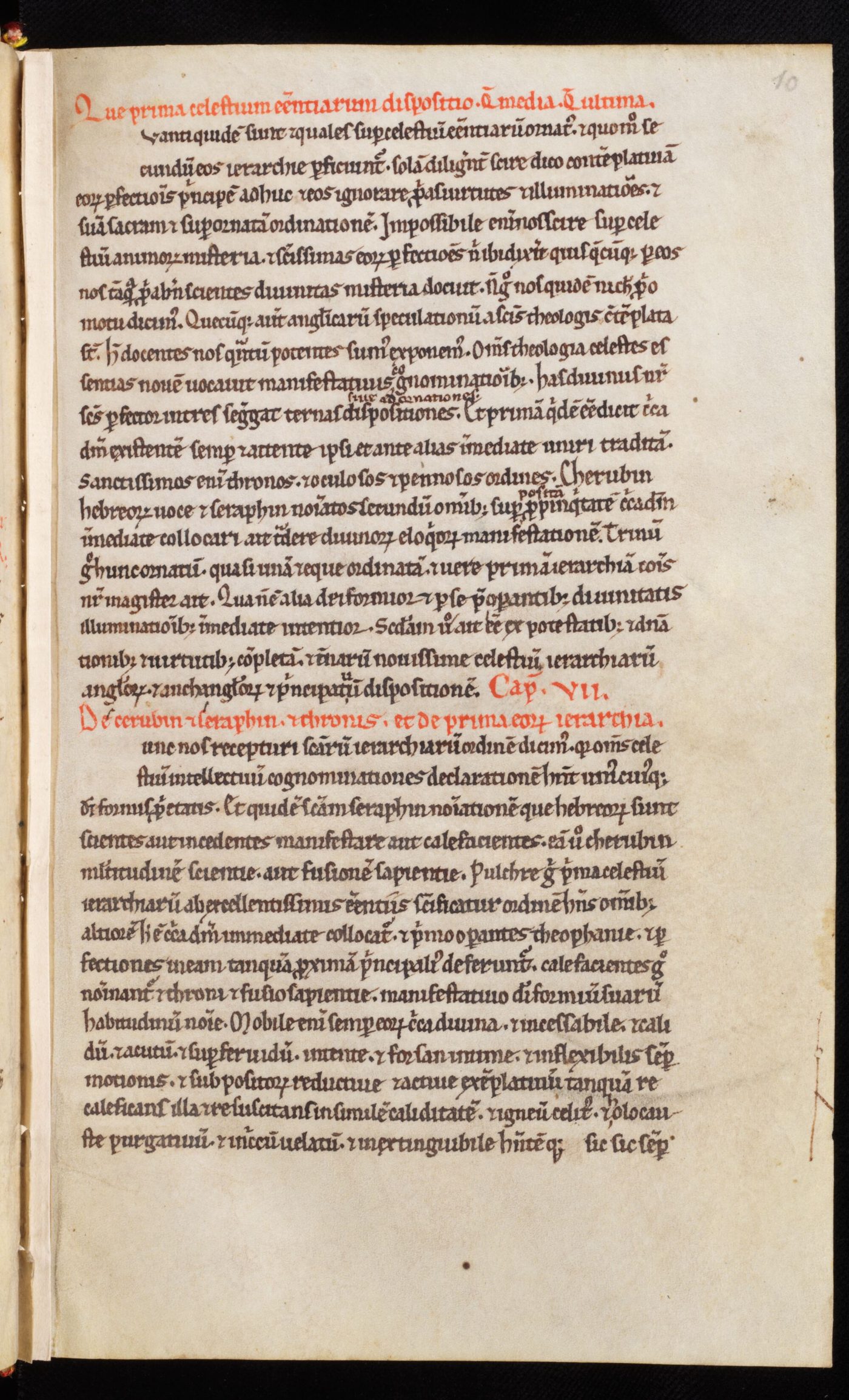
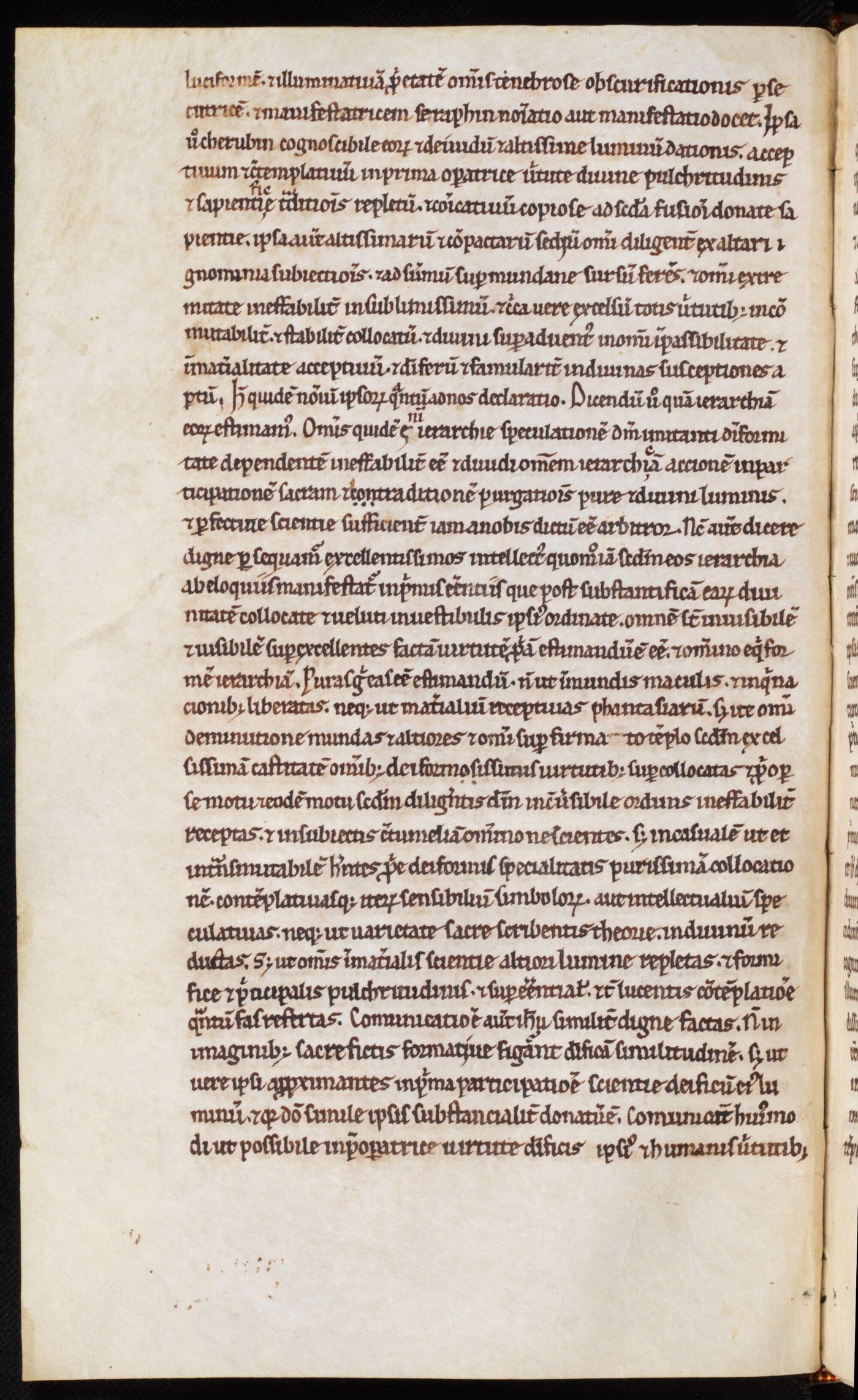
Method: Read by eye from CC0 e-codices images (2000 px), abbreviations expanded, compared with Parker 1894; House English.
VII.1a (general)
Latin (Eriugena, Basel O III 5): [H]unc nos recepturi sanctarum ierarchiarum ordinem dicimus, quod omnes celestium intellectuum cognominationes declarationem habent uniuscuiusque deiformis proprietatis.
Parker 1894: We, whilst admitting this as the arrangement of the Hierarchies, affirm that every appellation of the celestial minds denotes the Godlike characteristic of each;
House translation: Receiving this order of the holy hierarchies, we say that every name given to the heavenly intelligences declares the God-formed property of each one.
- Initial H left for the rubricator (not filled) [as seen].
VII.1b (Seraphim, Cherubim)
Latin (Eriugena, Basel O III 5): Et quidem sanctam seraphin nominationem, que hebreorum sunt scientes [?], 'incendentes' manifestare aut 'calefacientes'; eam vero cherubin 'multitudinem scientie' aut 'fusionem sapientie'.
Parker 1894: and those who know Hebrew affirm that the holy designation of the Seraphin denotes that they are fiery or burning; but that of Cherubin, a fulness of knowledge and stream of wisdom.
House translation: Those who know Hebrew say that the holy name 'Seraphim' shows them as 'kindlers' or 'warmers', and the name 'Cherubim' as 'a multitude of knowledge' or 'an outpouring of wisdom'.
- 'que hebreorum sunt scientes': the scribe's wording as read; the sense is 'those learned in Hebrew things'. [uncertain abbreviation]
- Eriugena's 'multitudinem scientie' is more literal than Parker's 'fulness'; 'fusio' = pouring-out, stream.
VII.1c (first hierarchy)
Latin (Eriugena, Basel O III 5): Pulchre igitur prima celestium ierarchiarum ab excellentissimis essentiis s[a]cr[i]ficatur [?], ordinem habens omnibus altiorem, si[ue] est [?] circa deum immediate collocata, et primo operantes theophanie et perfectiones in eam tanquam proximam principaliter deferuntur. Calefacientes igitur nominantur et throni et fusio sapientie, manifestativo deiformium suarum habitudinum nomine.
Parker 1894: Naturally, then, the first of the heavenly Hierarchies is ministered by the most exalted Beings, holding, as it does, a rank which is higher than all, by the fact that it is established immediately around God, and that the first-wrought Divine manifestations and perfections pass earlier to it, as being nearest. They are called, then, Burning and Thrones and Stream of Wisdom—by a name which explains their Godlike dispositions.
House translation: Fittingly, then, the first of the heavenly hierarchies is served in holy rite by the most excellent beings, holding a rank higher than all, since it is set immediately around God, and the first-working theophanies and perfections are carried to it first, as to the nearest. So they are named 'Warmers' and 'Thrones' and 'Outpouring of Wisdom' — names that show their God-formed dispositions.
- s[a]cr[i]ficatur: abbreviation read as sacrificatur, Eriugena's literal calque of Greek ἱερουργεῖται ('is performed as sacred rite'); Parker 'is ministered'. [uncertain expansion]
- 'primo operantes theophanie': Eriugena keeps the Greek 'theophanie' (θεοφάνειαι) - 'God-appearances'. Parker 'first-wrought Divine manifestations'.
- Note: here the Thrones are named alongside Seraphim and Cherubim as one first triad - Goth (Lauviah) belongs to the Thrones in Lenain's scheme.
VII.1d (Seraphim described)
Latin (Eriugena, Basel O III 5): Mobile enim semper eorum circa divina et incessabile, et calidum et acutum et superfervidum intente et forsan intime et inflexibilis semper motionis, et subpositorum reductive et active exemplativum, tanquam recalefaciens illa et resuscitans in similem caliditatem, et igneum celitus et holocauste purgativum, et incelatum [?] et inextinguibile habentemque sic [...]
Parker 1894: The appellation of Seraphin plainly teaches their ever moving around things Divine, and constancy, and warmth, and keenness, and the seething of that persistent, indomitable, and inflexible perpetual motion, and that vigorous transformation of the subordinate, by precept and example, as giving new life and rekindling them to the same heat; and purifying through fire and burnt offering, and the light-like and light-shedding characteristic which can never be concealed or consumed ...
House translation: For their motion about divine things is ever moving and unceasing, warm and sharp, intensely over-boiling, close and unbending; it lifts up those below, working and giving them a pattern, as if re-warming them and waking them to a like heat; it is fiery from heaven and purifies like a whole burnt-offering; it is unhidden and unquenchable, and always holds [...]
- 'igneum celitus et holocauste purgativum' - the same phrase the e-codices cataloguer quotes from Hugh's commentary on f. 70r, confirming this is the CH VII passage.
- 'incelatum' = 'unconcealed' (Parker 'can never be concealed'). [reading uncertain]
- f. 10r ends 'sic sic sep[...]' (dittography 'sic sic' in the MS); continuation on 10v not transcribed in this pass.
VII.1e (Cherubim described)
Latin (Eriugena, Basel O III 5): [...] et manifestatricem seraphin nominatio aut manifestatio docet. Ipsa vero cherubin cognoscibile eorum et deividum [?] et altissime luminum dationis acceptivum, et contemplativum in prima operatrice virtute divine pulchritudinis, et sapientie traditionis [sic, interlinear] repletum, et communicativum copiose ad secunda fusione donate sapientie.
Parker 1894: But the appellation of the Cherubin denotes their knowledge and their vision of God, and their readiness to receive the highest gift of light, and their power of contemplating the Divine comeliness in its first revealed power, and their being filled with the impartation which maketh wise, and their ungrudging communication to those next to them by pouring forth the wisdom given to themselves.
House translation: [...] so the name - or rather the showing - of the Seraphim teaches. The name of the Cherubim shows their power to know and to see God, their receiving of the highest gift of light, their contemplating of divine beauty in its first-working power, their being filled with the handing-down of wisdom, and their sharing it richly with those second to them, by the outpouring of the wisdom given.
- 'deividum' = 'God-seeing' (Greek θεοπτικόν). [abbreviation uncertain]
- Interlinear 'sic' (or similar) over 'traditionis' in the MS - a reader's mark. [as seen]
VII.1f (THRONES)
Latin (Eriugena, Basel O III 5): Ipsa autem altissimarum et co[m]pactarum [?] sedium [nominatio] omni[no] [?] diligenter exaltata [?] ab ignominia subiectionis, et ad summum supermundane sursum ferens, et omni extremitate ineffabiliter in sublimissimum, et circa vere excelsum totis virtutibus incommutabiliter et stabiliter collocatum, et divinum superadventum in omni impassibilitate et immaterialitate acceptivum, et deiferum, et famulariter in divinas susceptiones apertum.
Parker 1894: The appellation of the most exalted and pre-eminent Thrones denotes their manifest exaltation above every grovelling inferiority, and their celestial tendency towards higher things; and their unswerving separation from all remoteness; and their invariable and firmly-fixed settlement around the veritable Highest, with the whole force of their powers; and their capacity for receiving the approaches of the Godhead, through the absence of all passion and earthly tendency, and their bearing God; and the ardent expansion of themselves for the Divine receptions.
House translation: The name of the highest and set-fast Seats [Thrones] shows them lifted wholly clear of the disgrace of lowliness; borne up above the world toward the summit; raised beyond every outer edge, unspeakably, into the most sublime; set about the truly Exalted One with all their powers, unchangeably and steadfastly; receiving the divine coming-upon-them in complete freedom from passion and from matter; God-bearing; and opened, as servants, to receive the divine.
- Eriugena calls the Thrones 'sedes' (seats), not 'throni', in this sentence - Latin for Greek θρόνοι.
- Line 1 of the Thrones sentence is hard to read (abbreviations 'copactarum', 'omni', 'diligenter exaltari'); my reconstruction is marked [?]. Greek sense (Parker): 'exaltation above every grovelling inferiority'.
- 'deiferum' = God-bearing (θεοδόχον/θεοφόρον) - the core gift of the Thrones, and the line most relevant to the Angel Goth.
- 'divinum superadventum' = the divine 'coming-over' (ἐπιφοίτησις). Parker 'approaches of the Godhead'.
- 'famulariter … apertum' = 'opened as servants' (Parker 'ardent expansion of themselves'). Eriugena's word stresses service, not ardour.
VII.1g (close)
Latin (Eriugena, Basel O III 5): Hec quidem nominum ipsorum quantum a nobis declaratio. Dicendum vero quam ierarchiam eorum estimamus.
Parker 1894: This, then, is the explanation of their names, so far as we can give it; but we ought to say what we think their Hierarchy is.
House translation: This, as far as we can give it, is the explanation of their names. Now we must say what we judge their hierarchy to be.
Verification: Single reader, AI-assisted; several abbreviations uncertain (marked). Needs a second read, ideally against Eriugena in PL 122 (1853, PD) when downloaded.