
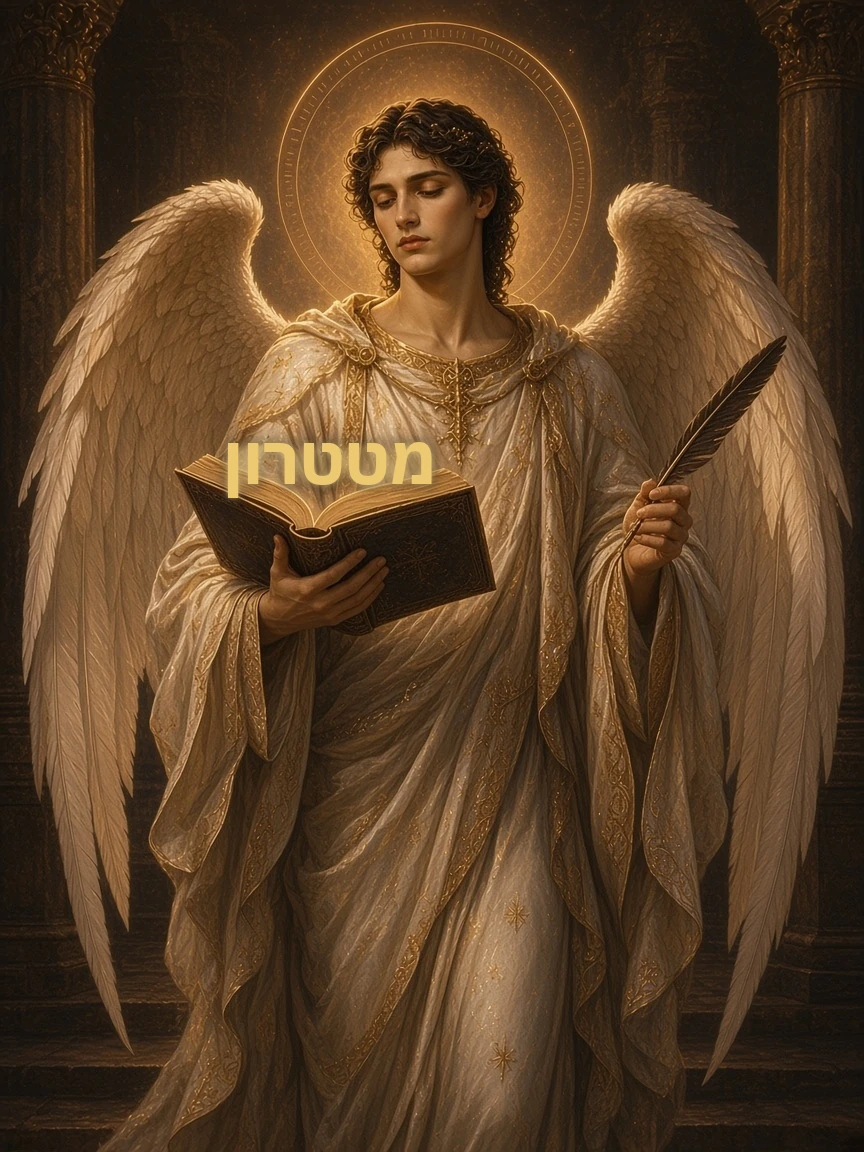
One of the ten archangels · 1 in Agrippa’s list (III.10)
Metatron מטטרון
Also known as Metatron, Mitatron (מטטרון, מיטטרון) · Enoch · Sar ha-Panim, “Prince of the Presence” · “the Youth” (na‘ar) (sources under “Also known as” below)
Name: uncertain; no scholarly consensus.
Tracing the name backward
We go backward from the newest source to the oldest dated one, and step back only where a dated text or a published scholarly link anchors the step. Unproven or second-hand links are drawn dashed and marked. Raziel’s full chart is on his page.
Rest the pointer on a section to open it; click to keep it open.Tap a section to open it; tap again to close.
Name originwhat the name means and how it was built
The name has no agreed etymology. It is written two ways, with six letters (מטטרון) and with seven (מיטטרון). Andrei Orlov lists at least nine scholarly proposals (Orlov, The Enoch-Metatron Tradition, 2005), among them: Latin metator, a guide or forerunner who goes ahead to mark the camp (favoured by Eleazar of Worms and Nachmanides, rejected by Scholem, revived by Philip Alexander); Greek meta thronos, “beside the throne”; and Greek metetethē, “he was taken”, from the Septuagint of Genesis 5:24 (Mopsik). None is proven.
Earliest sourcesthe name traced backward, with dated anchors
Solid = a link anchored in a dated sourceDashed = unproven, second-hand or a later equationNewest at the top; each step goes back in time. Tap any box to open its anchor.
- 7th c. CE or later (redaction debated)
“Metatron, the great scribe”Targum Pseudo-Jonathan on Genesis 5:24Medium
Enoch was taken up “and he was called Metatron, the Great Scribe” (Orlov’s translation).
about as old
- 5th–6th c. CE (Alexander)
Enoch become Metatron; “the lesser YHWH”3 Enoch (Sefer Hekhalot) 3–15; 12:5Medium
The patriarch Enoch is transformed into the angel Metatron, Prince of the Presence, and called “the lesser YHWH”.
- seen by scholars (Scholem; Orlov) as a forerunner; 3 Enoch lists Yahoel among Metatron’s names
Yahoel, the angel who bears God’s nameApocalypse of Abraham 10 (1st–2nd c. CE; Slavonic copies)Medium
An angel in whom the divine name dwells guides Abraham. The book does not call him Metatron.
- the human scribe whom later texts identify with Metatron
Enoch, the heavenly scribeJubilees 4:23; 2 Enoch (1st c. CE?)Medium
Enoch writes in heaven. The identification with Metatron is made only by the later texts above. Read 1 Enoch, Jubilees, Book of Giants and 2 Enoch (Library).
same age or a little older
- seen by scholars (Scholem; Orlov) as a forerunner; 3 Enoch lists Yahoel among Metatron’s names
- Babylonian Talmud, redacted c. 6th c. CE
Metatron — the oldest secure witnessHagigah 15a; Sanhedrin 38b; Avodah Zarah 3bHigh
Elisha ben Abuyah sees Metatron seated, writing down the merits of Israel, and fears there are two divine powers in heaven; Metatron is punished with sixty lashes of fire to show he is an angel (Hagigah 15a). His name is like his Master’s (Sanhedrin 38b, on Exodus 23:21; paraphrased).
before this: only proposed etymologies
- —
metator? meta thronos? metetethē?philological proposals (Orlov 2005)Low
Each would place the name’s birth in the Greek or Roman world, but none is anchored in a text that names him.
no anchor
The trail endsThe name occurs only in Jewish writings (Jewish Encyclopedia)No anchor
No text before the rabbinic period names Metatron.
Also known asother names the sources give
Also known as Metatron, Mitatron (מטטרון, מיטטרון)1 · Enoch2 · Sar ha-Panim, “Prince of the Presence”3 · “the Youth” (na‘ar)4 · “the lesser YHWH”5 · “the great scribe”6
Sources for these names
- six- and seven-letter spellings in rabbinic literature (Orlov 2005)
- 3 Enoch 4; Targum Pseudo-Jonathan on Genesis 5:24
- 3 Enoch 1
- 3 Enoch 3–4
- 3 Enoch 12:5
- Targum Pseudo-Jonathan on Genesis 5:24
Kept off the line: Mithra (Kohut’s 19th-century identification; the Jewish Encyclopedia thinks at most “a few traits” were borrowed); Yahoel (a forerunner and a name in 3 Enoch’s list, but a different book’s angel).
Comparisonssimilar figures, where scholars draw the link
- “Two powers in heaven”. Hagigah 15a is the classic text in Alan Segal’s Two Powers in Heaven (1977), which studies how the rabbis argued against a second divine figure.
- Yahoel. The angel of the Apocalypse of Abraham who bears God’s name; scholars (Scholem; Orlov) see him as a forerunner.
- Mithra. Kohut (1866) identified Metatron with Mithra; the Jewish Encyclopedia allows only borrowed traits. Treated here as a proposal, not a link.
Comparisons are listed only where a scholar makes the link, or are marked as the Hall’s own note. A parallel of role is not a lineage of name.
Further readingbooks in Raziel’s Library and beyond
Unverified and sourceswhat is still to check, and every source
Checked No open unverified claims in this entry beyond those marked dashed in the chart.
Sources
- Jewish Encyclopedia, “Meṭaṭron” (1906)
- Orlov, “Etymology of the Name Metatron”; Orlov, “Metatron as the Scribe”
- Encyclopaedia Judaica, “Metatron” (Scholem)
- Segal, Two Powers in Heaven (1977)
- Alexander, “3 (Hebrew Apocalypse of) Enoch”, in Charlesworth, OTP 1 (1983)
Hover or tap to turn the card.
- Name
- Metatron; also Mitatron. Six- and seven-letter spellings מטטרון and מיטטרון stand together in the sources; the Hall does not pick one as “correct.” MedievalThe page’s own “Also known as”; Orlov 2005, as already cited here
- Letters
- מטטרון (as in this page’s heading). The seven-letter form מיטטרון is also attested. Medieval
- Rank
- “Meratiron [Metatron], that is, the prince of faces, whose duty it is to bring others to the face of the prince; and by him the Lord spake to Moses.” RenaissanceAgrippa III.10, 1651 English, Hall panel
- Station
- Cether (Kether), “a Crown or Diadem,” the name Eheia, “attributed to God the Father,” through the Seraphinus / Haioth Hacadosch and the primum mobile. RenaissanceAgrippa III.10, 1651 English, Hall panel
- Also called
- Sar ha-Panim, “Prince of the Presence”; “the Youth” (na‘ar); “the lesser YHWH”; “the great scribe.” MedievalAs already cited on this page: 3 Enoch (Sefer Hekhalot) 1, 3–4, 12:5; Targum Pseudo-Jonathan on Genesis 5:24. The Hall does not yet hold a 3 Enoch / Odeberg shelf copy; the citations stand as this page already gives them (Alexander in Charlesworth OTP 1; Orlov).
- Enoch
- The later books identify Enoch with Metatron. Targum Pseudo-Jonathan on Genesis 5:24: Enoch was taken up “and he was called Metatron, the Great Scribe” (Orlov’s translation, as already on this page). 3 Enoch 3–15: the patriarch is transformed into the angel Metatron. 1 Enoch itself does not make that identification (as this page already says). Medieval
- Talmud
- Oldest secure witness on this page: Hagigah 15a; Sanhedrin 38b; Avodah Zarah 3b. Elisha ben Abuyah sees Metatron seated, writing down the merits of Israel, and fears there are two divine powers; Metatron is punished with sixty lashes of fire to show he is an angel (Hagigah 15a). Medieval
- Tenth seat
- In Agrippa III.10 the tenth numeration (Malchuth) has “the soul of Messiah” as president, “or (as others say) the intelligence Metattron [Metatron] which is called the first Creature, or the soul of the world, and was the ruler of Moses.” That is a second Agrippan office, not a second angel. RenaissanceJ.F., Three Books of Occult Philosophy, London 1651 (the edition the Hall holds and already cites). The Hall's English panel for III.10, as transcribed, is cut off after the third numeration; seats 4-10 are quoted from the remainder of that same 1651 English chapter.
- Colours
- None named for Metatron himself in Agrippa III.10 or in the sources already on this page. HouseNot attested
- Incense
- Not attested in the sources already on this page. House
- Feast
- None in the sources already on this page. House
Persona: as the books describe him
The books do not agree on what the name Metatron means; this page already records that there is no scholarly consensus, and lists the proposals (Latin metator, Greek meta thronos, Greek metetethē) without choosing one. What the dated texts do say is office. In Agrippa’s 1651 English of III.10 he is “Meratiron [Metatron], that is, the prince of faces,” the particular intelligence of Cether, “whose duty it is to bring others to the face of the prince; and by him the Lord spake to Moses.” Renaissance
The Talmud already knows him as a scribe who sits and writes. Hagigah 15a is the classic scene: Elisha ben Abuyah sees Metatron seated, writing the merits of Israel, and fears a second power in heaven; Metatron is flogged with fire to show that he is an angel, not a second God. Sanhedrin 38b says his name is like his Master’s (on Exodus 23:21). The Targum on Genesis 5:24 and 3 Enoch (Sefer Hekhalot) identify him with Enoch taken up: “the great scribe,” Prince of the Presence, “the Youth,” and, in 3 Enoch 12:5, “the lesser YHWH.” Those last titles are cited as this page already cites them; the Hall does not yet hold Odeberg’s 3 Enoch on an open shelf. Medieval
Agrippa also, at the tenth numeration, lets “others” name Metatron again — “the first Creature, or the soul of the world, and was the ruler of Moses” — beside “the soul of Messiah.” The two seats are written side by side, not collapsed. Renaissance
Still to find
Passages we know of but do not yet hold in a public-domain or open copy, or a Hall-held check still outstanding. They are on the Library's to-acquire list.
- A Hall shelf copy of 3 Enoch (Sefer Hekhalot), e.g. Odeberg or Alexander’s English in Charlesworth, OTP 1, so the 3 Enoch citations already on this page can be checked in a held book.
- The remainder of Agrippa III.10 in the Hall’s own English-panel transcription (the panel, as held, is cut off after the third numeration). Seats 4–10 are quoted in this entry from the same 1651 J.F. English the Hall already cites.