
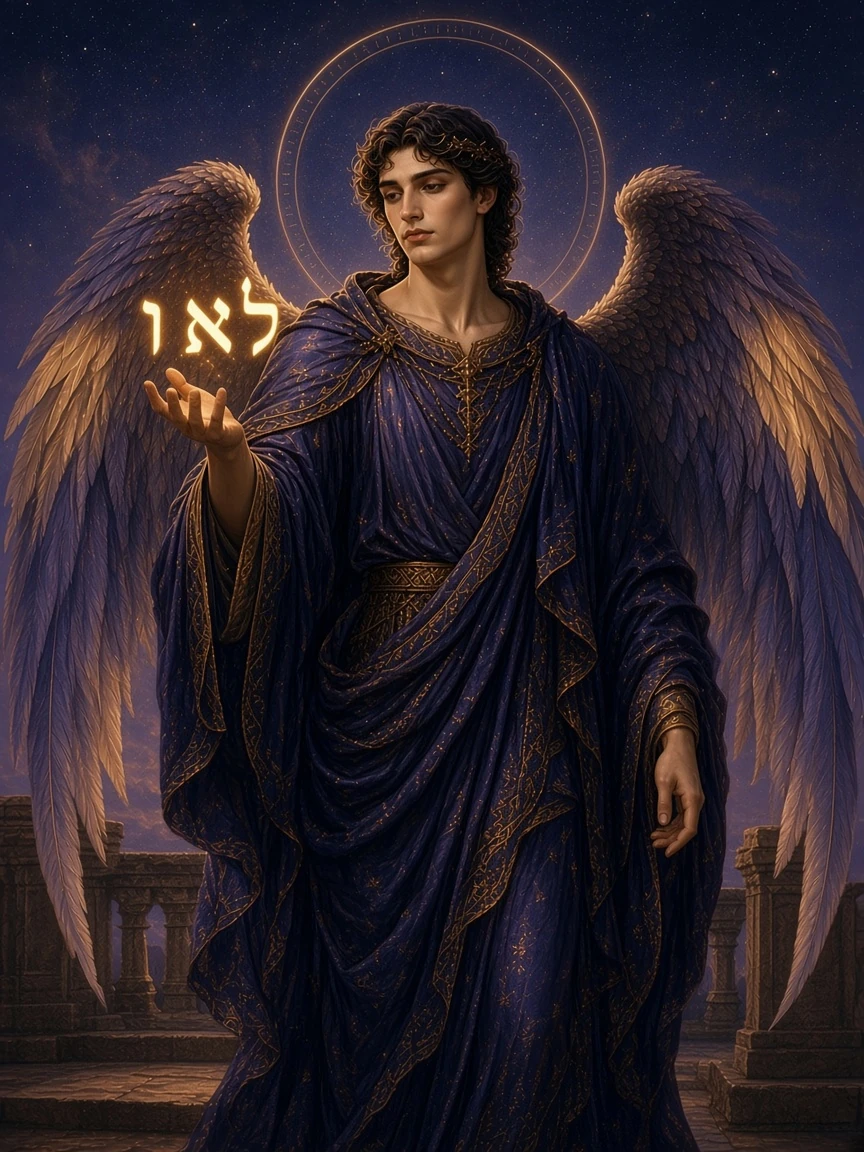
11th of the 72 · Choir of Cherubim
Lauviah לאו
Also known as Lauviah · Lauiah · לאו (the three letters) (sources under “Also known as” below)
Name: the triad לאו with an angelic ending.
Tracing the name backward
We go backward from the newest source to the oldest dated one, and step back only where a dated text or a published scholarly link anchors the step. Unproven or second-hand links are drawn dashed and marked. Raziel’s full chart is on his page.
Rest the pointer on a section to open it; click to keep it open.Tap a section to open it; tap again to close.
Name originwhat the name means and how it was built
One of the 72 “names” read out of Exodus 14:19–21. The triad לאו is taken letter by letter from the three verses; Renaissance Christian kabbalists (Reuchlin 1517; Agrippa 1533) turned each triad into an angel by adding -el or -iah.
- Choir Cherubim
- Degrees of the zodiac 51°–55°
- Psalm verse Ps 18:47 Vulg. Ps 17:47
From Lenain (1823), as set out in the Sanctuary’s table of the 72.
Earliest sourcesthe name traced backward, with dated anchors
Solid = a link anchored in a dated sourceDashed = unproven, second-hand or a later equationNewest at the top; each step goes back in time. Tap any box to open its anchor.
- 1823
LauviahLenain, La Science cabalistique (Paris 1823; BIU Santé Ms 5365)Medium
Lenain gives each of the 72 a choir, five degrees of the zodiac and a psalm verse, as listed in the Sanctuary’s table of the 72.
older
- 1652–1654
the 72 in a circleKircher, Oedipus Aegyptiacus II.1Medium
Kircher draws the 72 names as a great circle. Unverified for this name until the Hall reads Kircher’s plate.
older
- 1533 (English 1651)
LauiahAgrippa, Three Books of Occult Philosophy III.25, table of the 72High
The table of the 72 angels, each formed by adding -el or -iah to a triad of letters. Read Agrippa, De occulta philosophia, Cologne 1533 (Library).
older
- 1517
the triad becomes an angel’s nameJohannes Reuchlin, De arte cabalistica, Book IIIHigh
The oldest dated source the Hall relies on for the angel-names of the 72 (as on the Sanctuary’s Lauviah page). Before this there are only the letters.
the letters, not yet an angel
- 11th c.
לאו as one of the 72 namesRashi on Sukkah 45aHigh
Rashi explains the 72 names as read from the three verses of Exodus 14:19–21, “each of 72 letters”: the first letter of the first verse, the last of the middle verse and the first of the last, “and so on in this order”; the first name is והו (Hall translation; Sefaria).
read out of three verses
- the verses themselves
Exodus 14:19–21three verses of 72 letters eachHigh
Letter 11 of verse 19, letter 11 counted from the end of verse 20, and letter 11 of verse 21, by Rashi’s rule. Hall check Computed from the Hebrew consonantal text of Exodus 14:19–21 (Sefaria, “Tanach with Text Only”; 72 letters in each verse): letter 11 of verse 19 is ל, letter 11 from the end of verse 20 is א, letter 11 of verse 21 is ו (final forms normalised). All 72 triads in the Sanctuary table match this count. Read Exodus in Gutenberg Bible: Exodus, Psalms and more (Library).
no anchor
The trail endsNo angel named Lauviah before Reuchlin (1517)No anchor
Before the Renaissance there are the letters and the method, but no angel of this name.
Also known asother names the sources give
Also known as Lauviah1 · Lauiah2 · לאו (the three letters)3
Sources for these names
- Lenain 1823 (Sanctuary table of the 72)
- Agrippa III.25, table of the 72 (English 1651)
- Exodus 14:19–21 by Rashi’s rule (on Sukkah 45a)
Comparisonssimilar figures, where scholars draw the link
- The decans (House note). Lenain gives each of the 72 five degrees of the zodiac (72 × 5 = 360), so two of them make one 10° decan, the old Egyptian star-division (Neugebauer & Parker). That is arithmetic and the Hall’s own note, not a scholar’s identification.
Comparisons are listed only where a scholar makes the link, or are marked as the Hall’s own note. A parallel of role is not a lineage of name.
Further readingbooks in Raziel’s Library and beyond
Unverified and sourceswhat is still to check, and every source
Unverified
- Unverified Kircher plate not yet read for this name
Sources
- Rashi on Sukkah 45a (Sefaria)
- Reuchlin, De arte cabalistica (1517), Book III
- Agrippa, Three Books of Occult Philosophy III.25 (1533; English 1651)
- Kircher, Oedipus Aegyptiacus (1652–54)
- Lenain, La Science cabalistique (1823)
Hover or tap to turn the card.
- Name
- Lauviah, “God praised and exalted” (Dieu loué et exalté); Agrippa 1651: Lauiah Revival Lenain, La Science cabalistique (1823), manuscript copy BIU Santé Ms 5365 (n60, n61); not yet checked against the printed 1823 edition: “Son attribut (Dieu loué et exalté).”. Agrippa 1651, III.25 table: Lauiah.
- Letters
- לאו (Lamed, Aleph, Vav) → לאויה Renaissance Exodus 14:19–21, by the rule already cited on this page from Rashi on Sukkah 45a; Reuchlin 1517; Agrippa III.25. The same triad is in the list of seventy-two names in Sefer Raziel HaMalakh (Amsterdam 1701; Hall, pp. 93–100)
- Number
- 11 of 72 Renaissance Reuchlin 1517, Book III; Agrippa, Three Books of Occult Philosophy III.25 (English 1651): “the seventy two Angels, bearing the name of God, Schemhamphorse”
- Order
- Cherubim, the second choir (angels 9–16) Revival Lenain, La Science cabalistique (1823), manuscript copy BIU Santé Ms 5365 (n60, n61); not yet checked against the printed 1823 edition, as set out in the Sanctuary’s table of the 72. For the choir’s name, Dionysius, Celestial Hierarchy VII (Hall translation): the name “Cherubim” as “a multitude of knowledge” or “an outpouring of wisdom.”
- Word (psalm)
- Ps 18:47 (Vulg. Ps 17:47): “The Lord liveth, and blessed be my God, and let the God of my salvation be exalted.” Ancient Hebrew WLC; Reuchlin 1517 (Latin); Clementine Vulgate: Vivit Dominus, et benedictus Deus meus, et exaltetur Deus salutis meæ. English: Douay-Rheims, as in the Hall’s Seventy-Two Names table. Lenain prescribes the psalm verse named in his entry, recited at the hour below
- The three letters in Sefer Raziel
- “LAV [לאו] points that when they saw His wonders in Egypt, above and below, which He did in heaven and on earth, then ‘dominion and fear are with Him’ (Job 25:2); all the world feared Him.” This is the first לאו in the list (the 11th name), not the second (the 17th). The book speaks of the letters of the Name, not of an angel called Lauviah. Medieval Sefer Raziel HaMalakh (Amsterdam 1701), Hall translation: pp. 65–72 (and, where the longer entries stand, pp. 55–64); the seventy-two names listed on pp. 93–100
- Domain
- This genius rules over fame; he has influence over great persons, the learned, and over all who become famous by their talents. Revival Lenain, La Science cabalistique (1823), manuscript copy BIU Santé Ms 5365 (n60, n61); not yet checked against the printed 1823 edition: “Ce génie domine la renommée; il influe sur les grands personnages, les savans, et sur tous ceux qui deviennent célèbres par leurs talens.”
- Gifts
- He serves against lightning and to obtain victory. Revival Lenain, La Science cabalistique (1823), manuscript copy BIU Santé Ms 5365 (n60, n61); not yet checked against the printed 1823 edition. Practice as Lenain gives it: “L'on prononce le 50e. verset du pseaume 17” “Il sert contre la foudre & pour obtenir la victoire.”
- Heaven
- No source on the Hall shelf names a planet, decan or genie for Lauviah. Lenain’s domain, above, is what is attested Revival Lenain, La Science cabalistique (1823), manuscript copy BIU Santé Ms 5365 (n60, n61); not yet checked against the printed 1823 edition. Agrippa III.25’s table gives the name only
- Degrees
- 51°–55° of the zodiac Revival Lenain 1823, as set out in the Sanctuary’s table of the 72
- Days
- 30 March, 10 June, 20 August, 1 November and 12 January. This is the 11th of the 72, not the 17th (Goth). Both have the letters לאו; Lenain separates them by divine name. The manuscript gives genie 11 and genie 12 the same hour (3:40–4:00); it is left as written, not corrected, until the 1823 print is read. Revival Lenain, La Science cabalistique (1823), manuscript copy BIU Santé Ms 5365 (n60, n61); not yet checked against the printed 1823 edition: “Il préside les jours suivants: 30 mars, 10 juin, 20 août, 1 novembre, 12 janvier.”
- Hour
- The favourable hour begins from three forty until four o’clock. Revival Lenain, La Science cabalistique (1823), manuscript copy BIU Santé Ms 5365 (n60, n61); not yet checked against the printed 1823 edition: “L'heure favorable commence depuis 3 heures 40 minutes jusqu'à 4 heures.”
- Seal
- His three letters לאו, as printed by Reuchlin and listed in Agrippa’s Schemhamphorse table. The “seals” of the 72 sold today are modern. Kircher’s 72-names plate has not yet been read for this name on this page Renaissance Reuchlin 1517; Agrippa III.25 (1651). Kircher: see “Unverified” under Further reading on this page
- Feast
- None in any calendar; Lenain’s five days above Revival Lenain, La Science cabalistique (1823), manuscript copy BIU Santé Ms 5365 (n60, n61); not yet checked against the printed 1823 edition. No feast in the Shem 72 table
- Colours
- No source gives Lauviah a colour House Not attested in Lenain, Agrippa III.25, Sefer Raziel’s לאו entries, or the Solomonic books checked for this page
- Incense
- None named for Lauviah. Agrippa I.44 and the Key of Solomon (Mathers 1889, Book II, ch. 10) give fumes by planet, but no source names a planet for this angel, so none is applied House Gap, not an inference
Persona: as the books describe him
The books give Lauviah no body and no face; this angel is known by a name and by what the books say he does. The three letters לאו are the 11th of the seventy-two names read from Exodus 14:19–21. Sefer Raziel HaMalakh (Amsterdam 1701) prints that list and says of this triad: “LAV [לאו] points that when they saw His wonders in Egypt, above and below, which He did in heaven and on earth, then ‘dominion and fear are with Him’ (Job 25:2); all the world feared Him.” This is the first לאו in the list (the 11th name), not the second (the 17th). The book speaks of the letters of the Name, not of an angel called Lauviah. Medieval
Renaissance Christian kabbalists (Reuchlin 1517; Agrippa 1533, English 1651) turned each triad into an angel by adding -iah or -el. Agrippa’s table of “the seventy two Angels, bearing the name of God, Schemhamphorse” lists Lauiah (III.25). Reuchlin gives the psalm verse: “The Lord liveth, and blessed be my God, and let the God of my salvation be exalted.” (Ps 18:47, Douay-Rheims, after the Vulgate and Reuchlin’s Latin). Renaissance
Lenain (1823, manuscript copy BIU Santé Ms 5365, not yet checked against the printed edition) sets him among the Cherubim, in the 51°–55° of the sphere. This genius rules over fame; he has influence over great persons, the learned, and over all who become famous by their talents. He serves against lightning and to obtain victory. The favourable hour begins from three forty until four o’clock. This is the 11th of the 72, not the 17th (Goth). Both have the letters לאו; Lenain separates them by divine name. The manuscript gives genie 11 and genie 12 the same hour (3:40–4:00); it is left as written, not corrected, until the 1823 print is read. This page is the 11th of the 72, not the 17th (Goth). Both have the letters לאו; Lenain separates the two. The existing Hall cards honour him as “he”; Lenain writes “il,” because French génie is masculine. Revival
The Key of Solomon as printed by Mathers (1889), the Goetia, the Hygromanteia and the Testament of Solomon, in the copies on Raziel’s Library shelf, do not name Lauviah. A Mathers fragment mentions the seventy-two names of the Schema Hamphorasch on talismans, without this angel’s name. Zohar and Bahir are not held as books in the Library; no passage from them naming Lauviah has been checked here. No source checked for this page gives him a colour, an incense, a feast, or a planet. House