
Chinese shelf · Pu Songling · 聊齋志異 · Giles IV · Tale 4
種梨 · Planting a Pear-treeZhong li · Giles 1880, vol. 1, no. IV
Public domain. Pu Songling (1640–1715). Translated by Herbert A. Giles, 1880. Giles sometimes shortened or softened passages, so the two columns do not always match line for line.
Chinese 文言
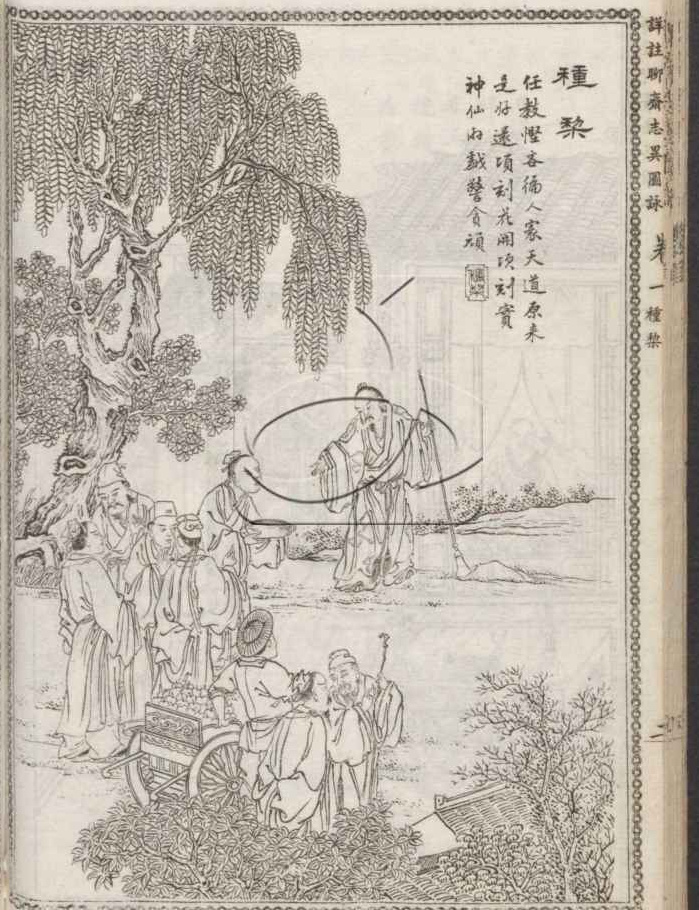
有鄉人貨梨於市,頗甘芳,價騰貴。有道士破巾絮衣,丐於車前,鄉人咄之而不去,鄉人怒,加以叱罵。道士曰:「一車數百顆,老衲止丐其一,於居士亦無大損,何怒為?」觀者勸置劣者一枚,令去,鄉人執不肯。
肆中傭保者,見喋聒不堪,遂出錢市一枚,付道士,道士拜謝,謂眾曰:「出家人不解吝惜,我有佳梨,請出供客。」或曰:「既有之,何不自食?」曰:「吾特需此核作種。」於是掬梨大啗,且盡,把核於手,解肩上鑱坎地上深數寸,納之,而覆以土,向市人索湯沃灌。好事者,於臨路店,索得沸瀋,道士接浸坎處。萬目攢視,見有勾萌出,漸大,俄成樹,枝葉扶疏,倏而花,倏而實,碩大芳馥,纍纍滿樹。道人乃即樹頭,摘賜觀者,頃刻而盡,已乃以鑱伐樹,丁丁良久乃斷,帶葉荷肩頭從容徐步而去。
初道士作法時,鄉人亦雜眾中,引領注目,竟忘其業。道士既去,始顧車中,則梨已空矣,方悟適所俵散,皆己物也。又細視車上一靶亡,是新鑿斷者,心大憤恨。急跡之,轉過牆隅,則斷靶棄垣下,始知所伐梨本,即是物也。道士不知所在,一市粲然。
異史氏曰:鄉人憒憒,憨狀可掬,其見笑於市人,有以哉。每見鄉中稱素封者,良朋乞米,則怫然,且計曰:「是數日之資也。」或勸濟一危難,飯一煢獨,則又忿然計曰:「此十人五人之食也。」甚而父子兄弟,較盡錙銖。及其淫博迷心,則傾囊不吝,刀鋸臨頸,則贖命不遑。諸如此類,正不勝道,蠢爾鄉人,又何足怪?
English Giles 1880
A countryman was one day selling his pears in the market. They were unusually sweet and fine flavoured, and the price he asked was high. A Taoist46 priest in rags and tatters stopped at the barrow and begged one of them. The countryman told him to go away, but as he did not do so he began to curse and swear at him. The priest said, “You have several hundred pears on your barrow; I ask for a single one, the loss of which, Sir, you would not feel. Why then get angry?” The lookers-on told the countryman to give him an inferior one and let him go, but this he obstinately refused to do. Thereupon the beadle of the place, finding the commotion too great, purchased a pear and handed it to the priest. The latter received it with a bow and turning to the crowd said, “We who have left our homes and given up all that is dear to us47 are at a loss to understand selfish niggardly conduct in others. Now I have some exquisite pears which I shall do myself the honour to put before you.” Here somebody asked, “Since you have pears yourself, why don’t you eat those?” “Because,” replied the priest, “I wanted one of these pips to grow them from.” So saying, he munched up the pear; and when he had finished took a pip in his hand, unstrapped a pick from his back, and proceeded to make a hole in the ground, several inches deep, wherein he deposited the pip, filling in the earth as before. He then asked the bystanders for a little hot water to water it with, and one among them who loved a joke fetched him some boiling water from a neighbouring shop. The priest poured this over the place where he had made the hole, and every eye was fixed upon him when sprouts were seen shooting up, and gradually growing larger and larger. By-and-by, there was a tree with branches sparsely covered with leaves; then flowers, and last of all fine, large, sweet-smelling pears hanging in great profusion. These the priest picked and handed round to the assembled crowd until all were gone, when he took his pick and hacked away for a long time at the tree, finally cutting it down. This he shouldered, leaves and all, and sauntered quietly away. Now, from the very beginning, our friend the countryman had been amongst the crowd, straining his neck to see what was going on, and forgetting all about his business. At the departure of the priest he turned round and discovered that every one of his pears was gone. He then knew that those the old fellow had been giving away so freely were really his own pears. Looking more closely at the barrow he also found that one of the handles was missing, evidently having been newly cut off. Boiling with rage, he set out in pursuit of the priest, and just as he turned the corner he saw the lost barrow-handle lying under the wall, being in fact the very pear-tree that the priest had cut down. But there were no traces of the priest—much to the amusement of the crowd in the market-place.
Giles’s notes
- That is, of the religion of Tao, or, as it is sometimes called, Rationalism. It was founded some six centuries before the Christian era by a man named Lao-tzŭ, “Old boy,” who was said to have been born with white hair and a beard. Originally a pure system of metaphysics, it is now but a shadow of its former self, and is corrupted by the grossest forms of superstition borrowed from Buddhism, which has in its turn adopted many of the forms and beliefs of Taoism, so that the two religions are hardly distinguishable one from the other. ↩
- A celibate priesthood belongs properly to Buddhism, and is not a doctrine of the Taoist church. ↩
English: Herbert A. Giles, Strange Stories from a Chinese Studio, vol. 1 (London: Thos. de la Rue, 1880), public domain, text via Project Gutenberg #43627. Footnotes are Giles’s. Chinese: 蒲松齡《聊齋志異》, public domain, text via Chinese Wikisource (modern editors’ glosses and the Qing commentaries are left out, and variant readings follow the first reading given).