
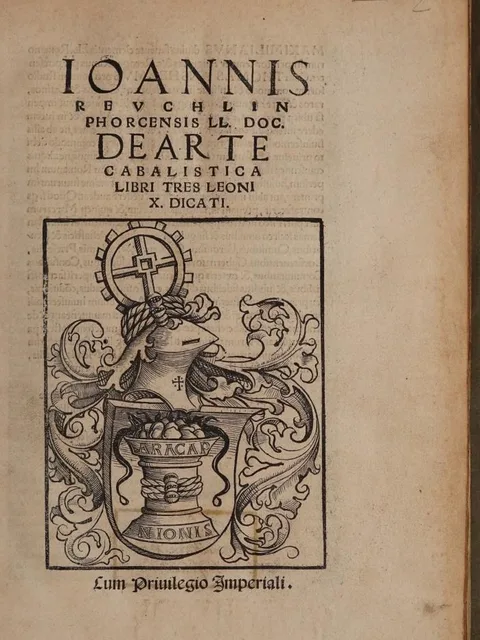
On the Art of the Kabbalah
Hagenau, 1517
Johann Reuchlin’s De arte cabalistica, the oldest printed book to set out the seventy-two sacred names of the angels, each with its psalm verse in Hebrew and Latin. Raziel keeps all supernatural lore.
Book sleeve
What this book is about
A Renaissance scholar’s book about the Kabbalah, written for Latin readers. Reuchlin sets it as a conversation in Frankfurt between a Jewish scholar, a Pythagorean philosopher and a Muslim, who talk about the hidden wisdom of the Hebrew letters and the holy names.
What you’ll find inside
- Three books of dialogue on the Kabbalah and its links to Pythagoras
- The seventy-two sacred names of the angels, drawn from Exodus 14:19–21
- For each name, the psalm verse that belongs to it, in Hebrew and Latin
- The 1517 woodcut title page with Reuchlin’s arms
About the author
Johann Reuchlin (1455–1522) was a German lawyer and humanist and one of the first Christian scholars to teach Hebrew. He dedicated this book to Pope Leo X.
- Author
- Johann Reuchlin (1455–1522)
- Printed
- Hagenau: Thomas Anshelm, 1517
- Language
- Latin, with Hebrew
- Copy
- Wellcome Collection, 186 PDF pages; the seventy-two verses are on PDF pp. 136–140 (leaves LIX–LXI)
- Licence
- Public Domain Mark 1.0 (Internet Archive b13135004_0001)
- Credit
- Wellcome Collection, via Internet Archive
Reuchlin wrote the book as a dialogue between a Jewish scholar, a Pythagorean and a Muslim, meeting in Frankfurt. In Book III he gives the seventy-two holy names drawn from Exodus 14:19–21, three letters each, and the psalm verse that belongs to each angel. Every later table, from Agrippa (1533) to Lenain (1823), stands on this one.
See the House corpus of the seventy-two names, built from this book.