
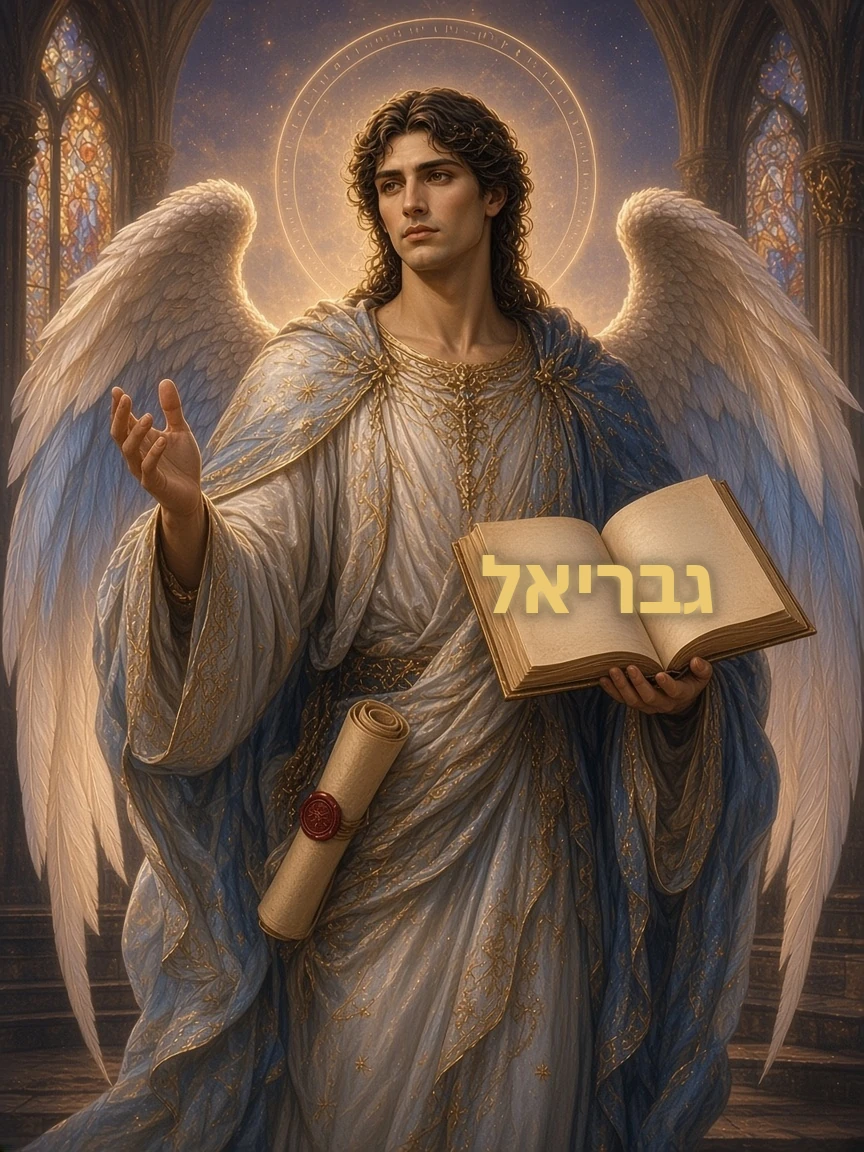
One of the ten archangels · 9 in Agrippa’s list (III.10)
Gabriel גַּבְרִיאֵל
Also known as גַּבְרִיאֵל Gavri’el · Γαβριήλ · Jibrīl, Jibrāʾīl (جبريل) (sources under “Also known as” below)
Name: “God is my strength” or “man of God”.
Tracing the name backward
We go backward from the newest source to the oldest dated one, and step back only where a dated text or a published scholarly link anchors the step. Unproven or second-hand links are drawn dashed and marked. Raziel’s full chart is on his page.
Rest the pointer on a section to open it; click to keep it open.Tap a section to open it; tap again to close.
Name originwhat the name means and how it was built
From gever “(strong) man”, root g-b-r “to be strong”, + El “God”. The Book of Daniel plays on it: Daniel sees one “having the appearance of a man (gaver)”, and the next verse names him Gavri’el (Daniel 8:15–16). Whether the name means “God is my strength” or “man of God” is debated; both rest on the same root.
Earliest sourcesthe name traced backward, with dated anchors
Solid = a link anchored in a dated sourceDashed = unproven, second-hand or a later equationNewest at the top; each step goes back in time. Tap any box to open its anchor.
- 7th c. CE
جِبْرِيل JibrīlQur’an 2:97–98; 66:4High
The angel who brings the revelation down upon the Prophet’s heart (2:97).
- an identification by the commentators, not the verse
rūḥ al-qudus, “the Holy Spirit”Qur’an 16:102; exegesisMedium
The verse names “the Holy Spirit” as bringer of the revelation; Muslim exegetes identify this spirit with Gabriel.
the name passes into Arabic
- an identification by the commentators, not the verse
- 1st c. CE
Γαβριήλ “who stands in the presence of God”Luke 1:19, 1:26High
“I am Gabriel, that stand in the presence of God” (Luke 1:19, KJV). He brings the news to Zechariah and to Mary.
one or two centuries older
- 2nd–1st c. BCE
Gabriel on the towersWar Scroll, 1QM 9:15–16High
Written on the tower shields with Michael, Sariel and Raphael.
older, in Daniel
- c. 167–164 BCE
גַּבְרִיאֵל “the man Gabriel”Daniel 8:16; 9:21High
He explains Daniel’s visions; in 9:21 he comes in swift flight at the time of the evening offering.
older still, in Enoch
- 3rd c. BCE (composition); Qumran copies 2nd c. BCE
Gabriel — the oldest secure witness1 Enoch 9:1; 20:7 (Book of the Watchers)High
“Gabriel, one of the holy angels, who is over Paradise and the serpents and the Cherubim” (1 Enoch 20:7, Charles 1917). Read The archangels: names and duties (Library, web of references).
before this: only the root of the name
- ancient Semitic
g-b-r “strong”, gever “man”; El “God”Hebrew and Aramaic vocabulary; Daniel 8:15–16 wordplayMedium
The building blocks are ordinary Hebrew words. A philological link, not a name history.
no anchor
- before the exile
The trail endsNo earlier source names an angel GabrielNo anchor
Rabbinic tradition itself says that “the names of the angels were brought by the Jews from Babylon” (Simeon ben Lakish, Jerusalem Talmud, Rosh Hashanah 1:2 [JE: “Yer. R. H. 54d”]; Genesis Rabbah 48:9; wording of the Jewish Encyclopedia, “Michael”). No text from before the Babylonian exile names any angel.
Also known asother names the sources give
Also known as גַּבְרִיאֵל Gavri’el1 · Γαβριήλ2 · Jibrīl, Jibrāʾīl (جبريل)3
Sources for these names
- Daniel 8:16; 9:21
- Luke 1:19, 26
- Qur’an 2:97–98; 66:4
Kept off the line: “the Holy Spirit” (rūḥ al-qudus, Qur’an 16:102), because the identification is the commentators’, not the verse’s.
Comparisonssimilar figures, where scholars draw the link
- Islam. Jibrīl, bringer of revelation (Qur’an 2:97). The commentators identify him with “the Holy Spirit” (16:102).
- Christianity. The angel of the Annunciation (Luke 1).
- Other cultures. The Hall has not found a published scholar who identifies Gabriel with a figure of another religion.
Comparisons are listed only where a scholar makes the link, or are marked as the Hall’s own note. A parallel of role is not a lineage of name.
Further readingbooks in Raziel’s Library and beyond
Unverified and sourceswhat is still to check, and every source
Checked No open unverified claims in this entry beyond those marked dashed in the chart.
Sources
- Jewish Encyclopedia, “Gabriel” (1906)
- Charles, The Book of Enoch (1917), in the Library
Hover or tap to turn the card.
In the Menologion of Basil II
This half-year facsimile (September–February) has no separate feast of Gabriel and no Annunciation plate. The 1907 index titles the plate below only as the synaxis of the holy archangels, 8 November.

- Name
- Gabriel, גַּבְרִיאֵל, “God is my strength” or “man of God.” The Book of Daniel plays on the root: Daniel sees one “having the appearance of a man (gaver),” and the next verse names him Gavri’el (Daniel 8:15–16). AncientAs already on this page
- Letters
- גבריאל (unpointed); the heading points it גַּבְרִיאֵל. Ancient
- Office (Daniel)
- “The man Gabriel” explains Daniel’s visions; in 9:21 he comes in swift flight at the time of the evening offering (Daniel 8:16; 9:21). Ancient
- Office (Luke)
- “I am Gabriel, that stand in the presence of God” (Luke 1:19, KJV); he is sent to Mary in 1:26. Ancient
- Office (1 Enoch)
- “Gabriel, one of the holy angels, who is over Paradise and the serpents and the Cherubim” (1 Enoch 20:7, Charles 1917). Ancient
- Station
- The ninth name is Sadai / Elhai; “his numeration is Iesod, that is foundation,” through the Angels / Cherubim into the sphere of the Moon; “his intelligence is Gabriel, who was the keeper of Joseph, Joshua and Daniel.” RenaissanceJ.F., Three Books of Occult Philosophy, London 1651 (the edition the Hall holds and already cites). The Hall's English panel for III.10, as transcribed, is cut off after the third numeration; seats 4-10 are quoted from the remainder of that same 1651 English chapter.
- Planet
- Moon, in both of Agrippa’s III.24 lists (first list and the “somewhat differing” list). RenaissanceAgrippa III.24, 1651 English, Hall panel
- Winds
- North, in Agrippa III.24: “Gabriel over the Northern.” Renaissance
- Meaning in Agrippa III.24
- In the five-name gloss, Gabriel is “the vertue of God.” RenaissanceAgrippa III.24, Hall panel
- Guided
- Joseph, Joshua and Daniel (Agrippa III.10 and III.47). Renaissance
- Colours
- None named for Gabriel himself in the sources already on this page. HouseNot attested
- Incense
- Not attested in the sources already on this page. House
- Feast
- Not given in the sources already on this page. House
Persona: as the books describe him
Daniel names him first among the books on this page: “the man Gabriel,” who comes in swift flight at the evening offering and makes the visions understood. Luke has him stand in the presence of God and speak the announcement to Mary: “I am Gabriel, that stand in the presence of God.” In 1 Enoch, Charles’s English (in the Library) sets him “over Paradise and the serpents and the Cherubim” (20:7). Those are three offices, cited side by side. Ancient
Agrippa’s 1651 English of III.10 places him at Iesod (Yesod), through the Moon: “the keeper of Joseph, Joshua and Daniel.” III.47 says “Joseph, Joshua and Daniel with Gabriel.” Both of Agrippa’s planetary lists in III.24 keep him over the Moon, and the same chapter sets him over the northern wind. In the name-meaning list of III.24 he is “the vertue of God.” Renaissance
Still to find
Passages we know of but do not yet hold in a public-domain or open copy, or a Hall-held check still outstanding. They are on the Library's to-acquire list.
- The remainder of Agrippa III.10 in the Hall’s own English-panel transcription. Iesod / “keeper of Joseph, Joshua and Daniel” is quoted here from the same 1651 J.F. English the Hall already cites.
- Testament of Solomon 18:6 (Gabriel binds the second decan), already noted among this page’s further reading.