
2 Enoch 1–2 (short recension) — House translation (rev. 2, second read)
Witness: Belgrade, National Library of Serbia MS 151 (16th c.; destroyed in WWII) as printed by Stojan Novaković, 'Apokrif o Enohu', Starine XVI (Zagreb: JAZU, 1884), pp. 67-81; this passage p. 70
Scan: https://archive.org/details/starine_knjiga_16-17-18-jazu (Public Domain Mark 1.0); page image leaf n82 saved at starine16-leaf82.jpg
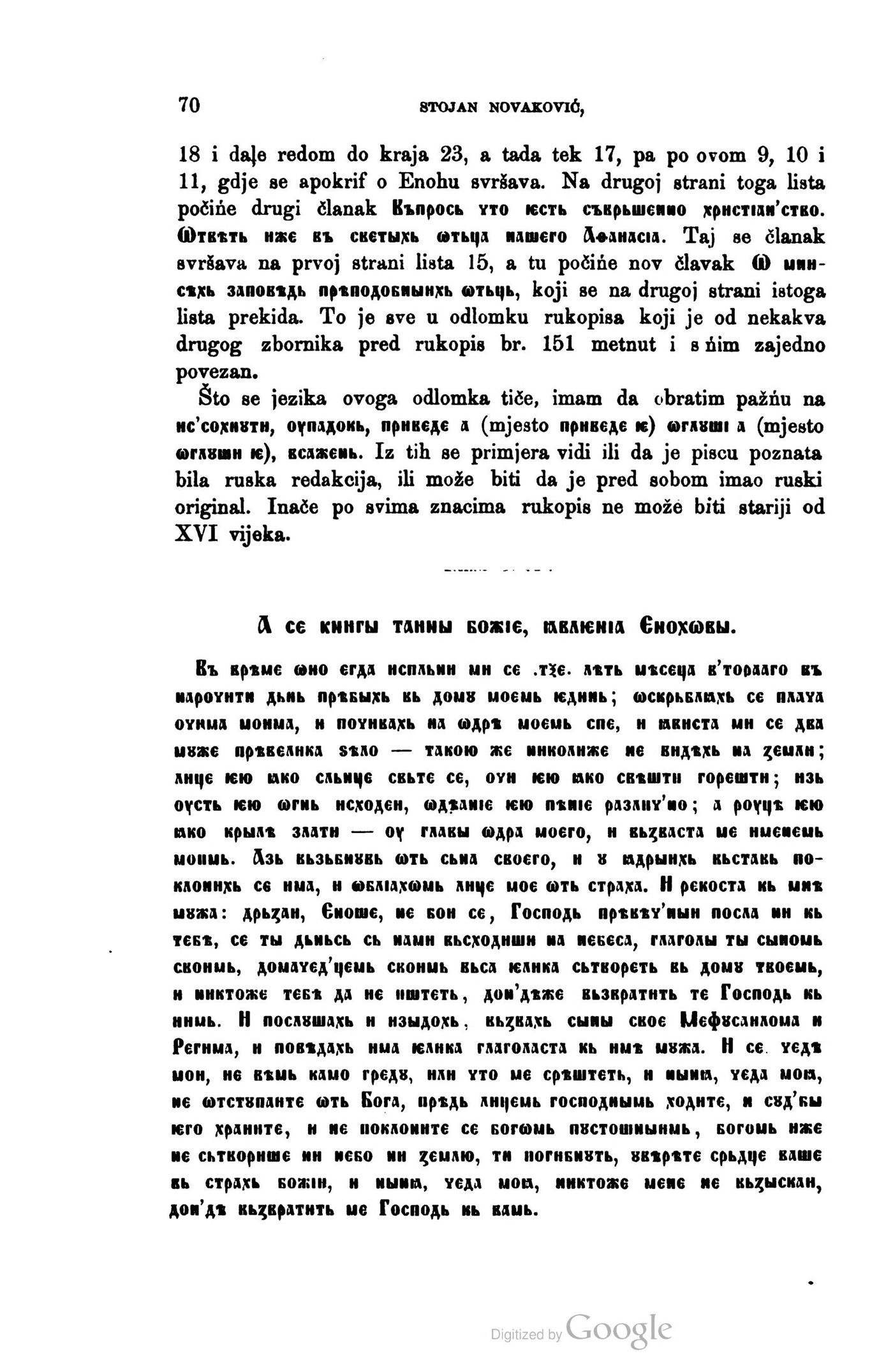
Method: Rosetta method: original read by eye from the 1884 page image (OCR on archive.org is unusable: Cyrillic rendered as Latin letters), normalised Church Slavonic spelling, then compared line by line with Morfill 1896 and Bonwetsch 1922 before writing the House English. Uncertain readings are marked [unclear]/[uncertain].
title
Slavonic (1884 print, normalised): А се книгы таины божіе, ꙗвлєниꙗ Єнохѡвы.
Morfill/Charles 1896: (B's title, n.1) These are the secret books of God which were shown to Enoch.
Bonwetsch 1922: (note) 'Aber dies die Bücher die Geheimnisse, die Offenbarung Gottes an Henoch' V.
House translation: And these are the books of God's secrets, the revelations of Enoch.
- Novaković's title differs slightly from the V witness quoted by Bonwetsch; we follow the 1884 print.
1:1-2
Slavonic (1884 print, normalised): Въ врѣме ѡно егда испльни ми се .тѯе. лѣть, мѣсеца в'тораго въ нарочити дьнь прѣбыхъ въ домѹ моемь єдинь;
Morfill/Charles 1896: (long rec. A) Hardly had I accomplished 165 years, when I begat my son Methusal: after that I lived 200 years and accomplished all the years of my life, 365 years. On the first day of the first month I was alone in my house... [n.1: 'In the second month on an appointed day, B']
Bonwetsch 1922: (short rec.) Zu jener Zeit, sprach Henoch, als mir vollendet wurden dreihundertundfünfundsechzig Jahre, im ersten Monat an dem bestimmten Tag, und ich allein in meinem Hause war [n.: 'des zweiten' VB¹]
House translation: In that time, when 365 years were fulfilled for me, in the second month, on the appointed day, I was alone in my house;
- .тѯе. is the Cyrillic numeral 300+60+5 = 365 (read from the scan; matches Gen 5:23).
- Print has the ч-glyph that looks like у (also in 'уеда' = чеда 'children'); read нарочити 'appointed, solemn', confirmed by Morfill's note 'on an appointed day, B'.
- Short recension gives only the total 365; the long recension adds 165 + 200 (Methuselah's birth). Timeline value: the year-count is the frame of the whole book.
1:2-3
Slavonic (1884 print, normalised): ѡскрьбѣхъ се плача ѡчима моима, и почивахъ на ѡдрѣ моемь спе,
Morfill/Charles 1896: (n.2, B) I had made myself melancholy weeping with my eyes, and I lay down on my bed to sleep.
Bonwetsch 1922: bekümmert und weinend mit meinen Augen. Und ich ruhte auf meinem Bett schlafend.
House translation: I grieved, weeping with my eyes, and I rested on my bed asleep,
- Print spells оучима/поуивахъ with the ч-glyph; normalised here to ѡчима, почивахъ. [reading of ѡскрьб- verb ending unclear in scan]
1:4-5
Slavonic (1884 print, normalised): и ꙗвиста ми се два мѹжа прѣвелика ѕѣло — такою же николиже не видѣхъ на ꙁемли; лице єю ꙗко сльнце свѣтеще се, ѡчи єю ꙗко свѣшти горешти; изь оусть єю ѡгнь исходеи, ѡдѣание єю пѣние разлиꙑно; а роуцѣ єю ꙗко крилѣ злати —
Morfill/Charles 1896: And there appeared to me two men very tall, such as I have never seen on earth. And their faces shone like the sun, and their eyes were like burning lamps; and fire came forth from their lips. Their dress had the appearance of feathers... [n.: 'B, their dress and singing were wonderful'; 'And on their shoulders as it were golden wings, B']
Bonwetsch 1922: zwei überaus sehr große Männer ... ihre Angesichter leuchtend wie die Sonne, ihre Augen wie brennende Fackeln, aus ihrem Mund Feuer hervorgehend, ihre Kleider vorzügliche Federn, und ihre Arme wie goldene Flügel.
House translation: and there appeared to me two men, exceedingly great, such as I had never seen on earth: their faces shining like the sun, their eyes like burning lamps, fire going out of their mouths, their clothing a many-voiced singing, and their arms like golden wings.
- CORRECTION vs Morfill/Bonwetsch: the 1884 print reads пѣние 'singing', not пѣрие 'feathers'. Bonwetsch and Morfill's main text follow 'feathers'. The House text keeps what this witness actually prints and records 'feathers' as the other reading.
- разлиꙑно: the print has разлиѹ'но with the ч/у glyph; read различно 'various, manifold'. [uncertain]
- роуцѣ: 'hands/arms' (dual). Morfill's 'on their shoulders' paraphrases B; the print says hands/arms.
- 2nd read: print has мѹже (not dual мѹжа) — kept as printed.
1:5-7
Slavonic (1884 print, normalised): оу главы ѡдра моего, и възваста ме именемь моимь. Азь възбѹдивь ѿ сьна своего, и ѹꙗдрыихъ [?] въставь поклонихъ се има, и ѡблиꙗхомь [?] лице мое ѿ страха.
Morfill/Charles 1896: They stood at the head of my bed and called me by my name. I awoke from my sleep and saw clearly these men standing in front of me. I hastened and made obeisance to them and was terrified, and the appearance of my countenance was changed from fear. [n.: 'standing up quickly (?), B'; 'Veiled my face, B']
Bonwetsch 1922: Und sie standen zu Häupten meines Bettes und riefen mich mit meinem Namen. Ich aber erwachte von meinem Schlaf ... Ich aber beeilte mich und stand auf und betete sie an. Und es erbleichte mein Angesicht ... vor Furcht.
House translation: at the head of my bed, and they called me by my name. I woke from my sleep and, rising swiftly, bowed down to them, and my face was drenched [?] for fear.
- 2nd read: print has no reflexive се after възбѹдивь.
- 2nd read: ѹꙗдрыихъ — cf. OCS ꙗдръ 'swift'; sense 'quickly' (Morfill n. B 'standing up quickly (?)'). [uncertain]
- 2nd read CORRECTION: the verb is ѡблиꙗхомь (print ѡбліахомь), not ѡблѣдѣ. Literally 'I was drenched/poured over as to my face' — tears or sweat; Bonwetsch 'erbleichte', Morfill B 'veiled my face' are other MSS' verbs. [uncertain]
1:8-10
Slavonic (1884 print, normalised): И рекоста къ мнѣ мѹжа: дрьꙁаи, Єноше, не бои се; Господь прѣвѣчныи посла ни къ тебѣ; се ты дьньсь сь нами въсходиши на небеса. Глаголи ты сыномь своимь и домачедцемь своимь вьса єлика сътворетъ въ домѹ твоемь, и никтоже тебѣ да не ищетъ, доньдѣже възвратить те Господь къ нимь. И послѹшахъ и изыдохъ, възвахъ сыны свое Мефѹсаилома и Регима, и повѣдахъ има єлика глаголаста къ мнѣ мѹжа.
Morfill/Charles 1896: Be of good cheer, Enoch, be not afraid; the everlasting God hath sent us to thee, and lo! to-day thou shalt ascend with us into heaven. And tell thy sons and thy servants, all who work in thy house, and let no one seek thee, till the Lord bring thee back to them. And I hastened to obey them, and went out of my house. And I called my sons Methusal, Regim [and Gaidal], and told them what wonderful things the two men had said to me.
Bonwetsch 1922: Sei mutig, Henoch, fürchte dich nicht. Der ewige Herr hat uns zu dir gesandt ... Und ich gehorchte und ging, rief meine Söhne Methusalom und Regim und tat ihnen kund, so viel zu mir die Männer geredet.
House translation: And the men said to me: Take courage, Enoch, do not fear. The Lord who is before the ages has sent us to you; behold, today you go up with us into the heavens. Tell your sons and your household everything they are to do in your house, and let no one search for you until the Lord brings you back to them. And I obeyed and went out, and I called my sons Methuselah and Regim, and told them all that the men had said to me.
- прѣвѣчныи: literally 'before-the-ages, pre-eternal'; richer than Morfill's 'everlasting'. Printed with the ч/к-like glyph (прѣкѣуьныи in OCR).
- Short recension names only Methuselah and Regim; 'Gaidal' is a long-recension addition (Morfill brackets it).
- домачедцемь 'household members' (OCR: домауедцемь).
- 2nd read CORRECTION: print reads Мефѹсаилома (Mefusailom) and глаголаста къ мнѣ мѹжа 'the men said to me' (first read had къ нимъ 'to them').
2:1-4
Slavonic (1884 print, normalised): И се, чеда моꙗ, не вѣмь камо гредѹ, или что ме срѣштеть; и нынѣ, чеда моꙗ, не ѿстѹпаите ѿ Бога, прѣдь лицемь господнимь ходите, и сѹдьбы его храните, и не поклоните се богомь пѹстошнымь, богомь иже не сътвориша ни небо ни ꙁемлю — ти погибнѹть; ѹврѣте срьдце ваше въ страхь божии. И нынѣ, чеда моꙗ, никтоже мене не възыскаи, доньдѣ възвратить ме Господь къ вамь.
Morfill/Charles 1896: Hear me, my children, for I do not know whither I am going, or what awaits me. Now, my children, I say unto you: turn not aside from God: walk before the face of the Lord and keep his judgements and do not worship vain gods, who did not make heaven and earth, for these shall perish...
Bonwetsch 1922: Und siehe, meine Kinder, ich weiß nicht, wohin ich gehe oder was mir begegnet, und jetzt, meine Kinder, tretet nicht ab von dem Herrn. Vor dem Angesicht des Herrn wandelt ...
House translation: And behold, my children, I do not know where I am going or what will meet me. And now, my children, do not turn away from God: walk before the face of the Lord and keep his judgments, and do not bow down to empty gods, gods that made neither heaven nor earth — they will perish. Set your hearts within the fear of God. And now, my children, let no one search for me until the Lord brings me back to you.
- пѹстошнымь 'empty, vain' (Morfill 'vain gods').
- 2nd read CORRECTION: print clearly reads ѹврѣте (from оувьрѣти 'to put in, enclose'), not a form of 'make firm': 'set/enclose your hearts in the fear of God'.
Corrections to prior translations
- 1:5 clothing = 'singing' (пѣние) in this witness, not 'feathers' (Morfill/Bonwetsch main text).
- 1:5 golden wings are the men's arms/hands (роуцѣ), not 'on their shoulders' (Morfill's B note).
- 1:8 прѣвѣчныи = 'before the ages', stronger than 'everlasting'.
- Short recension: second month, appointed day; sons Methuselah and Regim only.
Second-read corrections (own first draft)
- 1:6-7 verb read ѡблиꙗхомь ('face drenched'), not ѡблѣдѣ ('grew pale'); no reflexive се after възбѹдивь.
- 1:10 'the men said to me' (къ мнѣ), not 'to them'; name spelled Мефѹсаилома.
- 2:3 ѹврѣте срьдце = 'set/enclose your hearts in the fear of God' (was 'make firm').
- 1:4 print мѹже kept as printed.