
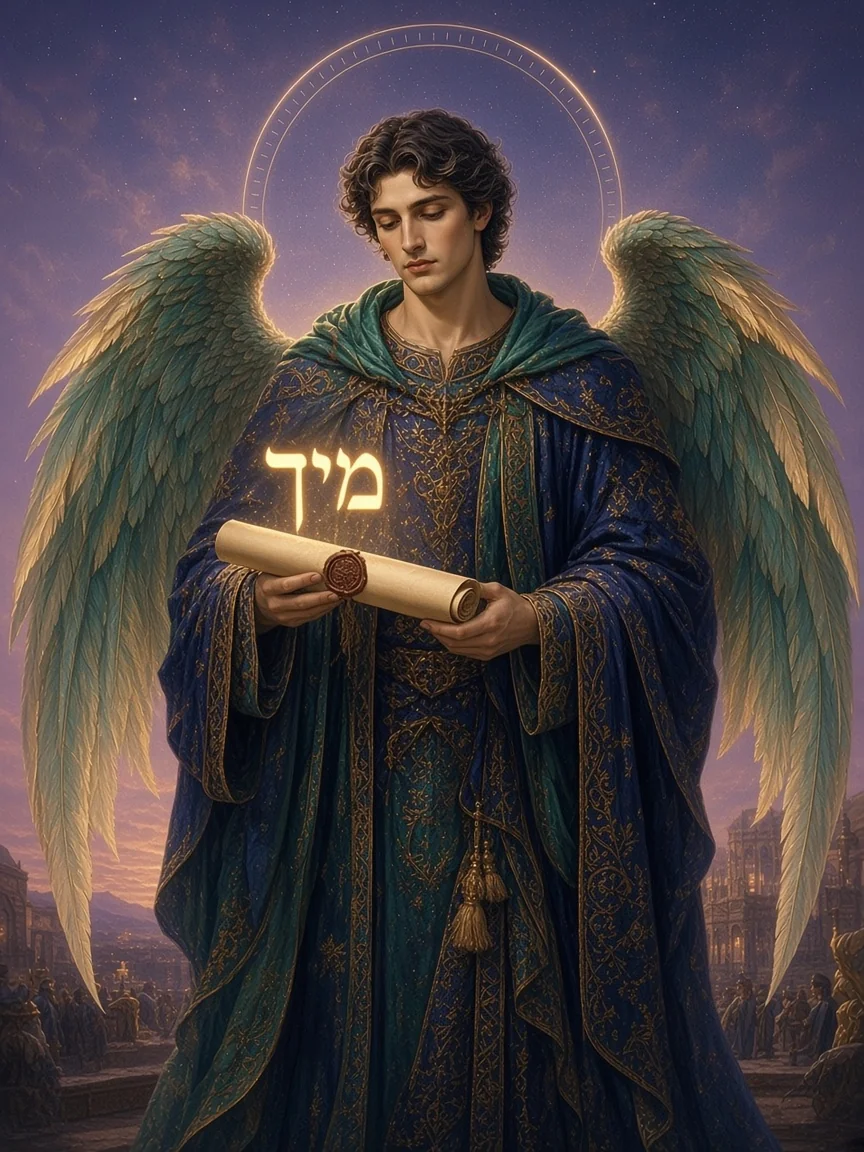
42nd of the 72 · Choir of Virtues
Mikael מיך
Also known as Mikael · Michael · מיך (the three letters) (sources under “Also known as” below)
Name: the triad מיך with an angelic ending.
Tracing the name backward
We go backward from the newest source to the oldest dated one, and step back only where a dated text or a published scholarly link anchors the step. Unproven or second-hand links are drawn dashed and marked. Raziel’s full chart is on his page.
Rest the pointer on a section to open it; click to keep it open.Tap a section to open it; tap again to close.
Name originwhat the name means and how it was built
One of the 72 “names” read out of Exodus 14:19–21. The triad מיך is taken letter by letter from the three verses; Renaissance Christian kabbalists (Reuchlin 1517; Agrippa 1533) turned each triad into an angel by adding -el or -iah. Agrippa’s 1651 table spells this name “Michael”, the same as the archangel; the Sanctuary keeps the two apart, as Lenain does by writing Mikael.
- Choir Virtues
- Degrees of the zodiac 206°–210°
- Psalm verse Ps 121:7 Vulg. Ps 120:7
From Lenain (1823), as set out in the Sanctuary’s table of the 72.
Earliest sourcesthe name traced backward, with dated anchors
Solid = a link anchored in a dated sourceDashed = unproven, second-hand or a later equationNewest at the top; each step goes back in time. Tap any box to open its anchor.
- 1823
MikaelLenain, La Science cabalistique (Paris 1823; BIU Santé Ms 5365)Medium
Lenain gives each of the 72 a choir, five degrees of the zodiac and a psalm verse, as listed in the Sanctuary’s table of the 72.
older
- 1652–1654
the 72 in a circleKircher, Oedipus Aegyptiacus II.1Medium
Kircher draws the 72 names as a great circle. Unverified for this name until the Hall reads Kircher’s plate.
older
- 1533 (English 1651)
MichaelAgrippa, Three Books of Occult Philosophy III.25, table of the 72High
The table of the 72 angels, each formed by adding -el or -iah to a triad of letters. Read Agrippa, De occulta philosophia, Cologne 1533 (Library).
older
- 1517
the triad becomes an angel’s nameJohannes Reuchlin, De arte cabalistica, Book IIIHigh
The oldest dated source the Hall relies on for the angel-names of the 72 (as on the Sanctuary’s Lauviah page). Before this there are only the letters.
the letters, not yet an angel
- 11th c.
מיך as one of the 72 namesRashi on Sukkah 45aHigh
Rashi explains the 72 names as read from the three verses of Exodus 14:19–21, “each of 72 letters”: the first letter of the first verse, the last of the middle verse and the first of the last, “and so on in this order”; the first name is והו (Hall translation; Sefaria).
read out of three verses
- the verses themselves
Exodus 14:19–21three verses of 72 letters eachHigh
Letter 42 of verse 19, letter 42 counted from the end of verse 20, and letter 42 of verse 21, by Rashi’s rule. Hall check Computed from the Hebrew consonantal text of Exodus 14:19–21 (Sefaria, “Tanach with Text Only”; 72 letters in each verse): letter 42 of verse 19 is מ, letter 42 from the end of verse 20 is י, letter 42 of verse 21 is כ (final forms normalised). All 72 triads in the Sanctuary table match this count. Read Exodus in Gutenberg Bible: Exodus, Psalms and more (Library).
no anchor
The trail endsNo angel named Mikael before Reuchlin (1517)No anchor
Before the Renaissance there are the letters and the method, but no angel of this name.
Also known asother names the sources give
Also known as Mikael1 · Michael2 · מיך (the three letters)3
Sources for these names
- Lenain 1823 (Sanctuary table of the 72)
- Agrippa III.25, table of the 72 (English 1651)
- Exodus 14:19–21 by Rashi’s rule (on Sukkah 45a)
Comparisonssimilar figures, where scholars draw the link
- The decans (House note). Lenain gives each of the 72 five degrees of the zodiac (72 × 5 = 360), so two of them make one 10° decan, the old Egyptian star-division (Neugebauer & Parker). That is arithmetic and the Hall’s own note, not a scholar’s identification.
Comparisons are listed only where a scholar makes the link, or are marked as the Hall’s own note. A parallel of role is not a lineage of name.
Further readingbooks in Raziel’s Library and beyond
Unverified and sourceswhat is still to check, and every source
Unverified
- Unverified Kircher plate not yet read for this name
Sources
- Rashi on Sukkah 45a (Sefaria)
- Reuchlin, De arte cabalistica (1517), Book III
- Agrippa, Three Books of Occult Philosophy III.25 (1533; English 1651)
- Kircher, Oedipus Aegyptiacus (1652–54)
- Lenain, La Science cabalistique (1823)
Hover or tap to turn the card.
- Name
- Mikael, to whom the kabbalists give the attributes “virtue of God, house of God, like unto God” (vertu de Dieu, maison de Dieu, semblable à Dieu); he corresponds to the name Biub or Biud, “after the language of the Canadians” RevivalLenain 1823, typographic reissue of ch. VI (to check against the 1823 printing and Ms 5365). Agrippa III.25 (English 1651), table of the 72: “Michael.” The page keeps the Hall’s spelling Mikael. This is the forty-second of the 72, not the archangel Michael.
- Letters
- מיך (Mem, Yod, Kaf (final Kaf)) → מיכאל RenaissanceExodus 14:19–21, letter 42 of each verse (v. 20 backward); Reuchlin 1517; House corpus.
- Number
- 42 of 72 RenaissanceReuchlin 1517 III; Agrippa III.25; Kircher 1653, leaf triad 42 מיך (standard order, not yet checked letter-by-letter for this spoke)
- Order
- Virtues, angels 41–48. Lenain’s reissue writes “5e. ordre … chœur des vertus,” though this choir follows the Powers RevivalLenain 1823: “Ce génie et ceux qui suivent, jusqu’au 48e., appartiennent au 5e. ordre des anges, que les orthodoxes appellent le chœur des vertus.” The Sanctuary table of the 72 places 41–48 in the Virtues.
- Word (psalm)
- Psalm 121:7 (Vulg. 120:7): “The Lord keepeth thee from all evil: may the Lord keep thy soul.” (Douay: the same sense.) AncientHebrew WLC; Douay-Rheims / Vulgate. Lenain tells the reader to pronounce the 7th verse of Psalm 120 and quotes “Dominus custodit te ab omni malo; custodiat animam tuam Dominus.”
- Domain
- Monarchs, princes, and nobles; he keeps their subjects in obedience, and discovers conspiracies and all who seek to destroy their persons and their governments RevivalLenain 1823: “Ce génie influe sur les monarques, les princes et les nobles ; il maintient leurs sujets dans l’obéissance, découvre les conspirations, et tous ceux qui cherchent à détruire leurs personnes et leurs gouvernements.”
- Gifts
- To travel in safety RevivalLenain 1823: “Il sert pour voyager en sûreté.”
- Those born under him
- Will occupy themselves with political affairs; will be curious, will want to know the secrets of cabinets and foreign news, and will be distinguished in affairs of state by their knowledge of diplomacy RevivalLenain 1823: “La personne qui est née sous cette influence s’occupera des affaires politiques; elle sera curieuse, voudra connaître les secrets des cabinets et les nouvelles étrangères, et elle se distinguera dans les affaires d’état par ses connaissances dans la diplomatie.”
- Shadow
- Lenain’s “contrary genius” rules over traitors; it influences malice, and all who spread false news. This is a separate spirit, not Mikael RevivalLenain 1823: “Le génie contraire domine sur les traîtres ; il influe sur la malveillance, et sur tous ceux qui propagent de fausses nouvelles.”
- Heaven
- The twenty-first decan, genie Arpien. A planet is not named in the recovered sentence RevivalLenain 1823: “correspondant à la 21e. décade et au génie nommé Arpien.” The typographic reissue does not name a planet here.
- Degrees
- 206°–210° of the zodiac RevivalThe Sanctuary table of the 72, and Lenain’s 5° rule. The typographic reissue of this entry is broken, and writes “depuis le 216e. degré … jusqu’au 210e.”
- Days
- 30 April, 11 July, 21 September, 2 December, 12 February RevivalLenain 1823
- Hour
- From 1:40 to 2:00 exactly. Lenain does not repeat “du soir” in this sentence; the surrounding entries are evening hours RevivalLenain 1823: “depuis 1 heure 40 minutes jusqu’à 2 heures juste.”
- Colours
- None attested for Mikael. Lenain does not name a planet in the recovered sentence, so no metal is inferred from the Key of Solomon I.18 HouseNo planet is preserved in the typographic reissue for this entry. Key of Solomon I.18 gives metals only by planet.
- Incense
- None attested for Mikael himself HouseNot attested in Lenain or Agrippa’s table of the 72 as a perfume for this name. Key of Solomon II.10 gives only general sweet spices.
- Seal
- The three letters מיך, as printed by Reuchlin and set by Kircher in the 72-names plate (1653). The “seals” of the 72 sold today are modern RenaissanceReuchlin 1517; Kircher 1653
- Feast
- None in any calendar; Lenain’s five days above RevivalLenain 1823
Persona: as the books describe him
The books give Mikael no body and no face; he is known by what he does. Lenain sets him among the Virtues, angels 41–48 (the reissue writes “5e. ordre … chœur des vertus”). The kabbalists, Lenain says, give him the attributes virtue of God, house of God, and like unto God. His verse asks the Lord to keep the soul from all evil (Psalm 121:7 / Vulg. 120:7). He serves for travelling in safety. He influences monarchs, princes, and nobles, keeps their subjects in obedience, and discovers conspiracies. The people born under him will occupy themselves with political affairs, will be curious about the secrets of cabinets and foreign news, and will be distinguished in affairs of state by diplomacy (Lenain 1823). He is not the archangel Michael. Wording is not softened. Revival
The holy name Biub or Biud is given by Lenain, “after the language of the Canadians”, as the name to which this genius corresponds. It is a divine name in that entry, not a second name for the angel. The Hall’s existing page, and the Renaissance and “if met today” cards, honour him as “him.” Lenain writes “il,” because French génie is masculine. House
The Key of Solomon, the Lemegeton (Goetia), the Hygromanteia, and Sefer Raziel ha-Malakh were searched for this distinctive Shem name; they do not give it as one of the 72. Agrippa’s table spells the name “Michael.” The Hygromanteia’s Friday pairing “Angel Michael · demon Asmodai” is the archangel, not this forty-second of the 72. The Goetia’s spirit no. 37 (Phenex) is not identified with him. The Hall’s open extract of Dionysius, Celestial Hierarchy, is chapter VII (Thrones); the Virtues and Principalities chapters are not yet separate pages. The Zohar and the Bahir are not yet among the Hall’s open copies. House
Still to find
Passages we know of but do not yet hold in a public-domain or open copy, or have not yet read for this name. They are on the Library’s to-acquire or to-read list.
- The Virtues or Principalities chapter of Dionysius, Celestial Hierarchy (the Hall’s open extract is chapter VII, Thrones)
- Kircher, Oedipus Aegyptiacus II.1 (Rome 1653), a letter-by-letter check of this spoke on the 72-names plate (the triad is already placed in the standard order)
- Lenain 1823 printed edition (Google Books qt9SAAAAcAAJ) and a line-by-line reading of BIU Santé Ms 5365 for this entry (the French above is from the typographic reissue)
- The Zohar and the Bahir — not yet open copies in the Library; not attested here for this name