
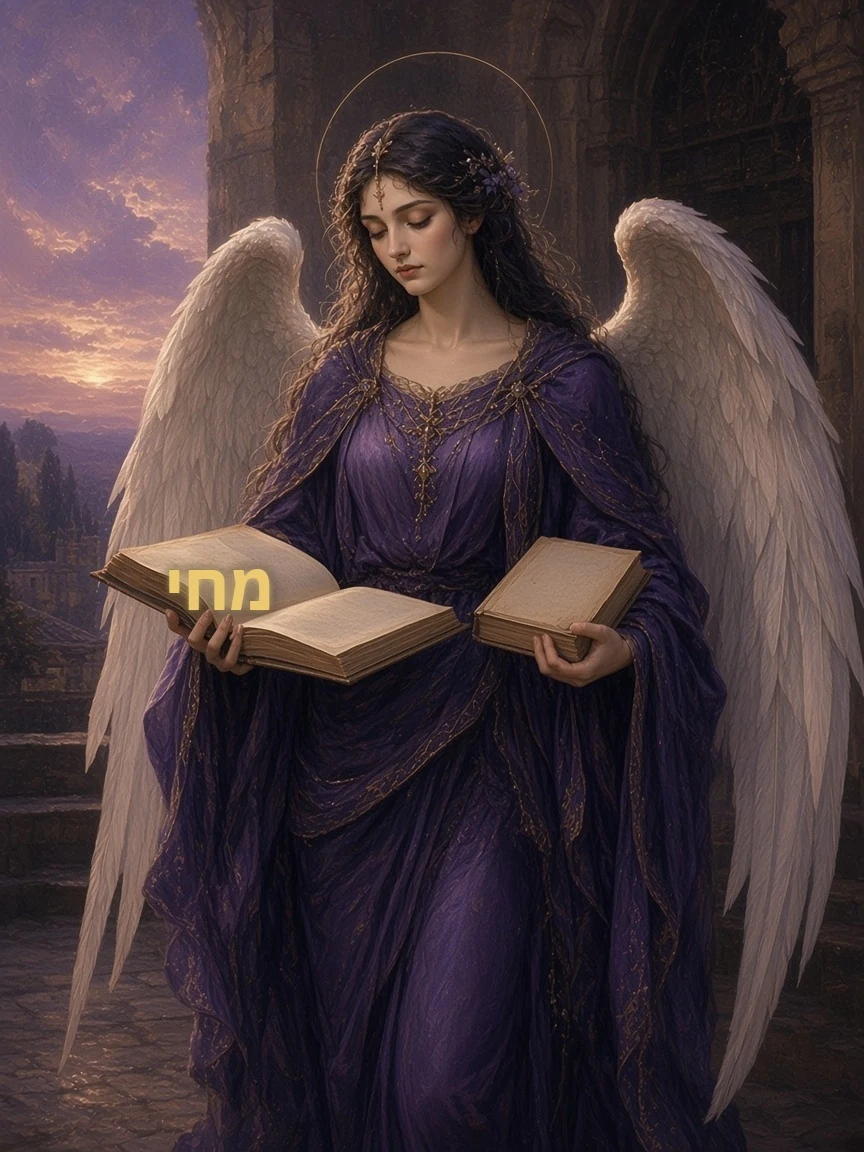
64th of the 72 · Choir of Angels
Mehiel מחי
Also known as Mehiel1 · Alli2 · מחיאל (Mehiel)3 · מחי (the three letters)4
Sources for these names
- 1. Lenain, typographic reissue, and the Sanctuary page: “Mehiel.” Agrippa’s 1651 English spelling for this name was not recovered from the Hall’s table OCR and is not supplied here
- 2. Lenain, typographic reissue: “Il correspond au saint nom Alli, d'après la langue des Mongols.” The 1823 printing reads “la langue des Mogols” (p. 89). Kircher’s plate, Lenain’s source for this column, has Mogores (the Mughals). All three are cited; none is silently corrected
- 3. Angel form of the triad מחי: Exodus 14:19–21 by the rule in Agrippa III.25 and Reuchlin 1517; House corpus, The Seventy-Two Names, מחיאל. The typographic reissue and the 1823 printing (p. 89) both print מהיאל, with he where the Shem triad has het. The difference is noted; the letters on this page are the corpus triad מחי
- 4. Exodus 14:19–21 by Rashi’s rule (on Sukkah 45a); Reuchlin 1517, Book III
Name: the triad מחי with an angelic ending.
Tracing the name backward
We go backward from the newest source to the oldest dated one, and step back only where a dated text or a published scholarly link anchors the step. Unproven or second-hand links are drawn dashed and marked. Raziel’s full chart is on his page.
Rest the pointer on a section to open it; click to keep it open.Tap a section to open it; tap again to close.
Name originwhat the name means and how it was built
One of the 72 “names” read out of Exodus 14:19–21. The triad מחי is taken letter by letter from the three verses; Renaissance Christian kabbalists (Reuchlin 1517; Agrippa 1533) turned each triad into an angel by adding -el or -iah.
Where the sources are thin. For this name the Hall has two firm anchors: the three letters, read from Exodus 14:19–21 by Rashi’s rule and recomputed by the Hall, and Lenain’s spelling of 1823. The Sanctuary’s table gives no spelling from Agrippa’s English table of 1651, and the Hall has not read Kircher’s plate. So the step from the letters to this spelling is not yet traced through any Renaissance source we have checked. Unverified
- Choir Archangels
- Degrees of the zodiac 316°–320°
- Psalm verse Ps 33:18 Vulg. Ps 32:18
From Lenain (1823), as set out in the Sanctuary’s table of the 72.
Earliest sourcesthe name traced backward, with dated anchors
Solid = a link anchored in a dated sourceDashed = unproven, second-hand or a later equationNewest at the top; each step goes back in time. Tap any box to open its anchor.
- 1823
MehielLenain, La Science cabalistique (Paris 1823; BIU Santé Ms 5365)Medium
Lenain gives each of the 72 a choir, five degrees of the zodiac and a psalm verse, as listed in the Sanctuary’s table of the 72.
older
- 1652–1654
the 72 in a circleKircher, Oedipus Aegyptiacus II.1Medium
Kircher draws the 72 names as a great circle. Unverified for this name until the Hall reads Kircher’s plate.
older
- 1533 (English 1651)
no English 1651 spelling recordedAgrippa, Three Books of Occult Philosophy III.25, table of the 72Low
The Sanctuary’s table gives no 1651 English spelling for this name, so the Hall has not yet read Agrippa’s form here. Unverified Agrippa’s table contains all 72 triads; read Agrippa, De occulta philosophia, Cologne 1533 (Library).
older
- 1517
the triad becomes an angel’s nameJohannes Reuchlin, De arte cabalistica, Book IIIHigh
The oldest dated source the Hall relies on for the angel-names of the 72 (as on the Sanctuary’s Lauviah page). Before this there are only the letters.
the letters, not yet an angel
- 11th c.
מחי as one of the 72 namesRashi on Sukkah 45aHigh
Rashi explains the 72 names as read from the three verses of Exodus 14:19–21, “each of 72 letters”: the first letter of the first verse, the last of the middle verse and the first of the last, “and so on in this order”; the first name is והו (Hall translation; Sefaria).
read out of three verses
- the verses themselves
Exodus 14:19–21three verses of 72 letters eachHigh
Letter 64 of verse 19, letter 64 counted from the end of verse 20, and letter 64 of verse 21, by Rashi’s rule. Hall check Computed from the Hebrew consonantal text of Exodus 14:19–21 (Sefaria, “Tanach with Text Only”; 72 letters in each verse): letter 64 of verse 19 is מ, letter 64 from the end of verse 20 is ח, letter 64 of verse 21 is י (final forms normalised). All 72 triads in the Sanctuary table match this count. Read Exodus in Gutenberg Bible: Exodus, Psalms and more (Library).
no anchor
The trail endsNo angel named Mehiel before Reuchlin (1517)No anchor
Before the Renaissance there are the letters and the method, but no angel of this name.
Also known asother names the sources give
Also known as Mehiel1 · מחי (the three letters)2
Sources for these names
- Lenain 1823 (Sanctuary table of the 72)
- Exodus 14:19–21 by Rashi’s rule (on Sukkah 45a)
Comparisonssimilar figures, where scholars draw the link
- The decans (House note). Lenain gives each of the 72 five degrees of the zodiac (72 × 5 = 360), so two of them make one 10° decan, the old Egyptian star-division (Neugebauer & Parker). That is arithmetic and the Hall’s own note, not a scholar’s identification.
Comparisons are listed only where a scholar makes the link, or are marked as the Hall’s own note. A parallel of role is not a lineage of name.
Further readingbooks in Raziel’s Library and beyond
Unverified and sourceswhat is still to check, and every source
Unverified
- Unverified Kircher plate not yet read for this name
- Unverified Agrippa’s 1651 spelling for this name
Sources
- Rashi on Sukkah 45a (Sefaria)
- Reuchlin, De arte cabalistica (1517), Book III
- Agrippa, Three Books of Occult Philosophy III.25 (1533; English 1651)
- Kircher, Oedipus Aegyptiacus (1652–54)
- Lenain, La Science cabalistique (1823)
Hover or tap to turn the card.
- Name
- Mehiel, “God who gives life to all things” (Dieu qui vivifie toutes choses); called Alli RevivalLenain 1823, typographic reissue. Nation-name: reissue “Mongols”; 1823 printing p. 89 “Mogols”; Kircher’s plate “Mogores.” Agrippa’s 1651 English form was not recovered from the Hall table OCR.
- Letters
- מחי (Mem, Het, Yod) → מחיאל RenaissanceExodus 14:19–21, letter 64 of each verse (v.20 backward); Reuchlin 1517; House corpus. The typographic reissue and the 1823 printing (p. 89) print מהיאל, with he where the triad has het.
- Number
- 64 of 72 RenaissanceReuchlin 1517 III; Agrippa III.25 table
- Order
- Angels, the ninth choir, in Lenain’s entry as printed (angels 64–72). Agrippa, Kircher, and Lenain’s own tables of eight names to a choir keep 64 with the Archangels; the typographic reissue follows those tables and corrects this entry to Archangels. The 1823 printing (p. 90) and Ms 5365 (leaf n96) open the ninth choir here. Both are cited; the header follows Lenain’s entry as printed RevivalLenain 1823: “Ce génie et ceux qui suivent, jusqu'au 72e., appartiennent au 9e. ordre, que les orthodoxes appellent le chœur des anges.” Editorial note of the typographic reissue on the choir, checked against the 1823 printing and Ms 5365.
- Word (psalm)
- Psalm 32:18 in the Vulgate, Psalm 33:18 in the Hebrew (House corpus): “Behold the eyes of the Lord are on them that fear him: and on them that hope in his mercy.” Lenain calls it the 18th verse of psalm 32, which is that verse in the Vulgate numbering. He also says this psalm is good against adversities; it grants the prayers and vows of those who hope in the mercy of God AncientHebrew WLC; Douay-Rheims (the House has not yet issued its own rendering). The 1823 printing (p. 90) quotes Ecce oculi Domini super metuentes eum : et in eis, qui sperant super misericordia ejus. The typographic reissue resets this as “misericordiam,” the accusative; the 1823 reading is used here. Lenain 1823: “Ce psaume est bon contre les adversités; il exauce les prières et les vœux de ceux qui espèrent en la miséricorde de Dieu.”
- Domain
- Scholars, professors, orators and authors; she influences printing and the book trade, and all who make that commerce RevivalLenain 1823: “il domine sur les savants, les professeurs, les orateurs et les auteurs; il influe sur l'imprimerie et la librairie, et sur tous ceux qui en font le commerce.”
- Gifts
- This psalm is good against adversities; it grants the prayers and vows of those who hope in the mercy of God. The genius protects against rage and ferocious animals RevivalLenain 1823: “Ce psaume est bon contre les adversités; il exauce les prières et les vœux de ceux qui espèrent en la miséricorde de Dieu. Ce génie protège contre la rage et les animaux féroces.” The wording is Lenain’s and is not softened.
- Those born under her
- Will be distinguished in literature RevivalLenain 1823: “La personne qui est née sous cette influence se distinguera dans la littérature.”
- Shadow
- Lenain’s “contrary genius” dominates false scholars; it influences controversies, literary disputes, and criticism. This is a separate spirit, not Mehiel RevivalLenain 1823: “Le génie contraire domine sur les faux savants; il influe sur les controverses, les disputes littéraires et la critique.”
- Heaven
- The 32nd decan, genie Astiro. Lenain does not name a planet in this entry RevivalLenain 1823: “correspondant à la 32e. décade et au génie nommé Astiro.” The preceding entry (63 · Anauel) is also of the 32nd decan and is under Mercury; that planet is not restated here, and is not supplied by the Hall.
- Degrees
- 316°–320° of the zodiac, inclusive RevivalLenain 1823, p. 89, and Ms 5365, leaf n96 (5° to each of the 72). The typographic reissue misprints this as 316°–220°; the 1823 reading is used here.
- Days
- 22 May, 2 August, 13 October, 24 December, 6 March RevivalLenain 1823, typographic reissue
- Hour
- From 9:00 in the evening until 9:20; the divine names and the psalm verse are pronounced RevivalLenain 1823: “L'invocation se fait depuis 9 heures du soir jusqu'à 9 heures 20 minutes, en prononçant les noms divins avec le 18e. verset du psaume 32.” This entry does not say “every day” or “fasting.”
- Colours
- No colour is given for her, and Lenain does not name a planet in this entry, so none is inferred from the Key of Solomon RevivalNot in Lenain. The preceding entry’s Mercury is not carried forward.
- Incense
- None attested for Mehiel herself. RevivalNot in Lenain. Mathers’ Key of Solomon II.10 (Hall) is a general sweet perfume, not a per-angel list. Agrippa I.44 is not in the Hall English panels. Modern angel-dictionary lists are not used.
- The letters in Sefer Raziel
- The Book of the Angel Raziel on this shelf writes of the triad מחי. One Hall English passage of the First Operation: “MḤY [מחי] — its form KVRV [כור"ו], YM [י"ם], two [and] two holinesses with which they sanctify Him always; they are the secret of the Cherubim. And the truth: these 20 holinesses are two classes: one class, Israel below, and the second class, guardians [שמורת]; they are the multitudes above, who sanctify Him always.” These are words about the Name’s letters, not a use of the later angel-name Mehiel. RevivalHall English, from the 1701 tradition, Book of the Angel Raziel, pp. 65–72.
- Also on the shelves
- Agrippa III.25 (English 1651) has a Schemhamphorse table of the seventy-two names; the Hall’s OCR of that table did not recover the spelling for this entry, and it is not supplied from memory. Kircher’s plate is cited only for the nation-column (Mogores) noted above, and is not otherwise read here for this name’s letters and office. The Goetia’s seventy-two spirits are a different list; her name is not among them. The Hygromanteia, the Testament of Solomon and Sefer Yetzirah on this shelf do not name her. Zohar and Bahir are not on the Hall shelves. RevivalHall text search, 26 Nov 2026; magick.ly editorial notes on the choir, degrees, people-name and psalm Latin, checked against the 1823 printing pp. 89–90 and Ms 5365 leaf n96.
- Seal
- Her three letters מחי, as the triad is formed in Reuchlin and Agrippa. The Hall has not yet read Kircher’s plate for this name’s letters and office, and has not recovered Agrippa’s 1651 spelling from the English table OCR. The “seals” of the 72 sold today are modern RenaissanceReuchlin 1517; Agrippa III.25.
- Feast
- None in any calendar; Lenain’s five days above RevivalLenain 1823
Persona: as the books describe her
The books give Mehiel no body and no face; she is known by what she does. Lenain’s own entry, as printed in 1823 and in Ms 5365, sets her at the opening of the ninth choir, the Angels, a sentence applied through the 72nd. Agrippa, Kircher, and Lenain’s own tables of eight names to a choir keep the 64th with the Archangels, and the typographic reissue corrects the entry to match those tables; both accounts are cited. Her verse says, “Behold the eyes of the Lord are on them that fear him: and on them that hope in his mercy” (Psalm 32:18 in the Vulgate, 33:18 in the Hebrew; Lenain calls it the 18th verse of psalm 32). This psalm, he says, is good against adversities, and grants the prayers and vows of those who hope in the mercy of God. She protects against rage and ferocious animals. She rules over scholars, professors, orators and authors, and influences printing, the book trade, and all who make that commerce. The person born under her will be distinguished in literature (Lenain 1823). Revival
The name Alli comes from Lenain. The typographic reissue has “according to the language of the Mongols”; the 1823 printing has “Mogols”; Kircher’s plate has Mogores. All three are cited. Agrippa’s 1651 English spelling for this name was not recovered from the Hall’s table OCR and is not invented here. The Sanctuary and Lenain have Mehiel. The Sanctuary’s two cards disagree on the pronoun: the Renaissance painting’s caption says “he”; the today card (Tartu) says “she.” Lenain writes “il”, because French génie is masculine. The Hall follows the today card and honours her as “she”, and records the disagreement. House
The triad מחי stands in the Book of the Angel Raziel on this shelf as one of the 72 Names; those words are about the letters, not a use of the later angel-name, and are not added to her Lenain office. Revival No colour is given for her, and Lenain does not name a planet in this entry, so none is inferred from the Key of Solomon. The Goetia, the Hygromanteia, the Testament of Solomon and Sefer Yetzirah on this shelf do not name her. Zohar and Bahir are not on the Hall shelves.