
Chinese shelf · Pu Songling · 聊齋志異 · Giles XIV · Tale 14
陸判 · Judge LuLu pan · Giles 1880, vol. 1, no. XIV
Public domain. Pu Songling (1640–1715). Translated by Herbert A. Giles, 1880. Giles sometimes shortened or softened passages, so the two columns do not always match line for line.
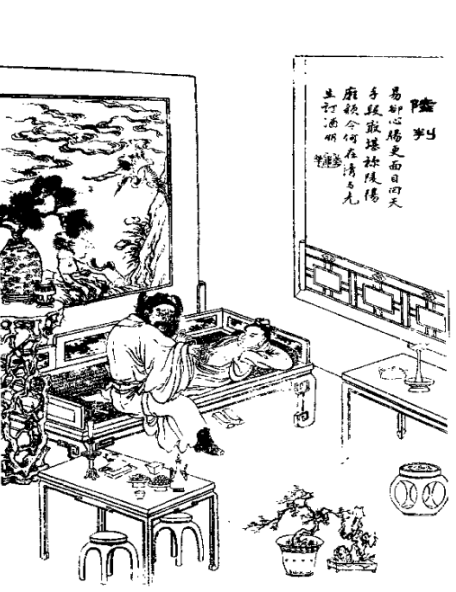
Chinese 文言
陵陽朱爾旦,字小明。性豪放。然素鈍,學雖篤,尚未知名。一日,文社眾飲。或戲之云:「君有豪名,能深夜赴十王殿,負得左廊判官來,眾當醵作筵。」蓋陵陽有十王殿,神鬼皆以木彫,妝飾如生。東廡有立判,綠面赤須,貌尤獰惡。或夜聞兩廊拷訊聲。入者,毛皆森豎。故眾以此難朱。朱笑起,徑去。居無何,門外大呼曰:「我請髯宗師至矣!」眾皆起。俄負判入,置幾上,奉觴,酹之三。眾睹之,瑟縮不安于座,仍請負去。朱又把酒灌地,祝曰:「門生狂率不文,大宗師應該不為怪。荒舍匪遙,合乘興來覓飲,幸勿為畛畦。」乃負之去。
次日,眾果招飲。抵暮,半醉而歸,興未闌,挑燈獨酌。忽有人搴簾入,視之,則判官也。朱起曰:「意吾殆將死矣!前夕冒瀆,今來加斧鑕耶?」判啟濃髯微笑曰:「非也。昨蒙高義相訂,夜偶暇,敬踐達人之約。」朱大悅,牽衣促坐,自起滌器爇火。判曰:「天道溫和,可以冷飲。」朱如命,置瓶案上,奔告家人治肴果。妻聞,大駭,戒勿出。朱不聽,立俟治具以出。易琖交酬,始詢姓氏。曰:「我陸姓,無名字。」與談古典,應答如響。問:「知制藝否?」曰:「妍媸亦頗辨之。陰司誦讀,與陽世略同。」陸豪飲,一舉十觥。朱因竟日飲,遂不覺玉山傾頹,伏几醺睡。比醒,則殘燭昏黃,鬼客已去。
自是三兩日輒一來,情益洽,時抵足臥。朱獻窗稿,陸輒紅勒之,都言不佳。一夜,朱醉,先寢,陸猶自酌。忽醉夢中,覺臟腹微痛;醒而視之,則陸危坐床前,破腔出腸胃,條條整理。愕曰:「夙無仇怨,何以見殺?」陸笑云:「勿懼,我為君易慧心耳。」從容納腸已,複合之,末以裹足布束朱腰。作用畢,視榻上亦無血跡。腹間覺少麻木。見陸置肉塊幾上。問之,曰:「此君心也。作文不快,知君之毛竅塞耳。適在冥間,于千萬心中,揀得佳者一枚,為君易之,留此以補闕數。」乃起,掩扉去。天明解視,則創縫已合,有線而赤者存焉。自是文思大進,過眼不忘。數日,又出文示陸。陸曰:「可矣。但君福薄,不能大顯貴,鄉﹑科而已。」問:「何時?」曰:「今歲必魁。」未幾,科試冠軍,秋闈果中經元。同社生素揶揄之;及見闈墨,相視而驚,細詢始知其異。共求朱先容,願納交陸。陸諾之。眾大設以待之。更初,陸至,赤髯生動,目炯炯如電。眾茫乎無色,齒欲相去;漸引去。
朱乃攜陸歸飲,既醺,朱曰:「湔腸伐胃,受賜已多。尚有一事欲相煩,不知可否?」陸便請命。朱曰:「心腸可易,面目想亦可更。山荊,予結髮人,下體頗亦不惡,但頭面不甚佳麗。尚欲煩君刀斧,如何?」陸笑曰:「諾,容徐圖之。」過數日,半夜來叩關。朱急起延入。燭之,見襟裹一物。詰之,曰:「君曩所囑,向艱物色。適得一美人首,敬報君命。」朱撥視,頸血猶溫。陸立促急入,勿驚禽犬。朱慮門戶夜扃。陸至,一手推扉,扉自外門內闢。引至臥室,見夫人側身眠。陸以頭授朱抱之;自于靴中出白刃如匕首,按夫人項,著力如切腐狀,迎刃而解,首落枕畔;急于生懷,取美人首合項上,詳審端正,而後按捺。已而移枕塞肩際,命朱瘞首靜所,乃去。朱妻醒,覺頸間微麻,而頰甲錯;搓之,得血片,甚駭。呼婢汲盥;婢見面血狼藉,驚絕。濯之,盆水盡赤。舉首則面目全非,又駭極。夫人引鏡自照,錯愕不能自解。朱入告之;因反覆細視,則長眉掩鬢,笑靨承顴,畫中人也。解領驗之,有紅線一周,上下肉色,判然而異。
先是,吳侍御有女甚美,未嫁而喪二夫,故十九猶未醮也。上元游十王殿,時遊人甚雜,內有無賴賊窺而艷之,遂陰訪居里,乘夜梯入,穴寢門,殺一婢于床下,逼女與淫;女力拒聲喊,賊怒,亦殺之。吳夫人微聞鬧聲,呼婢往視,見尸駭絕。舉家盡起,停尸堂上,置首項側,一門啼號,紛騰終夜。詰旦啟衾,則身在而失其首。遍撻侍女,謂所守不恪,致葬犬腹。侍御告郡。郡嚴限捕賊,三月而罪人弗得。漸有以朱家換頭之異聞吳公者。吳疑之,遣媼探諸其家;入見夫人,駭走以告吳公。公視女尸故存,驚疑無以自決。猜朱以左道殺女,往詰朱。朱曰:「室人夢易其首,實不解其何故;謂仆殺之,則冤也。」吳不信,訟之。收家人鞠之,一如朱言。郡守不能決。朱歸,求計于陸。陸曰:「不難,當使伊女自言之。」吳夜夢女曰:「兒為蘇溪楊大年所賊,無與朱孝廉。彼不艷于其妻,陸 判官取兒頭與之易之,是兒身死而頭生也。願勿相仇。」醒告夫人,所夢同。乃言于官。問,果有楊大年;執而械之,遂伏其罪。吳乃詣朱,請見夫人,由此為翁婿。乃以朱妻首合女尸而葬焉。
朱三入禮闈,皆以場規被放。於是灰心仕進,積三十年。一夕,陸告曰:「君壽不永矣。」問其期,對以王日。「能相救否?」曰:「惟天所命,人何能私?且自達人觀之,生死一耳,何必生之為樂,死之為悲?」朱以為然。即治衣衾棺槨;既竟,盛服而沒。翌日,夫人方扶柩哭,朱忽冉冉自外至。夫人懼。朱曰:「我誠鬼,不異生時。慮爾寡母孤兒,殊戀戀耳。」夫人大慟,涕垂膺;朱依依慰解之。夫人曰:「古有還魂之說,君既有靈,何不再生?」朱曰:「天數不可違也。」問:「在陰司作何務?」曰:「陸判荐我督案務,授有官爵,亦無所苦。」夫人欲再語,朱曰:「陸公與我同來,可設酒饌。」趨而出。夫人依言營備。但聞室中笑飲,亮氣高聲,宛若生前。半夜窺之,窅然已逝。自是三數日輒一來,時而留宿繾綣,家中事就便經紀。子瑋方五歲,來輒捉抱;至七八歲,則燈下教讀。子亦慧,九歲能文,十五入邑庠,竟不知無父也。從此來漸疏,日月至焉而已。又一夕來,謂夫人曰:「今與卿永訣矣。」問:「何往?」曰:「承帝命為太華卿,行將遠赴,事煩途隔,故不能來。」母子持之哭,曰:「勿爾!兒已成立,家計尚可存活,豈有百歲不拆之鸞鳳耶!」顧子曰:「好為人,勿墮父業。十年後一相見耳。」徑出門去,於是遂絕。
後瑋二十五,舉進士,官行人。奉命祭西岳,道經華陰,忽有輿從羽葆,馳衝鹵簿。訝之。審視車中人,其父也。下馬哭伏道左。父停輿曰:「官聲好,我目瞑矣。」瑋伏不起。朱促輿行,火馳不顧。去數步,回望,解佩刀遣人持贈。遙語曰:「佩之當貴。」瑋欲追從,見輿馬人從,飄忽若風,瞬息不見。痛恨良久。抽刀視之,製極精工,鐫字一行,曰:「膽欲大而心欲小,智欲圓而行欲方。」瑋後官至司馬。生五子,曰沉,曰潛,曰沕,曰渾,曰深。一夕,夢父曰:「佩刀宜贈渾也。」從之。渾仕為總憲,有政聲。
異史氏曰:「斷鶴續鳧,矯作者妄;移花接木,創始者奇;而況加鑿削于肝腸,施刀錐于頸項者哉!陸公者,可謂媸皮裹妍骨矣。明季至今,為歲不遠,陵陽陸公猶存乎?尚有靈焉否也?為之執鞭,所忻慕焉。」
English Giles 1880
At Ling-yang there lived a man named Chu Erh-tan, whose literary designation93 was Hsiao-ming. He was a fine manly fellow, but an egregious dunce, though he tried hard to learn. One day he was taking wine with a number of fellow-students, when one of them said to him, by way of a joke, “People credit you with plenty of pluck. Now, if you will go in the middle of the night to the Chamber of Horrors,94 and bring back the Infernal Judge from the left-hand porch, we’ll all stand you a dinner.” For at Ling-yang there was a representation of the Ten Courts of Purgatory, with the Gods and devils carved in wood, and almost life-like in appearance; and in the eastern vestibule there was a full-length image of the Judge with a green face, and a red beard, and a hideous expression in his features. Sometimes sounds of examination under the whip were heard to issue during the night from both porches, and persons who went in found their hair standing on end from fear; so the other young men thought it would be a capital test for Mr. Chu. Thereupon Chu smiled, and rising from his seat went straight off to the temple; and before many minutes had elapsed they heard him shouting outside, “His Excellency has arrived!” At this they all got up, and in came Chu with the image on his back, which he proceeded to deposit on the table, and then poured out a triple libation in its honour. His comrades who were watching what he did, felt ill at ease, and did not like to resume their seats; so they begged him to carry the Judge back again. But he first poured some wine upon the ground, invoking the image as follows:—“I am only a fool-hardy, illiterate fellow: I pray Your Excellency excuse me. My house is close by, and whenever Your Excellency feels so disposed I shall be glad to take a cup of wine with you in a friendly way.” He then carried the Judge back, and the next day his friends gave him the promised dinner, from which he went home half-tipsy in the evening. But not feeling that he had had enough, he brightened up his lamp, and helped himself to another cup of wine, when suddenly the bamboo curtain was drawn aside, and in walked the Judge. Mr. Chu got up and said, “Oh, dear! Your Excellency has come to cut off my head for my rudeness the other night.” The Judge parted his thick beard, and smiling, replied, “Nothing of the kind. You kindly invited me last night to visit you; and as I have leisure this evening, here I am.” Chu was delighted at this, and made his guest sit down, while he himself wiped the cups and lighted a fire.95 “It’s warm weather,” said the Judge; “let’s drink the wine cold.” Chu obeyed, and putting the bottle on the table, went out to tell his servants to get some supper. His wife was much alarmed when she heard who was there, and begged him not to go back; but he only waited until the things were ready, and then returned with them. They drank out of each other’s cups,96 and by-and-by Chu asked the name of his guest. “My name is Lu,” replied the Judge; “I have no other names.” They then conversed on literary subjects, one capping the other’s quotation as echo responds to sound. The Judge then asked Chu if he understood composition; to which he answered that he could just tell good from bad; whereupon the former repeated a little infernal poetry which was not very different from that of mortals. He was a deep drinker, and took off ten goblets at a draught; but Chu who had been at it all day, soon got dead drunk and fell fast asleep with his head on the table. When he waked up the candle had burnt out and day was beginning to break, his guest having already departed; and from this time the Judge was in the habit of dropping in pretty often, until a close friendship sprang up between them. Sometimes the latter would pass the night at the house, and Chu would show him his essays, all of which the Judge scored and underlined as being good for nothing. One night Chu got tipsy and went to bed first, leaving the Judge drinking by himself. In his drunken sleep he seemed to feel a pain in his stomach, and waking up he saw that the Judge, who was standing by the side of the bed, had opened him, and was carefully arranging his inside. “What harm have I done you?” cried Chu, “that you should thus seek to destroy me?” “Don’t be afraid,” replied the Judge, laughing, “I am only providing you with a more intelligent heart.”97 He then quietly put back Chu’s viscera, and closed up the opening, securing it with a bandage tied tightly round his waist. There was no blood on the bed, and all Chu felt was a slight numbness in his inside. Here he observed the Judge place a piece of flesh upon the table, and asked him what it was. “Your heart,” said the latter, “which wasn’t at all good at composition, the proper orifice being stuffed up.98 I have now provided you with a better one, which I procured from Hades, and I am keeping yours to put in its place.”99 He then opened the door and took his leave. In the morning Chu undid the bandage, and looked at his waist, the wound on which had quite healed up, leaving only a red seam. From that moment he became an apt scholar, and found his memory much improved; so much so, that a few days afterwards he showed an essay to the Judge for which he was very much commended. “However,” said the latter, “your success will be limited to the master’s degree. You won’t get beyond that.” “When shall I take it?” asked Chu. “This year,” replied the Judge. And so it turned out. Chu passed first on the list for the bachelor’s degree, and then among the first five for the master’s degree. His old comrades, who had been accustomed to make a laughing-stock of him, were now astonished to find him a full blown M.A., and when they learned how it had come about, they begged Chu to speak to the Judge on their behalf. The Judge promised to assist them, and they made all ready to receive him; but when in the evening he did come, they were so frightened at his red beard and flashing eyes that their teeth chattered in their heads, and one by one they stole away. Chu then took the Judge home with him to have a cup together, and when the wine had mounted well into his head, he said, “I am deeply grateful to Your Excellency’s former kindness in arranging my inside; but there is still another favour I venture to ask which possibly may be granted.” The Judge asked him what it was; and Chu replied, “If you can change a person’s inside, you surely could also change his face. Now my wife is not at all a bad figure, but she is very ugly. I pray Your Excellency try the knife upon her.” The Judge laughed, and said he would do so, only it would be necessary to give him a little time. Some days subsequently, the Judge knocked at Chu’s door towards the middle of the night; whereupon the latter jumped up and invited him in. Lighting a candle, it was evident that the Judge had something under his coat, and in answer to Chu’s inquiries, he said, “It’s what you asked me for. I have had great trouble in procuring it.” He then produced the head of a nice-looking young girl, and presented it to Chu, who found the blood on the neck was still warm. “We must make haste,” said the Judge, “and take care not to wake the fowls or dogs.”100 Chu was afraid his wife’s door might be bolted; but the Judge laid his hand on it and it opened at once. Chu then led him to the bed where his wife was lying asleep on her side; and the Judge, giving Chu the head to hold, drew from his boot a steel blade shaped like the handle of a spoon. He laid this across the lady’s neck, which he cut through as if it had been a melon, and the head fell over the back of the pillow. Seizing the head he had brought with him, he now fitted it on carefully and accurately, and pressing it down to make it stick, bolstered the lady up with pillows placed on either side. When all was finished, he bade Chu put his wife’s old head away, and then took his leave. Soon after Mrs. Chu waked up, and perceived a curious sensation about her neck, and a scaly feeling about the jaws. Putting her hand to her face, she found flakes of dry blood; and much frightened called a maid-servant to bring water to wash it off. The maid-servant was also greatly alarmed at the appearance of her face, and proceeded to wash off the blood, which coloured a whole basin of water; but when she saw her mistress’s new face she was almost frightened to death. Mrs. Chu took a mirror to look at herself, and was staring at herself in utter astonishment, when her husband came in and explained what had taken place. On examining her more closely, Chu saw that she had a well-featured pleasant face, of a medium order of beauty; and when he came to look at her neck, he found a red seam all round, with the parts above and below of a different coloured flesh. Now the daughter of an official named Wu was a very nice-looking girl who, though nineteen years of age, had not yet been married, two gentlemen who were engaged to her having died before the day.101 At the Feast of Lanterns,102 this young lady happened to visit the Chamber of Horrors, whence she was followed home by a burglar, who that night broke into the house and killed her. Hearing a noise, her mother told the servant to go and see what was the matter; and the murder being thus discovered, every member of the family got up. They placed the body in the hall, with the head alongside, and gave themselves up to weeping and wailing the livelong night. Next morning, when they removed the coverings, the corpse was there but the head had disappeared. The waiting-maids were accordingly flogged for neglect of duty, and consequent loss of the head, and Mr. Wu brought the matter to the notice of the Prefect. This officer took very energetic measures, but for three days no clue could be obtained; and then the story of the changed head in the Chu family gradually reached Mr. Wu’s ears. Suspecting something, he sent an old woman to make inquiries; and she at once recognised her late young mistress’s features, and went back and reported to her master. Thereupon Mr. Wu, unable to make out why the body should have been left, imagined that Chu had slain his daughter by magical arts, and at once proceeded to the house to find out the truth of the matter; but Chu told him that his wife’s head had been changed in her sleep, and that he knew nothing about it, adding that it was unjust to accuse him of the murder. Mr. Wu refused to believe this, and took proceedings against him; but as all the servants told the same story, the Prefect was unable to convict him. Chu returned home and took counsel with the Judge, who told him there would be no difficulty, it being merely necessary to make the murdered girl herself speak. That night Mr. Wu dreamt that his daughter came and said to him, “I was killed by Yang Ta-nien, of Su-ch‘i. Mr. Chu had nothing to do with it; but desiring a better-looking face for his wife, Judge Lu gave him mine, and thus my body is dead while my head still lives. Bear Chu no malice.” When he awaked, he told his wife, who had dreamt the same dream; and thereupon he communicated these facts to the officials. Subsequently, a man of that name was captured, who confessed under the bamboo that he had committed the crime; so Mr. Wu went off to Chu’s house, and asked to be allowed to see his wife, regarding Chu from that time as his son-in-law. Mrs. Chu’s old head was fitted on to the young lady’s body, and the two parts were buried together.
Subsequent to these events Mr. Chu tried three times for his doctor’s degree, but each time without success, and at last he gave up the idea of entering into official life. Then when thirty years had passed away, Judge Lu appeared to him one night, and said, “My friend, you cannot live for ever. Your hour will come in five days’ time.” Chu asked the Judge if he could not save him; to which he replied, “The decrees of Heaven cannot be altered to suit the purposes of mortals. Besides, to an intelligent man life and death are much the same.103 Why necessarily regard life as a boon and death as a misfortune?” Chu could make no reply to this, and forthwith proceeded to order his coffin and shroud;104 and then, dressing himself in his grave-clothes, yielded up the ghost. Next day, as his wife was weeping over his bier, in he walked at the front door, to her very great alarm. “I am now a disembodied spirit,” said Chu to her, “though not different from what I was in life; and I have been thinking much of the widow and orphan I left behind.” His wife, hearing this, wept till the tears ran down her face, Chu all the time doing his best to comfort her. “I have heard tell,” said she, “of dead bodies returning to life; and since your vital spark is not extinct, why does it not resume the flesh?” “The ordinances of Heaven,” replied her husband, “may not be disobeyed.” His wife here asked him what he was doing in the infernal regions; and he said that Judge Lu had got him an appointment as Registrar, with a certain rank attached, and that he was not at all uncomfortable. Mrs. Chu was proceeding to inquire further, when he interrupted her, saying, “The Judge has come with me; get some wine ready and something to eat.” He then hurried out, and his wife did as he had told her, hearing them laughing and drinking in the guest chamber just like old times come back again. About midnight she peeped in, and found that they had both disappeared; but they came back once in every two or three days, often spending the night, and managing the family affairs as usual. Chu’s son was named Wei, and was about five years old; and whenever his father came he would take the little boy upon his knee. When he was about eight years of age, Chu began to teach him to read; and the boy was so clever that by the time he was nine he could actually compose. At fifteen he took his bachelor’s degree, without knowing all this time that he had no father. From that date Chu’s visits became less frequent, occurring not more than once or so in a month; until one night he told his wife that they were never to meet again. In reply to her inquiry as to whither he was going, he said he had been appointed to a far-off post, where press of business and distance would combine to prevent him from visiting them any more. The mother and son clung to him, sobbing bitterly; but he said, “Do not act thus. The boy is now a man, and can look after your affairs. The dearest friends must part some day.” Then, turning to his son, he added, “Be an honourable man, and take care of the property. Ten years hence we shall meet again.” With this he bade them farewell, and went away.
Later on, when Wei was twenty-two years of age, he took his doctor’s degree, and was appointed to conduct the sacrifices at the Imperial tombs. On his way thither he fell in with a retinue of an official, proceeding along with all the proper insignia,105 and, looking carefully at the individual sitting in the carriage, he was astonished to find that it was his own father. Alighting from his horse, he prostrated himself with tears at the side of the road; whereupon his father stopped and said, “You are well spoken of. I now take leave of this world.” Wei remained on the ground, not daring to rise; and his father, urging on his carriage, hurried away without saying any more. But when he had gone a short distance, he looked back, and unloosing a sword from his waist, sent it as a present to his son, shouting out to him, “Wear this and you will succeed.” Wei tried to follow him; but, in an instant, carriage, retinue, and horses, had vanished with the speed of wind. For a long time his son gave himself up to grief, and then seizing the sword began to examine it closely. It was of exquisite workmanship, and on the blade was engraved this legend:—“Be bold, but cautious; round in disposition, square in action.”106 Wei subsequently rose to high honours, and had five sons named Ch‘ên, Ch‘ien, Wu, Hun, and Shên. One night he dreamt that his father told him to give the sword to Hun, which he accordingly did; and Hun rose to be a Viceroy of great administrative ability.
Giles’s notes
- Every Chinese man and woman inherits a family name or surname. A woman takes her husband’s surname, followed in official documents by her maiden name. Children usually have a pet name given to them soon after birth, which is dropped after a few years. Then there is the ming or name, which once given is unchangeable, and by which the various members of a family are distinguished. But only the father and mother and certain other relatives are allowed to use this. Friends call each other by their literary designations or “book-names,” which are given generally by the teacher to whom the boy’s education is first entrusted. Brothers and sisters and others have all kinds of nick-names as with us. Dogs and cats are called by such names as “Blackey,” “Whitey,” “Yellowy,” “Jewel,” “Pearly,” &c., &c. Junks are christened “Large Profits,” “Abounding Wealth,” “Favourite of Fortune,” &c., &c. Places are often named after some striking geographical feature; e.g., Hankow--“mouth of the Han river,” i.e., its point of junction with the Yang-tsze; or they have fancy names, such as Fuhkien--“happily established;” Tientsin--“Heaven’s ford;” or names implying a special distinction, such as Nanking--“southern capital;” Shan-tung--“east of the mountains,” &c. ↩
- The name given by foreigners in China to the imitation of the ten torture-chambers of purgatory, as seen in every Ch‘êng-huang or municipal temple. The various figures of the devil-lictors and the tortured sinners are made either of clay or wood, and painted in very bright colours; and in each chamber is depicted some specimen of the horrible tortures that wicked people will undergo in the world to come. I have given in the Appendix a translation of the “Yü-li-ch‘ao,” a celebrated Taoist work on this subject, which should at any rate be glanced at by persons who would understand the drift of some of these stories. ↩
- To heat the wine, which is almost invariably taken hot. ↩
- In token of their mutual good feeling. ↩
- The Chinese as a nation believe to this day that the heart is the seat of the intellect and the emotions. ↩
- The heart itself is supposed to be pierced by a number of “eyes,” which pass right through; and in physical and mental health these passages are believed to be clear. ↩
- See No. XII., note 87. ↩
- The Hsi-yüan-lu, a well-known work on Chinese medical jurisprudence, and an officially-authorised book, while giving an absurd antidote against a poison that never existed [see my Chinese Sketches, p. 190], gravely insists that it is to be prepared at certain dates only, “in some place quite away from women, fowls, and dogs.” ↩
- It was almost a wonder that she got a second fiancé, few people caring to affiance their sons in a family where such a catastrophe has once occurred. The death of an engaged girl is a matter of much less importance, but is productive of a very curious ceremony. Her betrothed goes to the house where she is lying dead and steps over the coffin containing her body, returning home with a pair of the girl’s shoes. He thus severs all connection with her, and her spirit cannot haunt him as it otherwise most certainly would. ↩
- Held annually on the 15th of the first Chinese month--i.e., at the first full moon of the year, when coloured lanterns are hung at every door. It was originally a ceremonial worship in the temple of the First Cause, and dates from about the time of the Han dynasty, or nearly two thousand years ago. ↩
- It was John Stuart Mill who pointed out that the fear of death is due to “the illusion of imagination, which makes one conceive oneself as if one were alive and feeling oneself dead” (The Utility of Religion). ↩
- “Boards of old age” and “Clothes of old age sold here” are common shop-signs in every Chinese city; death and burial being always, if possible, spoken of euphemistically in some such terms as these. A dutiful son provides, when he can afford it, decent coffins for his father and mother. They are generally stored in the house, sometimes in a neighbouring temple; and the old people take pleasure in seeing that their funeral obsequies are properly provided for, though the subject is never raised in conversation. Chinese coffins are beautifully made; and when the body has been in for a day or two, a candle is closely applied to the seams all round to make sure it is air-tight,--any crack, however fine, being easily detected by the flickering of the flame in the escaping gas. Thus bodies may be kept unburied for a long time, until the geomancer has selected an auspicious site for the grave. ↩
- Gongs, red umbrellas, men carrying boards on which the officer’s titles are inscribed in large characters, a huge wooden fan, &c., &c. ↩
- “Be like a cash” [see No. II., note 42] is a not uncommon saying among the Chinese, the explanation of which rests upon the fact that a cash is “round in shape and convenient for use,” which words are pronounced identically with a corresponding number of words meaning “round in disposition, square in action.” It is, in fact, a play on words. ↩
English: Herbert A. Giles, Strange Stories from a Chinese Studio, vol. 1 (London: Thos. de la Rue, 1880), public domain, text via Project Gutenberg #43627. Footnotes are Giles’s. Chinese: 蒲松齡《聊齋志異》, public domain, text via Chinese Wikisource (modern editors’ glosses and the Qing commentaries are left out, and variant readings follow the first reading given).