
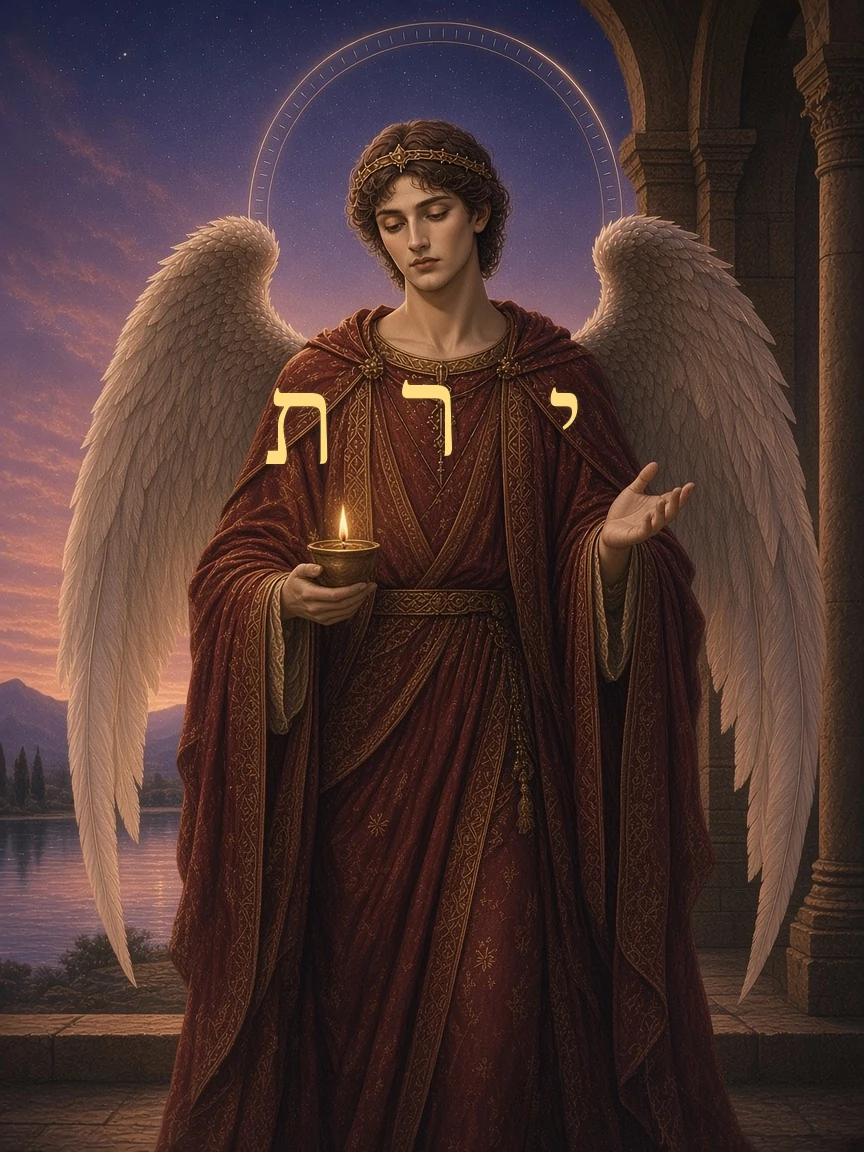
The 72 angels of the Name · number 27 · Dominions
Ierathel ירת
Also known as Ierathel · ירת (the three letters) (sources under “Also known as” below)
Name: the triad ירת with an angelic ending.
Tracing the name backward
We go backward from the newest source to the oldest dated one, and step back only where a dated text or a published scholarly link anchors the step. Unproven or second-hand links are drawn dashed and marked. Raziel’s full chart is on his page.
Rest the pointer on a section to open it; click to keep it open.Tap a section to open it; tap again to close.
Name originwhat the name means and how it was built
One of the 72 “names” read out of Exodus 14:19–21. The triad ירת is taken letter by letter from the three verses; Renaissance Christian kabbalists (Reuchlin 1517; Agrippa 1533) turned each triad into an angel by adding -el or -iah.
- Choir Dominions
- Degrees of the zodiac 131°–135°
- Psalm verse Ps 140:2 Vulg. Ps 139:2
From Lenain (1823), as set out in the Sanctuary’s table of the 72.
Earliest sourcesthe name traced backward, with dated anchors
Solid = a link anchored in a dated sourceDashed = unproven, second-hand or a later equationNewest at the top; each step goes back in time. Tap any box to open its anchor.
- 1823
IerathelLenain, La Science cabalistique (Paris 1823; BIU Santé Ms 5365)Medium
Lenain gives each of the 72 a choir, five degrees of the zodiac and a psalm verse, as listed in the Sanctuary’s table of the 72.
older
- 1652–1654
the 72 in a circleKircher, Oedipus Aegyptiacus II.1Medium
Kircher draws the 72 names as a great circle. Unverified for this name until the Hall reads Kircher’s plate.
older
- 1533 (English 1651)
IerathelAgrippa, Three Books of Occult Philosophy III.25, table of the 72High
The table of the 72 angels, each formed by adding -el or -iah to a triad of letters. Read Agrippa, De occulta philosophia, Cologne 1533 (Library).
older
- 1517
the triad becomes an angel’s nameJohannes Reuchlin, De arte cabalistica, Book IIIHigh
The oldest dated source the Hall relies on for the angel-names of the 72 (as on the Sanctuary’s Lauviah page). Before this there are only the letters.
the letters, not yet an angel
- 11th c.
ירת as one of the 72 namesRashi on Sukkah 45aHigh
Rashi explains the 72 names as read from the three verses of Exodus 14:19–21, “each of 72 letters”: the first letter of the first verse, the last of the middle verse and the first of the last, “and so on in this order”; the first name is והו (Hall translation; Sefaria).
read out of three verses
- the verses themselves
Exodus 14:19–21three verses of 72 letters eachHigh
Letter 27 of verse 19, letter 27 counted from the end of verse 20, and letter 27 of verse 21, by Rashi’s rule. Hall check Computed from the Hebrew consonantal text of Exodus 14:19–21 (Sefaria, “Tanach with Text Only”; 72 letters in each verse): letter 27 of verse 19 is י, letter 27 from the end of verse 20 is ר, letter 27 of verse 21 is ת (final forms normalised). All 72 triads in the Sanctuary table match this count. Read Exodus in Gutenberg Bible: Exodus, Psalms and more (Library).
no anchor
The trail endsNo angel named Ierathel before Reuchlin (1517)No anchor
Before the Renaissance there are the letters and the method, but no angel of this name.
Also known asother names the sources give
Also known as Ierathel1 · ירת (the three letters)2
Sources for these names
- Lenain 1823 (Sanctuary table of the 72)
- Exodus 14:19–21 by Rashi’s rule (on Sukkah 45a)
Comparisonssimilar figures, where scholars draw the link
- The decans (House note). Lenain gives each of the 72 five degrees of the zodiac (72 × 5 = 360), so two of them make one 10° decan, the old Egyptian star-division (Neugebauer & Parker). That is arithmetic and the Hall’s own note, not a scholar’s identification.
Comparisons are listed only where a scholar makes the link, or are marked as the Hall’s own note. A parallel of role is not a lineage of name.
Further readingbooks in Raziel’s Library and beyond
Unverified and sourceswhat is still to check, and every source
Unverified
- Unverified Kircher plate not yet read for this name
Sources
- Rashi on Sukkah 45a (Sefaria)
- Reuchlin, De arte cabalistica (1517), Book III
- Agrippa, Three Books of Occult Philosophy III.25 (1533; English 1651)
- Kircher, Oedipus Aegyptiacus (1652–54)
- Lenain, La Science cabalistique (1823)
Hover or tap to turn the card.
- Name
- Ierathel, “God who punishes the wicked” (Dieu qui punit les méchants); called Téos Revival Lenain 1823, pp. 62–63: “Il correspond au saint nom Téos, suivant la langue des Coptes”
- Letters
- ירת (Yod, Resh, Tav) → ירתאל Renaissance Exodus 14:19–21, letter 27 of each verse (v. 20 backward); Reuchlin 1517
- Number
- 27 of 72 Renaissance Reuchlin 1517 III; Agrippa III.25 table (English 1651: Ierathel)
- Order
- Dominions, the fourth choir (angels 25–32) Revival Lenain 1823, p. 61: through the 32nd
- Word (psalm)
- Reuchlin and the Hall Shem 72 table give Psalm 140:2 (Vulg. 139:2), Eripe me, Domine, ab homine malo; a viro iniquo eripe me. Lenain 1823, pp. 62–63, calls it the 1st verse of psalm 139 and quotes that same Latin (Vulgate 139:1 is the title in some countings; 139:2 is the first verse of the psalm proper). The quotation and the table agree; the verse number is a matter of how the title is counted. Ancient Lenain 1823; Reuchlin 1517; Hall Shem 72
- Domain
- The propagation of lights (enlightenment), civilization and liberty Revival Lenain 1823, p. 63
- Gifts
- To confound the wicked and calumniators, and to be delivered from our enemies; he protects against those who provoke us and attack us unjustly Revival Lenain 1823, p. 63
- Those born under him
- Will love peace, justice, the sciences and the arts, and will distinguish themselves in literature Revival Lenain 1823, p. 63
- Shadow
- Lenain’s contrary genius rules ignorance, slavery and intolerance. This is a separate spirit, not Ierathel Revival Lenain 1823, p. 63
- Heaven
- Jupiter; the fourteenth decade, genie Hépê; degrees 131°–135°, inclusive Revival Lenain 1823, p. 62
- Days
- 15 April, 26 June, 6 September, 17 November, 28 January Revival Lenain 1823, p. 62
- Hour
- From 8:40 to 9:00 in the morning Revival Lenain 1823, p. 62
- Colours
- No source gives Ierathel a colour. Lenain places him under Jupiter, but names no colour for him House Not attested
- Incense
- None for Ierathel himself House Not attested
- Seal
- His three letters ירת, as printed by Reuchlin and set by Kircher in the 72-names plate (1653). The “seals” of the 72 sold today are modern Renaissance Reuchlin 1517; Kircher 1653
- Feast
- None in any calendar; Lenain’s five days above Revival Lenain 1823
Persona: as the books describe him
The books give Ierathel no body and no face; he is known by what he does. Lenain sets him among the Dominions (angels 25–32). He is “God who punishes the wicked.” He serves to confound the wicked and calumniators, and to be delivered from our enemies; he protects against those who provoke us and attack us unjustly. He rules the propagation of lights, civilization and liberty. Those born under him will love peace, justice, the sciences and the arts, and will distinguish themselves in literature (Lenain 1823, pp. 62–63). Revival
The name Téos comes from Lenain, “following the language of the Copts” (p. 62). The Sanctuary’s existing card already speaks of Ierathel as “he”. Lenain writes “il”. The psalm he quotes is the Hall verse; he numbers it the 1st of psalm 139. House
On the other shelves
Each source holds only part of the picture. What follows was read on the Hall’s own shelves, or marked as not attested when it was not found. Nothing here is invented.
- Sefer Raziel ha-Malakh (Amsterdam 1701; Hall English, Book of the Angel Raziel, pp. 55–64) glosses the three letters as a Name, not as a portrait of the later angel. It “teaches that all of it moves, but He does not move from His place for ever. And its secret: in His unity, for He endures for ever. Its joining teaches two attributes which receive one from the other, up to Paḥad (Fear). Its form teaches that everything will be joined in the Yod, and in its bent tip, which does not move for ever.” Revival
- Agrippa III.25 (English 1651, Hall library): lists him as Ierathel among the seventy-two angels “bearing the name of God, Schemhamphorse.” The table gives the name only. Renaissance
- Reuchlin 1517 and the Hall Shem 72 table: the triad, and Psalm 140:2 (Vulg. 139:2), which is the verse Lenain quotes as the 1st of psalm 139. Renaissance
- Kircher, Oedipus Aegyptiacus II.1 (1653), the 72-names plate: the three letters. Renaissance
- Sefer Yetzirah and the Testament of Solomon: no entry under the name Ierathel. House Not attested
- Key of Solomon and the Hygromanteia: no per-angel office, likes, colour or incense for Ierathel. House Not attested
- The Lemegeton / Goetia (Hall): a different list of seventy-two spirits. Ierathel is not among them. The two lists are not to be mixed. House
- The Zohar and the Bahir are not yet on the Hall shelves as readable editions. No passage on Ierathel was taken from them. Unverified