
Chinese shelf · Pu Songling · 聊齋志異 · Giles XXIV · Tale 24
阿寶 · Miss A-pao; or, Perseverance RewardedA Bao · Giles 1880, vol. 1, no. XXIV
Public domain. Pu Songling (1640–1715). Translated by Herbert A. Giles, 1880. Giles sometimes shortened or softened passages, so the two columns do not always match line for line.
Chinese 文言
粵西孫子楚,名士也。生有枝指。性迂訥,人誑之,輒信為真。或值座有歌妓,則必遙望卻走。或知其然,誘之來,使妓狎逼之,則赬顏徹頸,汁珠珠下滴,因共為笑。遂貌其呆狀,相郵傳作丑語,而名之「孫痴」。
邑大賈某翁,與王侯埒富。姻戚皆貴胃。有女阿寶,絕色也。日擇良匹,大家兒爭委禽妝,皆不當翁意。生時失儷,有戲之者,勸其通媒。生殊不自揣,果從其數。翁素耳其名,而貧之。媒媼將出,適遇寶,問之,以告。女戲曰:「渠去其枝指,余當歸之。」媼告生。生曰:「不難。」媒去,生以斧自斷其指,大痛徹心,血益傾注,濱死。過數日,始能起,往見媒而示之。媼驚,奔告女。女亦奇之,戲請再去其痴。生聞而嘩辨,自謂不痴;然無由見而自剖。轉念阿寶未必美如天人,何遂高自位置如此?由是曩念頓冷。
會值清明,俗於是日,婦女出游,輕薄少年,亦結隊隨行,恣其月旦,有同社數人,強邀生去。或嘲之曰:「莫欲一觀可人否?」生亦知其戲己;然以受女揶揄故,亦思一見其人,忻然隨眾物色之。遙見有女子憩樹下,惡少年環如牆堵。眾曰:「此必阿寶也。」趨之,果寶也。審諦之,娟麗無雙。少頃,人益稠。女起,遽去。眾情顛倒,品頭題足,紛紛若狂。生獨默然。及眾他適,回視,生猶痴立故所,呼之不應。群曳之曰:「魂隨阿寶去耶?」亦不答。眾以其素訥,故不為怪,或推之﹑或挽之以歸。至家,直上床臥,終日不起,冥如醉,喚之不醒。家人疑其失魂,招于曠野,莫能效。強拍問之,則矇矓應云:「我在阿寶家。」及細詰之,又默不語。家人惶惑莫解。
初,生見女去,意不忍舍,覺身已從之行,漸傍其衿帶間,人無呵者。遂從女歸,坐臥依之,夜輒與狎,甚相得;然覺腹中奇餒,思欲一返家門,而迷不知路。女每夢與人交,問其名,曰:「我孫子楚也。」心異之,而不可以告人。生臥三日,氣休休若將澌滅。家人大恐,託人婉告翁,欲一招魂其家。翁笑曰:「平昔不相往還,何由遺魂吾家?」家人固哀之,翁始允。巫執故服﹑草荐以往。女詰得其故,駭極,不聽他往,直導入室,任招呼而去。巫歸至門,生榻上已呻。既醒,女室之香奩什具,何色何名,歷言不爽。女聞之,益駭,陰感其情之深。
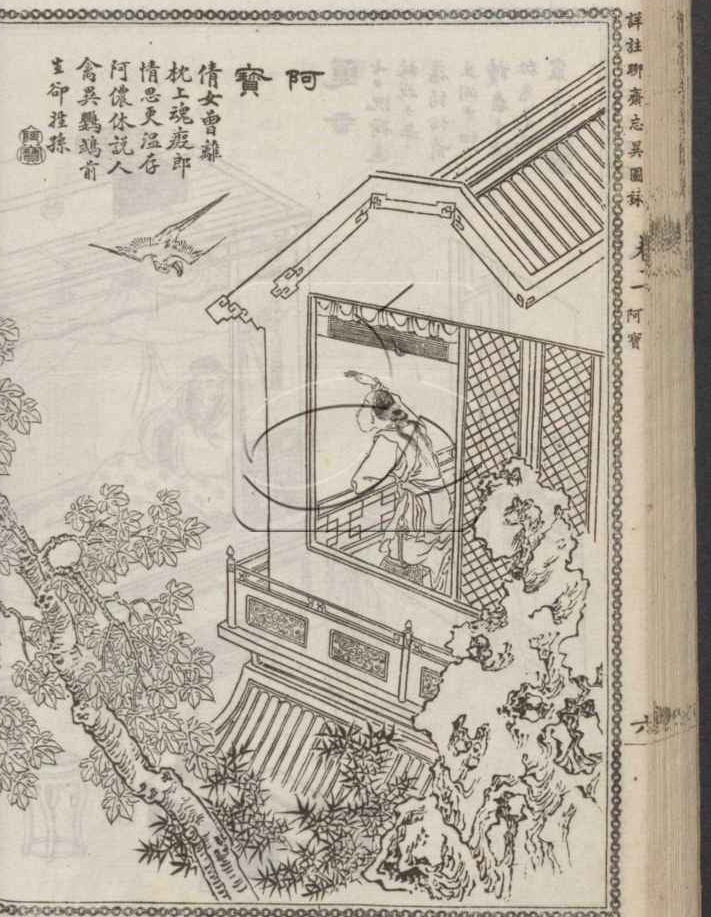
生既離床寢,坐立凝思,忽忽若忘。每伺察阿寶,希幸一再遘之。浴佛節,聞將降香水月寺,遂早旦往候道左,目眩睛勞。日涉午,女始至,自車中窺見生,以摻手搴帘,凝睇不轉。生益動,尾從之。女忽命青衣來詰姓字。生慇懃自展,魂益搖。車去,始歸。歸復病,冥然絕食,夢中輒呼寶名。每自恨魂不復靈。家舊養一鸚鵡,忽斃,小兒持弄于床。生自念:倘得身為鸚鵡,振翼可達女室。心方注想,身已翩然鸚鵡,遽飛而去,直達寶所。女喜而扑之,鎖其肘,飼以麻子。大呼曰:「姐姐勿鎖!我孫子楚也。」女大駭,解其縛,亦不去。女祝曰:「深情已篆中心。今已人禽異類,姻好何可復圓?」鳥云:「得近芳澤,于願已足。」他人飼之,不食;女自飼之,則食。女坐,則集其膝;臥,則依其床。如是三日。女甚憐之,陰使人目間生,生則僵臥,氣絕已三日,但心頭未冰耳。女又祝曰:「君能復為人,當誓死相從。」鳥云:「誑我!」女乃自矢。鳥側目若有所思。少間,女束雙彎,解履床下,鸚鵡驟下,銜履飛去。女急呼之,飛已遠矣。女使嫗往探,則生已寤。家人見鸚鵡銜繡履來,墮地死,方共異之。生既蘇,即索履。眾莫知故。適嫗至,入視生,問履所在。生曰:「是阿寶信誓物。借口相覆:小生不忘金諾也。」嫗反命。女益奇之,故使婢泄其情于母。母審之確,乃曰:「此子才名亦不惡,但有相如之貧。擇數年得婿若此,恐將為顯者笑。」女以履故,矢不他。翁媼從之。馳報行。生喜,疾頓瘳。翁議贅諸家。女曰:「婿不可久處岳家。況郎又貧,久益為人賤。兒既諾之,處蓬茅而甘藜藿,不怨也。」生乃亦迎成禮,相逢如隔世歡。
自是家得奩妝,小阜,頗增物產。而生痴于書,不知理家人生業;女善居積,亦不以他事累生。居三年,家益富。生忽病消渴卒。女哭之痛,淚眼不晴,至絕眠食。勸之不納,乘夜自經。婢覺之,急救以醒,終亦不食。三日,集親黨,將以殮生。聞棺中呻以息,啟之,已復活。自言:「見冥王,以生平朴誠,命作部曹。忽有人白:「孫部曹之妻將至。」王稽鬼錄,言:「此未應便死。」又白:「不食三日矣。」王顧謂:「感汝妻節義,姑賜再生。」因使馭卒控馬送余還。」由是體漸平。值歲大比,入闈之前,諸少年玩弄之,共擬隱僻之題七,引生僻處與語,言:「此某家關節,敬秘相授。」生信之,晝夜揣摩,制成七藝。眾隱笑之。時典試者慮熟題有蹈襲弊,力反常經,題紙下,七藝皆符。生以是掄魁。明年,舉進士,授詞林。上聞異,召問之。生具啟奏。上大嘉悅。後召見阿寶,賞賚有加焉。
異史氏曰:「性痴則其志凝,故書痴者文必工,藝痴者技必良;世之落拓而無成者,皆自謂不痴者也。且如粉花蕩產,盧雉傾家,顧痴人事哉!以是知慧黠而過,乃是真痴,彼孫子何痴乎!」
集痴類十:「窖鏹食貧。對客輒誇兒慧。愛兒不忍教讀。諱病恐人知。出資賺人嫖。竊赴飲會賺人賭。倩人作文欺父兄。父子帳目太清。家庭用機械。喜弟子善賭。」
English Giles 1880
In the province of Kuang-si there lived a scholar of some reputation, named Sun Tzŭ-ch‘u. He was born with six fingers, and such a simple fellow was he that he readily believed any nonsense he was told. Very shy with the fair sex, the sight of a woman was enough to send him flying in the opposite direction; and once when he was inveigled into a room where there were some young ladies, he blushed down to his neck and the perspiration dripped off him like falling pearls. His companions laughed heartily at his discomfiture, and told fine stories of what a noodle he looked, so that he got the nickname of Silly Sun.
In the town where our hero resided, there was a rich trader whose wealth equalled that of any prince or nobleman, and whose connections were all highly aristocratic.156 He had a daughter, A-pao, of great beauty, for whom he was seeking a husband; and the young men of position in the neighbourhood were vying with each other to obtain her hand, but none of them met with the father’s approval. Now Silly Sun had recently lost his wife; and some one in joke persuaded him to try his luck and send in an application. Sun, who had no idea of his own shortcomings, proceeded at once to follow this advice; but the father, though he knew him to be an accomplished scholar, rejected his suit on the ground of poverty. As the go-between157 was leaving the house, she chanced to meet A-pao, and related to her the object of her visit. “Tell him,” cried A-pao, laughing, “that if he’ll cut off his extra finger, I’ll marry him.” The old woman reported this to Sun, who replied, “That is not very difficult;” and, seizing a chopper, cut the finger clean off. The wound was extremely painful and he lost so much blood that he nearly died, it being many days before he was about again. He then sought out the go-between, and bade her inform Miss A-pao, which she did; and A-pao was taken rather aback, but she told the old woman to go once more and bid him cut off the “silly” from his reputation. Sun got much excited when he heard this, and denied that he was silly; however, as he was unable to prove it to the young lady herself, he began to think that probably her beauty was over-stated, and that she was giving herself great airs. So he ceased to trouble himself about her until the following spring festival,158 when it was customary for both men and women to be seen abroad, and the young rips of the place would stroll about in groups and pass their remarks on all and sundry. Sun’s friends urged him to join them in their expedition, and one of them asked him with a smile if he did not wish to look out for a suitable mate. Sun knew they were chaffing him, but he thought he should like to see the girl that had made such a fool of him, and was only too pleased to accompany them. They soon perceived a young lady resting herself under a tree, with a throng of young fellows crowding round her, and they immediately determined that she must be A-pao, as in fact they found she was. Possessed of peerless beauty, the ring of her admirers gradually increased, till at last she rose up to go. The excitement among the young men was intense; they criticised her face and discussed her feet,159 Sun only remaining silent; and when they had passed on to something else, there they saw Sun rooted like an imbecile to the same spot. As he made no answer when spoken to, they dragged him along with them, saying, “Has your spirit run away after A-pao?” He made no reply to this either; but they thought nothing of that, knowing his usual strangeness of manner, so by dint of pushing and pulling they managed to get him home. There he threw himself on the bed and did not get up again for the rest of the day, lying in a state of unconsciousness just as if he were drunk. He did not wake when called; and his people, thinking that his spirit had fled, went about in the fields calling out to it to return.160 However, he shewed no signs of improvement; and when they shook him, and asked him what was the matter, he only answered in a sleepy kind of voice, “I am at A-pao’s house;” but to further questions he would not make any reply, and left his family in a state of keen suspense.
Now when Silly Sun had seen the young lady get up to go, he could not bear to part with her, and found himself first following and then walking along by her side without anyone saying anything to him. Thus he went back with her to her home, and there he remained for three days, longing to run home and get something to eat, but unfortunately not knowing the way. By that time Sun had hardly a breath left in him; and his friends, fearing that he was going to die, sent to beg of the rich trader that he would allow a search to be made for Sun’s spirit in his house. The trader laughed and said, “He wasn’t in the habit of coming here, so he could hardly have left his spirit behind him;” but he yielded to the entreaties of Sun’s family, and permitted the search to be made. Thereupon a magician proceeded to the house, taking with him an old suit of Sun’s clothes and some grass matting; and when Miss A-pao heard the reason for which he had come, she simplified matters very much by leading the magician straight to her own room. The magician summoned the spirit in due form, and went back towards Sun’s house. By the time he had reached the door, Sun groaned and recovered consciousness; and he was then able to describe all the articles of toilette and furniture in A-pao’s room without making a single mistake. A-pao was amazed when the story was repeated to her, and could not help feeling kindly towards him on account of the depth of his passion. Sun himself, when he got well enough to leave his bed, would often sit in a state of abstraction as if he had lost his wits; and he was for ever scheming to try and have another glimpse at A-pao.
One day he heard that she intended to worship at the Shui-yüeh temple on the 8th of the fourth moon, that day being the Wash-Buddha festival; and he set off early in the morning to wait for her at the roadside. He was nearly blind with straining his eyes, and the sun was already past noontide before the young lady arrived; but when she saw from her carriage a gentleman standing there, she drew aside the screen and had a good stare at him. Sun followed her in a great state of excitement, upon which she bade one of her maids to go and ask his name. Sun told her who he was, his perturbation all the time increasing; and when the carriage drove on he returned home. Again he became very ill, and lay on his bed unconscious, without taking any food, occasionally calling on A-pao by name, at the same time abusing his spirit for not having been able to follow her as before. Just at this juncture a parrot that had been long with the family died; and a child, playing with the body, laid it upon the bed. Sun then reflected that if he was only a parrot one flap of his wings would bring him into the presence of A-pao; and while occupied with these thoughts, lo! the dead body moved and the parrot flew away. It flew straight to A-pao’s room, at which she was delighted; and catching it, tied a string to its leg, and fed it upon hemp-seed. “Dear sister,” cried the bird, “do not tie me by the leg: I am Sun Tzŭ-ch‘u.” In great alarm A-pao untied the string, but the parrot did not fly away. “Alas!” said she, “your love has engraved itself upon my heart; but now you are no longer a man, how shall we ever be united together?” “To be near your dear self,” replied the parrot, “is all I care about.” The parrot then refused to take food from anyone else, and kept close to Miss A-pao wherever she went, day and night alike. At the expiration of three days, A-pao, who had grown very fond of her parrot, secretly sent some one to ask how Mr. Sun was; but he had already been dead three days, though the part over his heart had not grown cold. “Oh! come to life again as a man,” cried the young lady, “and I swear to be yours for ever.” “You are surely not in earnest,” said the parrot, “are you?” Miss A-pao declared she was, and the parrot, cocking its head aside, remained some time as if absorbed in thought. By-and-by A-pao took off her shoes to bind her feet a little tighter;161 and the parrot, making a rapid grab at one, flew off with it in its beak. She called loudly after it to come back, but in a moment it was out of sight; so she next sent a servant to inquire if there was any news of Mr. Sun, and then learnt that he had come round again, the parrot having flown in with an embroidered shoe and dropped down dead on the ground. Also, that directly he regained consciousness he asked for the shoe, of which his people knew nothing; at which moment her servant had arrived, and demanded to know from him where it was. “It was given to me by Miss A-pao as a pledge of faith,” replied Sun; “I beg you will tell her I have not forgotten her promise.” A-pao was greatly astonished at this, and instructed her maid to divulge the whole affair to her mother, who, when she had made some inquiries, observed that Sun was well known as a clever fellow, but was desperately poor, and “to get such a son-in-law after all our trouble would give our aristocratic friends the laugh against us.”162 However, A-pao pleaded that with the shoe there as a proof against her, she would not marry anybody else; and, ultimately, her father and mother gave their consent. This was immediately announced to Mr. Sun, whose illness rapidly disappeared in consequence. A-pao’s father would have had Sun come and live with them;163 but the young lady objected, on the score that a son-in-law should not remain long at a time with the family of his wife,164 and that as he was poor he would lower himself still more by doing so. “I have accepted him,” added she, “and I shall gladly reside in his humble cottage, and share his poor fare without complaint.” The marriage was then celebrated, and bride and bridegroom met as if for the first time in their lives.165 The dowry A-pao brought with her somewhat raised their pecuniary position, and gave them a certain amount of comfort; but Sun himself stuck only to his books, and knew nothing about managing affairs in general. Luckily his wife was clever in that respect, and did not bother him with such things; so much so that by the end of three years they were comparatively well off, when Sun suddenly fell ill and died. Mrs. Sun was inconsolable, and refused either to sleep or take nourishment, being deaf to all entreaties on the subject; and before long, taking advantage of the night, she hanged herself.166 Her maid, hearing a noise, ran in and cut her down just in time: but she still steadily refused all food. Three days passed away, and the friends and relatives of Sun came to attend his funeral, when suddenly they heard a sigh proceeding forth from the coffin. The coffin was then opened and they found that Sun had come to life again. He told them that he had been before the Great Judge, who, as a reward for his upright and honourable life, had conferred upon him an official appointment. “At this moment,” said Sun, “it was reported that my wife was close at hand,167 but the Judge, referring to the register, observed that her time had not yet come. They told him she had taken no food for three days; and then the Judge, looking at me, said that as a recompense for her wifely virtues she should be permitted to return to life. Thereupon he gave orders to his attendants to put to the horses and see us safely back.” From that hour Sun gradually improved, and the next year went up for his master’s degree. All his old companions chaffed him exceedingly before the examination, and gave him seven themes on out-of-the-way subjects, telling him privately that they had been surreptitiously obtained from the examiners. Sun believed them as usual, and worked at them day and night until he was perfect, his comrades all the time enjoying a good laugh against him. However, when the day came it was found that the examiners, fearing lest the themes they had chosen in an ordinary way should have been dishonestly made public,168 took a set of fresh ones quite out of the common run—in fact, on the very subjects Sun’s companions had given to him. Consequently, he came out at the head of the list; and the next year, after taking his doctor’s degree, he was entered among the Han-lin Academicians.169 The Emperor, too, happening to hear of his curious adventures, sent for him and made him repeat his story; subsequently, summoning A-pao and making her some very costly presents.
Giles’s notes
- There is nothing in China like an aristocracy of birth. Any man may raise himself from the lowest level to the highest; and as long as he and his family keep themselves there, they may be considered aristocratic. Wealth has nothing to do with the question; official rank and literary tastes, separate or combined, these constitute a man’s title to the esteem of his fellows. Trade is looked upon as ignoble and debasing; and friendly intercourse between merchants and officials, the two great social divisions, is so rare as to be almost unknown. ↩
- The medium, without whose good offices no marriage can be arranged. Generally, but not always, a woman. ↩
- See No. II., note 41. ↩
- The so-called “golden lilies” always come in for a large share of criticism. See No. XII., note 86. This term originated with an emperor who reigned in the fifth century, when, in ecstasies at the graceful dancing of a concubine upon a stage ornamented with lilies, he cried out, “Every footstep makes a lily grow.” ↩
- A common custom; e.g. in the case of a little child lying dangerously ill, its mother will go outside the door into the garden or field, and call out its name several times, in the hope of bringing back the wandering spirit. ↩
- This process must be regularly gone through night and morning, otherwise the bandages become loose, and the gait of the walker unsteady. ↩
- I have explained before that any great disparity of means is considered an obstacle to a matrimonial alliance between two families. ↩
- This is a not unusual arrangement in cases where there are other sons in the bridegroom’s family, but none in that of the bride’s, especially if the advantage of wealth is on the side of the latter. ↩
- Such is the Chinese rule, adopted simply with a view to the preservation of harmony. ↩
- They are supposed never to see each other before the wedding-day; but, after careful investigation of the subject, I have come to the conclusion that certainly in seven cases out of ten, the intended bridegroom secretly procures a sight of his future wife. I am now speaking of the higher classes; among the poor, both sexes mix almost as freely as with us. ↩
- This would still be considered a creditable act on the part of a Chinese widow. It is, however, of exceedingly rare occurrence. ↩
- Being nearly dead from hanging. ↩
- This is occasionally done, great influence or a heavy bribe being brought to bear upon the Examiners, of whom there are only two for the Master’s degree, and the second of these, or Assistant-Examiner, holds but a subordinate position. See Appendix A, and No. LXXV., note 71. ↩
- Admission to the Han-lin, or Chinese National Academy, is the highest honour obtainable by a scholar. Its members are employed in drawing up Government documents, histories, etc. ↩
English: Herbert A. Giles, Strange Stories from a Chinese Studio, vol. 1 (London: Thos. de la Rue, 1880), public domain, text via Project Gutenberg #43627. Footnotes are Giles’s. Chinese: 蒲松齡《聊齋志異》, public domain, text via Chinese Wikisource (modern editors’ glosses and the Qing commentaries are left out, and variant readings follow the first reading given).