
Chinese shelf · Pu Songling · 聊齋志異 · Giles V · Tale 5
勞山道士 · The Taoist Priest of Lao-shanLaoshan daoshi · Giles 1880, vol. 1, no. V
Public domain. Pu Songling (1640–1715). Translated by Herbert A. Giles, 1880. Giles sometimes shortened or softened passages, so the two columns do not always match line for line.
Chinese 文言
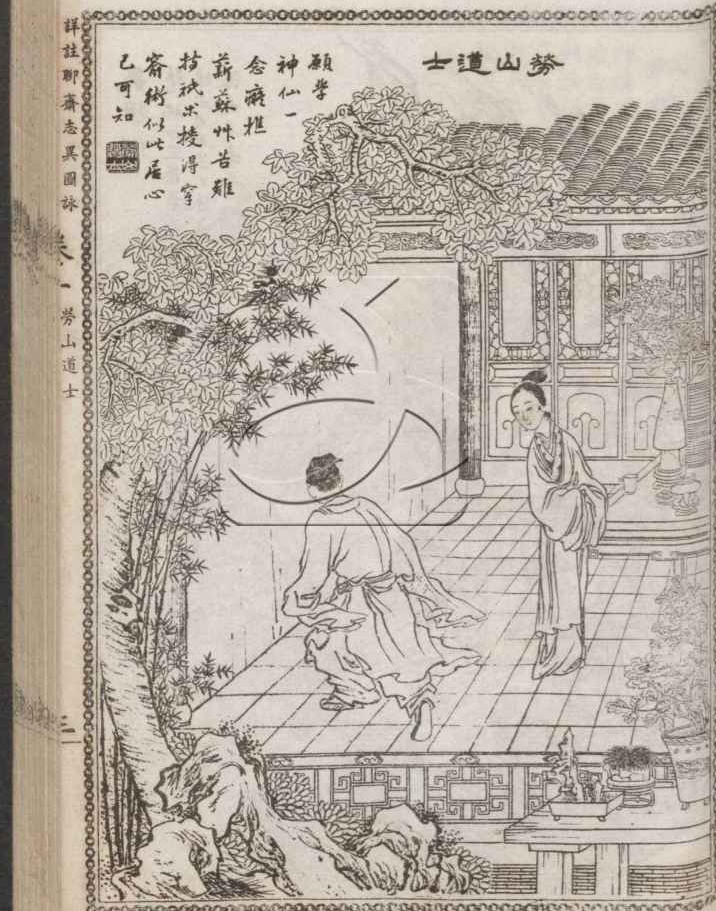
邑有王生行七,故家子。少慕道,聞勞山多仙人,負笈往遊,登一頂,有觀宇,甚幽。一道士坐蒲團上,素髮垂領,而神觀爽邁。叩而與語,理甚玄妙,請師之。道士曰:「恐嬌惰不能作苦。」答言:「能之。」其門人甚眾,薄暮畢集,王俱與稽首,遂留觀中。
凌晨,道士呼王去,授以斧,使隨眾採樵,王謹受教。過月餘,手足重繭,不堪其苦,陰有歸志。一夕歸,見二人與師共酌,日已暮,尚無燈燭,師乃剪紙如鏡,粘壁間,俄頃,月明輝壁,光鑒毫芒,諸門人環聽奔走。一客曰:「良宵勝樂,不可不同。」乃於案上取壺酒,分賚諸徒,且囑盡醉。王自思:「七八人,壺酒何能徧給?」遂各覓盎盂,競飲先釂,惟恐樽盡,而往復挹注,竟不少減,心奇之。俄一客曰:「蒙賜月明之照,乃爾寂飲,何不呼嫦娥來?」乃以箸擲月中,見一美人,自光中出,初不盈尺,至地,遂與人等,纖腰秀項,翩翩作霓裳舞。已而歌曰:「仙仙乎,而還乎,而幽我於廣寒乎?」其聲清越,烈如簫管。歌畢,盤旋而起,躍登几上,驚顧之間,已復為箸,三人大笑,又一客曰:「今宵最樂,然不勝酒力矣,其餞我於月宮可乎?」三人移席,漸入月中,眾視三人坐月中飲,鬚眉畢見,如影之在鏡中。移時,月漸暗,門人然燭來,則道士獨坐,而客杳矣。几上肴核尚存,壁上月,紙圓如鏡而已。道士問眾,「飲足乎?」曰:「足矣。」「足宜早寢,勿誤樵蘇。」眾諾而退。
王竊忻慕,歸念遂息。又一月,苦不可忍,而道士並不傳教一術,心不能持,辭曰:「弟子數百里,受業仙師,縱不能得長生術,或小有傳習,亦可慰求教之心,今閱兩三月,不過早樵而暮歸,弟子在家,未諳此苦。」道士笑曰:「我固謂不能作苦,今果然,明早,當遣汝行。」
王曰:「弟子操作多日,師略授小技,此來為不負也。」道士問何術之求?王曰:「每見師行處,牆壁所不能隔,但得此法,足矣。」道士笑而允之。乃傳以訣,令自咒畢,呼曰:「入之!」王面牆不敢入,又曰:「試入之。」王果從容入,及牆而阻。道士曰:「俛首驟入,勿逡巡。」王果去牆數步奔而入,及牆,虛若無物,回視,果在牆外矣。大喜,入謝。道士曰:「歸宜潔持,否則不驗。」遂資斧遣之歸。
抵家自詡遇仙,堅壁所不能阻,妻不信,王傚其作為,去牆數尺,奔而入;頭觸硬壁,驀然而踣,妻扶視之,額上墳起如巨卵焉。妻揶揄之,王慚忿,罵老道士之無良而已。
異史氏曰:聞此事,未有不大笑者,而不知世之為王生者,正復不少。今有傖父喜疢毒而畏藥石,遂有舐癰吮痔者,進宣威逞暴之術,以迎其旨,紿之曰,執此術也以往,可以橫行而無礙,初試,未嘗不小效,遂謂天下之大,舉可以如是行矣,勢不至觸硬壁而顛蹶,不止也。
English Giles 1880
There lived in our village a Mr. Wang, the seventh son in an old family. This gentleman had a penchant for the Taoist religion; and hearing that at Lao-shan there were plenty of Immortals,48 shouldered his knapsack and went off for a tour thither. Ascending a peak of the mountain he reached a secluded monastery where he found a priest sitting on a rush mat, with long hair flowing over his neck, and a pleasant expression on his face. Making a low bow, Wang addressed him thus:—“Mysterious indeed is the doctrine: I pray you, Sir, instruct me therein.” “Delicately-nurtured and wanting in energy as you are,” replied the priest, “I fear you could not support the fatigue.” “Try me,” said Wang. So when the disciples, who were very many in number, collected together at dusk, Wang joined them in making obeisance to the priest, and remained with them in the monastery. Very early next morning the priest summoned Wang, and giving him a hatchet sent him out with the others to cut firewood. Wang respectfully obeyed, continuing to work for over a month until his hands and feet were so swollen and blistered that he secretly meditated returning home. One evening when he came back he found two strangers sitting drinking with his master. It being already dark, and no lamp or candles having been brought in, the old priest took some scissors and cut out a circular piece of paper like a mirror, which he proceeded to stick against the wall. Immediately it became a dazzling moon, by the light of which you could have seen a hair or a beard of corn. The disciples all came crowding round to wait upon them, but one of the strangers said, “On a festive occasion like this we ought all to enjoy ourselves together.” Accordingly he took a kettle of wine from the table and presented it to the disciples, bidding them drink each his fill; whereupon our friend Wang began to wonder how seven or eight of them could all be served out of a single kettle. The disciples, too, rushed about in search of cups, each struggling to get the first drink for fear the wine should be exhausted. Nevertheless, all the candidates failed to empty the kettle, at which they were very much astonished, when suddenly one of the strangers said, “You have given us a fine bright moon; but it’s dull work drinking by ourselves. Why not call Ch‘ang-ngo49 to join us?” He then seized a chop-stick and threw it into the moon, whereupon a lovely girl stepped forth from its beams. At first she was only a foot high, but on reaching the ground lengthened to the ordinary size of women. She had a slender waist and a beautiful neck, and went most gracefully through the Red Garment figure.50 When this was finished she sang the following words:—
“Ye fairies! ye fairies! I’m coming back soon,
Too lonely and cold is my home in the moon.”
Her voice was clear and well sustained, ringing like the notes of a flageolet, and when she had concluded her song she pirouetted round and jumped up on the table, where, with every eye fixed in astonishment upon her, she once more became a chop-stick. The three friends laughed loudly, and one of them said, “We are very jolly to-night, but I have hardly room for any more wine. Will you drink a parting glass with me in the palace of the moon?” They then took up the table and walked into the moon where they could be seen drinking so plainly, that their eyebrows and beards appeared like reflections in a looking-glass. By-and-by the moon became obscured; and when the disciples brought a lighted candle they found the priest sitting in the dark alone. The viands, however, were still upon the table and the mirror-like piece of paper on the wall. “Have you all had enough to drink?” asked the priest; to which they answered that they had. “In that case,” said he, “you had better get to bed, so as not to be behindhand with your wood-cutting in the morning.” So they all went off, and among them Wang, who was delighted at what he had seen, and thought no more of returning home. But after a time he could not stand it any longer; and as the priest taught him no magical arts he determined not to wait, but went to him and said, “Sir, I travelled many long miles for the benefit of your instruction. If you will not teach me the secret of Immortality, let me at any rate learn some trifling trick, and thus soothe my cravings for a knowledge of your art. I have now been here two or three months, doing nothing but chop firewood, out in the morning and back at night, work to which I was never accustomed in my own home.” “Did I not tell you,” replied the priest, “that you would never support the fatigue? To-morrow I will start you on your way home.” “Sir,” said Wang, “I have worked for you a long time. Teach me some small art, that my coming here may not have been wholly in vain.” “What art?” asked the priest. “Well,” answered Wang, “I have noticed that whenever you walk about anywhere, walls and so on are no obstacle to you. Teach me this, and I’ll be satisfied.” The priest laughingly assented, and taught Wang a formula which he bade him recite. When he had done so he told him to walk through the wall; but Wang, seeing the wall in front of him, didn’t like to walk at it. As, however, the priest bade him try, he walked quietly up to it and was there stopped. The priest here called out, “Don’t go so slowly. Put your head down and rush at it.” So Wang stepped back a few paces and went at it full speed; and the wall yielding to him as he passed, in a moment he found himself outside. Delighted at this, he went in to thank the priest, who told him to be careful in the use of his power, or otherwise there would be no response, handing him at the same time some money for his expenses on the way. When Wang got home, he went about bragging of his Taoist friends and his contempt for walls in general; but as his wife disbelieved his story, he set about going through the performance as before. Stepping back from the wall, he rushed at it full speed with his head down; but coming in contact with the hard bricks, finished up in a heap on the floor. His wife picked him up and found he had a bump on his forehead as big as a large egg, at which she roared with laughter; but Wang was overwhelmed with rage and shame, and cursed the old priest for his base ingratitude.
Giles’s notes
- The “angels” of Taoism--immortality in a happy land being the reward held out for a life on earth in accordance with the doctrines of Tao, for which, as Mr. Chalmers says, “three terms suggest themselves--the Way, Reason, and the Word; but they are all liable to objection.” ↩
- The beautiful wife of a legendary chieftain, named Hou I, who flourished about 2,500 B.C. She is said to have stolen from her husband the elixir of immortality, and to have fled with it to the moon. ↩
- The name of a celebrated pas seul of antiquity. ↩
English: Herbert A. Giles, Strange Stories from a Chinese Studio, vol. 1 (London: Thos. de la Rue, 1880), public domain, text via Project Gutenberg #43627. Footnotes are Giles’s. Chinese: 蒲松齡《聊齋志異》, public domain, text via Chinese Wikisource (modern editors’ glosses and the Qing commentaries are left out, and variant readings follow the first reading given).