
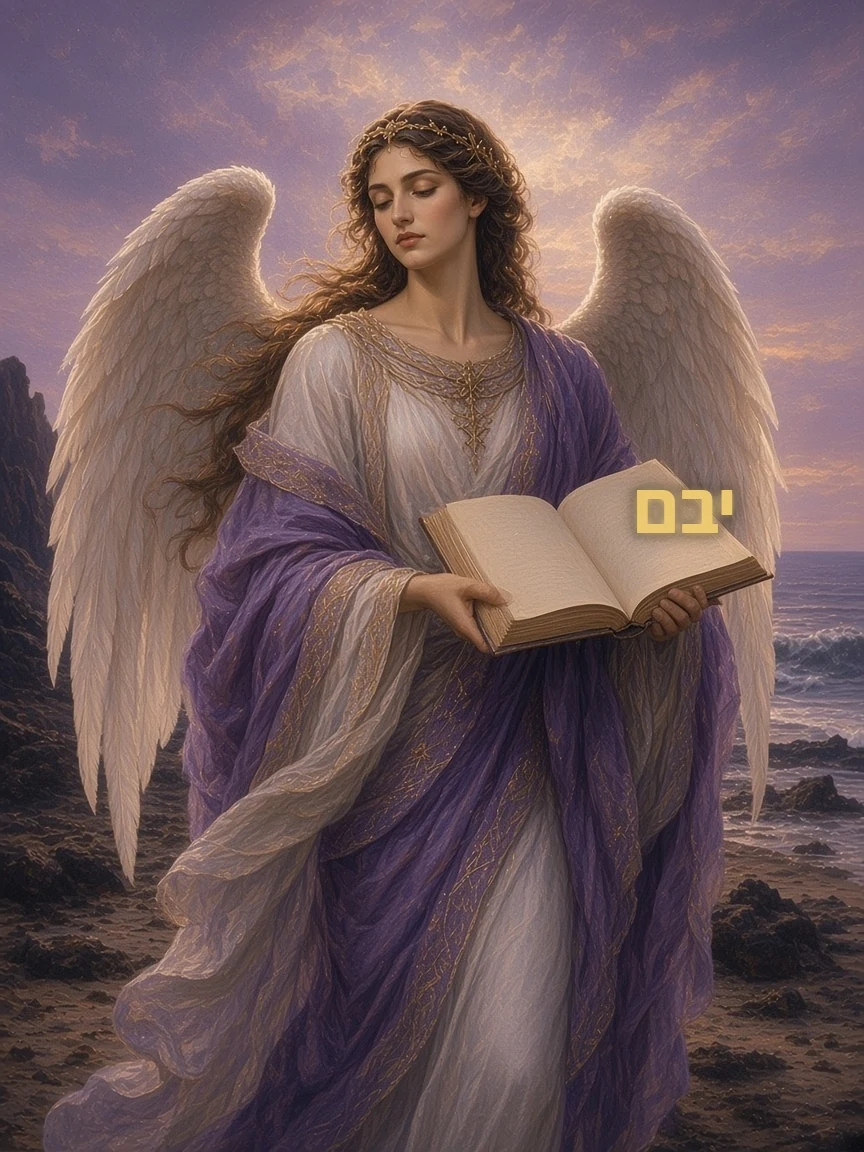
70th of the 72 · Choir of Angels
Jabamiah יבם
Also known as Jabamiah1 · Aris2 · יבמיה (Jabamiah)3 · יבם (the three letters)4
Sources for these names
- 1. Lenain, typographic reissue, heading of this entry, and the Sanctuary page: “Jabamiah.” The Hall has not yet recovered Agrippa III.25 (English 1651) for this name’s spelling
- 2. Lenain, typographic reissue: “Il correspond au saint nom Aris, suivant la langue des Béotiens.”
- 3. Angel form of the triad יבם: Exodus 14:19–21 by the rule in Agrippa III.25 and Reuchlin 1517; House corpus, The Seventy-Two Names, יבמיה. The typographic reissue prints יבמויה at this heading
- 4. Exodus 14:19–21 by Rashi’s rule (on Sukkah 45a); Reuchlin 1517, Book III
Name: the triad יבם with an angelic ending.
Tracing the name backward
We go backward from the newest source to the oldest dated one, and step back only where a dated text or a published scholarly link anchors the step. Unproven or second-hand links are drawn dashed and marked. Raziel’s full chart is on his page.
Rest the pointer on a section to open it; click to keep it open.Tap a section to open it; tap again to close.
Name originwhat the name means and how it was built
One of the 72 “names” read out of Exodus 14:19–21. The triad יבם is taken letter by letter from the three verses; Renaissance Christian kabbalists (Reuchlin 1517; Agrippa 1533) turned each triad into an angel by adding -el or -iah.
Where the sources are thin. For this name the Hall has two firm anchors: the three letters, read from Exodus 14:19–21 by Rashi’s rule and recomputed by the Hall, and Lenain’s spelling of 1823. The Sanctuary’s table gives no spelling from Agrippa’s English table of 1651, and the Hall has not read Kircher’s plate. So the step from the letters to this spelling is not yet traced through any Renaissance source we have checked. Unverified
- Choir Angels
- Degrees of the zodiac 346°–350°
- Psalm verse Gen 1:1 Vulg. Gen 1:1
From Lenain (1823), as set out in the Sanctuary’s table of the 72.
Earliest sourcesthe name traced backward, with dated anchors
Solid = a link anchored in a dated sourceDashed = unproven, second-hand or a later equationNewest at the top; each step goes back in time. Tap any box to open its anchor.
- 1823
JabamiahLenain, La Science cabalistique (Paris 1823; BIU Santé Ms 5365)Medium
Lenain gives each of the 72 a choir, five degrees of the zodiac and a psalm verse, as listed in the Sanctuary’s table of the 72.
older
- 1652–1654
the 72 in a circleKircher, Oedipus Aegyptiacus II.1Medium
Kircher draws the 72 names as a great circle. Unverified for this name until the Hall reads Kircher’s plate.
older
- 1533 (English 1651)
no English 1651 spelling recordedAgrippa, Three Books of Occult Philosophy III.25, table of the 72Low
The Sanctuary’s table gives no 1651 English spelling for this name, so the Hall has not yet read Agrippa’s form here. Unverified Agrippa’s table contains all 72 triads; read Agrippa, De occulta philosophia, Cologne 1533 (Library).
older
- 1517
the triad becomes an angel’s nameJohannes Reuchlin, De arte cabalistica, Book IIIHigh
The oldest dated source the Hall relies on for the angel-names of the 72 (as on the Sanctuary’s Lauviah page). Before this there are only the letters.
the letters, not yet an angel
- 11th c.
יבם as one of the 72 namesRashi on Sukkah 45aHigh
Rashi explains the 72 names as read from the three verses of Exodus 14:19–21, “each of 72 letters”: the first letter of the first verse, the last of the middle verse and the first of the last, “and so on in this order”; the first name is והו (Hall translation; Sefaria).
read out of three verses
- the verses themselves
Exodus 14:19–21three verses of 72 letters eachHigh
Letter 70 of verse 19, letter 70 counted from the end of verse 20, and letter 70 of verse 21, by Rashi’s rule. Hall check Computed from the Hebrew consonantal text of Exodus 14:19–21 (Sefaria, “Tanach with Text Only”; 72 letters in each verse): letter 70 of verse 19 is י, letter 70 from the end of verse 20 is ב, letter 70 of verse 21 is מ (final forms normalised). All 72 triads in the Sanctuary table match this count. Read Exodus in Gutenberg Bible: Exodus, Psalms and more (Library).
no anchor
The trail endsNo angel named Jabamiah before Reuchlin (1517)No anchor
Before the Renaissance there are the letters and the method, but no angel of this name.
Also known asother names the sources give
Also known as Jabamiah1 · יבם (the three letters)2
Sources for these names
- Lenain 1823 (Sanctuary table of the 72)
- Exodus 14:19–21 by Rashi’s rule (on Sukkah 45a)
Comparisonssimilar figures, where scholars draw the link
- The decans (House note). Lenain gives each of the 72 five degrees of the zodiac (72 × 5 = 360), so two of them make one 10° decan, the old Egyptian star-division (Neugebauer & Parker). That is arithmetic and the Hall’s own note, not a scholar’s identification.
Comparisons are listed only where a scholar makes the link, or are marked as the Hall’s own note. A parallel of role is not a lineage of name.
Further readingbooks in Raziel’s Library and beyond
Unverified and sourceswhat is still to check, and every source
Unverified
- Unverified Kircher plate not yet read for this name
- Unverified Agrippa’s 1651 spelling for this name
Sources
- Rashi on Sukkah 45a (Sefaria)
- Reuchlin, De arte cabalistica (1517), Book III
- Agrippa, Three Books of Occult Philosophy III.25 (1533; English 1651)
- Kircher, Oedipus Aegyptiacus (1652–54)
- Lenain, La Science cabalistique (1823)
Hover or tap to turn the card.
- Name
- Jabamiah, “Word that produces all things” (Verbe qui produit toutes choses); called Aris RevivalLenain 1823, typographic reissue heading “Jabamiah”: “Son attribut (Verbe qui produit toutes choses). Il correspond au saint nom Aris, suivant la langue des Béotiens.” The typographic reissue’s note (1) at this heading cites the Abbé de Villars, who says this name expresses the eternal fecundity of God (see the Comte de Gabalis, 4th conversation). The long story Villars tells there is not copied here. The Hall has not yet recovered Agrippa III.25 (English 1651) for this name’s spelling.
- Letters
- יבם (Yod, Bet, Mem) → יבמיה RenaissanceExodus 14:19–21, letter 70 of each verse (v.20 backward); Reuchlin 1517; House corpus, יבמיה. The typographic reissue prints יבמויה at this heading. Both are cited; the disagreement is not silently resolved.
- Number
- 70 of 72 RenaissanceReuchlin 1517 III; Agrippa III.25 table
- Order
- Angels, the ninth choir (angels 65–72 in Agrippa, Kircher, and Lenain’s tables; Lenain’s entry at the 64th already opens this choir as printed and applies it through the 72nd) RevivalLenain 1823, at the 64th genius, applying through the 72nd: “appartiennent au 9e. ordre, que les orthodoxes appellent le chœur des anges.”
- Word
- Genesis 1:1 (House corpus; an exception among the 72, which otherwise take a psalm verse): “In the beginning God created heaven, and earth.” AncientHebrew WLC; Douay-Rheims (the House has not yet issued its own rendering). Lenain 1823: “Il faut prononcer la demande avec les noms divins et le 1er verset de la Genèse : (Au commencement Dieu créa le ciel et la terre).” Reuchlin’s construction of the 72 usually pairs each name with a psalm verse; this entry is the exception recorded in the House corpus.
- Domain
- The generation of beings, and the phenomena of nature; she protects those who wish to regenerate themselves, and to restore in themselves the harmony that was broken by the disobedience of Adam, which is done by exalting oneself toward God, and by purifying through the elements those things that compose the nature of man: it is then that the sage re-enters the principle of creation, recovers his rights and his first dignity, returns the master of nature, and enjoys all the prerogatives that God gave him in creating him RevivalLenain 1823 (the body of the entry resumes after the Villars footnote, at “nommé Thopibui…”): “Ce génie domine sur la génération des êtres, et sur les phénomènes de la nature; il protège ceux qui veulent se régénérer, et rétablir chez eux l'harmonie qui a été rompue par la désobéissance d'Adam, laquelle se fait en s'exaltant vers Dieu, et en purifiant par les éléments ceux qui composent la nature de l'homme : c'est alors que le sage rentre dans le principe de la création; qu'il recouvre ses droits, sa première dignité ; qu'il revient le maître de la nature, et qu'il jouit de toutes les prérogatives que Dieu lui donna en le créant.” The wording is Lenain’s and is not softened. The typographic-reissue JSON had cut the entry at the footnote.
- Gifts
- Not separately headed in Lenain; see Domain RevivalLenain does not open a separate “il sert pour…” sentence at this entry. The protection of those who wish to regenerate themselves stands in the domain paragraph above.
- Those born under her
- Will be distinguished by their genius; will be esteemed by the scholars of all nations, and will become one of the first lights of philosophy RevivalLenain 1823: “La personne qui est née sous cette influence se distinguera par son génie; elle sera considérée par les savants de toutes les nations, et elle deviendra une des premières lumières de la philosophie.”
- Shadow
- Lenain’s “contrary genius” dominates atheism, and all those who propagate dangerous writings; it influences critics and literary disputes. This is a separate spirit, not Jabamiah RevivalLenain 1823 (after the remainder of the Villars footnote): “Le génie contraire domine l'athéisme, et tous ceux qui propagent des écrits dangereux; il influe sur les critiques et les disputes littéraires.” The wording is Lenain’s and is not softened. The leftover sentences of the Villars note, including “L'on voit, dans les Lettres cabalistiques, que le salut des cabalistes se faisait en Jabamiah et par Jabamiah,” belong to that note, not to the 71st entry, and are not treated as Jabamiah’s office.
- Heaven
- The 35th decan, genie Thopibui. Lenain names no planet in this entry RevivalLenain 1823, typographic reissue: “correspondant a la 35e. décade et au génie nommé Thopibui.” The typographic reissue prints “a” without an accent, as here. The name Thopibui resumes after the Villars footnote at p. 95. No planet is named here. The Hall does not carry Jupiter forward from the 69th entry (Chontaré) into this same-decan partner.
- Degrees
- 346°–350° of the zodiac, inclusive RevivalLenain 1823 (5° to each of the 72): “Son rayon commence depuis le 346e. degré de la sphère jusqu'au 350e., inclusivement.”
- Days
- 28 May, 8 August, 19 October, 30 December, 12 March RevivalLenain 1823: “Il préside aux cinq jours suivants : 28 mai, 8 août, 19 octobre, 30 décembre, 12 mars.”
- Hour
- Every day, from 11:00 in the evening until 11:20; the request is pronounced with the divine names and the first verse of Genesis RevivalLenain 1823: “L'invocation se fait tous les jours depuis 11 heures du soir jusqu'à 11 heures 20 minutes.” This entry does say “tous les jours.” It does not say “fasting.”
- Colours
- None attested. Lenain names no planet in this entry, so none is inferred RevivalNot in Lenain at this entry. The Hall does not carry a colour from the 69th genius. Mathers’ Key of Solomon I.18 (Hall) gives planetary colours only where a planet is named for that genius.
- Incense
- None attested for Jabamiah herself. RevivalNot in Lenain. Mathers’ Key of Solomon II.10 (Hall) is a general sweet perfume, not a per-angel list. Agrippa I.44 is not in the Hall English panels. Modern angel-dictionary lists are not used.
- The letters in Sefer Raziel
- The Book of the Angel Raziel on this shelf writes of the triad יבם. One Hall English passage of the First Operation: “YBM [יבם] — its form DYY [ד"יי]: the Name itself points that He rides on ten spheres, as he said (Ps. 68:5) ‘Extol Him who rides on the ʿAravot’; but its form points that the Name of four letters is sanctified and magnified as the three tens mentioned above in the number of Ehyeh, in his saying (Exod. 3:14) ‘Ehyeh asher Ehyeh’: three; they are Ehyeh for the Ten Words of the Torah, Ehyeh for the ten Sefirot, Ehyeh for the ten plagues in Egypt.” These are words about the Name’s letters, not a use of the later angel-name Jabamiah. RevivalHall English, from the 1701 tradition, Book of the Angel Raziel, pp. 65–72.
- Also on the shelves
- The Hall has not yet recovered Agrippa III.25 (English 1651) for this name’s spelling. Kircher’s plate is not yet read for this name’s letters and office. The Goetia’s seventy-two spirits are a different list; her name is not among them. The Hygromanteia, the Testament of Solomon and Sefer Yetzirah on this shelf do not name her. Zohar and Bahir are not on the Hall shelves. RevivalHall text search, 26 Nov 2026; typographic-reissue Hebrew and the Villars footnote checked against the entry as it resumes at p. 95.
- Seal
- Her three letters יבם, as the triad is formed in Reuchlin and Agrippa. The Hall has not yet read Kircher’s plate for this name’s letters and office. The “seals” of the 72 sold today are modern RenaissanceReuchlin 1517; Agrippa III.25.
- Feast
- None in any calendar; Lenain’s five days above RevivalLenain 1823
Persona: as the books describe her
The books give Jabamiah no body and no face; she is known by what she does. Lenain sets her among the Angels, the ninth order, a sentence written at the 64th genius and applied through the 72nd. Her verse is the first of Genesis, “In the beginning God created heaven, and earth” (Genesis 1:1; Lenain calls it the 1st verse of Genesis). This is the exception in the House corpus: the other names of the 72 are paired with a psalm verse. She rules over the generation of beings and the phenomena of nature, and protects those who wish to regenerate themselves and to restore in themselves the harmony that was broken by the disobedience of Adam, by exalting themselves toward God and by purifying through the elements those things that compose the nature of man; it is then that the sage re-enters the principle of creation, recovers his rights and his first dignity, returns the master of nature, and enjoys all the prerogatives that God gave him in creating him. The person born under her will be distinguished by their genius, will be esteemed by the scholars of all nations, and will become one of the first lights of philosophy (Lenain 1823). Revival
The name Aris comes from Lenain, “according to the language of the Boeotians.” The typographic reissue and the Sanctuary have Jabamiah. The Hall has not yet recovered Agrippa III.25 (English 1651) for this name’s spelling. The Hall honours her as “she”, as the Sanctuary card already does. Lenain writes “il”, because French génie is masculine. House
The triad יבם stands in the Book of the Angel Raziel on this shelf as one of the 72 Names; those words are about the letters, not a use of the later angel-name, and are not added to her Lenain office. Revival Lenain names no planet in this entry; no colour is inferred from the 69th genius. The Goetia, the Hygromanteia, the Testament of Solomon and Sefer Yetzirah on this shelf do not name her. Zohar and Bahir are not on the Hall shelves.