
Chinese shelf · Pu Songling · 聊齋志異 · Giles II · Tale 2
瞳人語 · The Talking PupilsTongren yu · Giles 1880, vol. 1, no. II
Public domain. Pu Songling (1640–1715). Translated by Herbert A. Giles, 1880. Giles sometimes shortened or softened passages, so the two columns do not always match line for line.
Chinese 文言
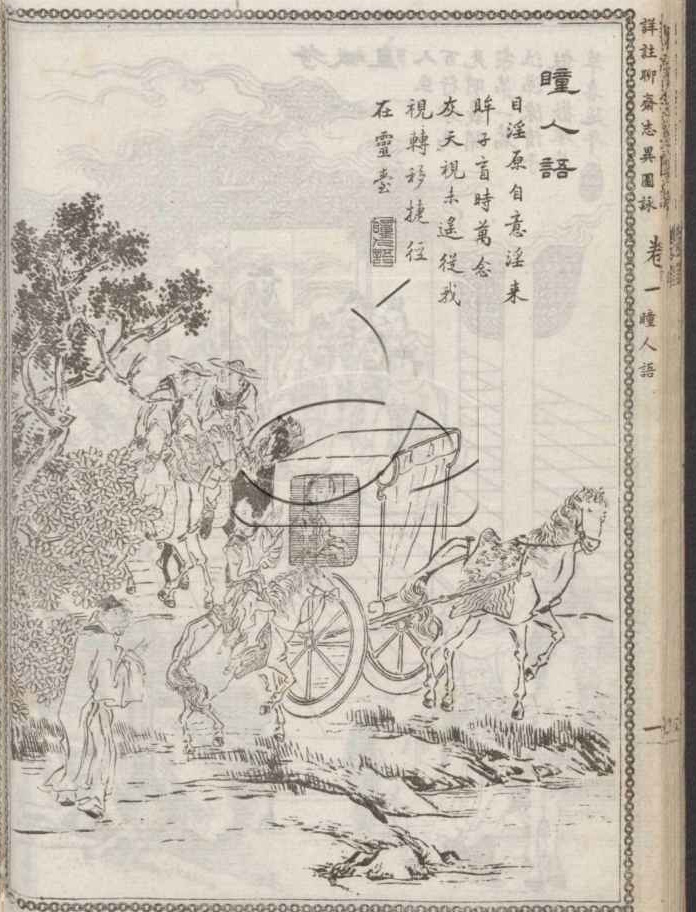
長安士方棟,頗有才名,而佻脫不持儀節。每陌上見游女,輒輕薄尾綴之。清明前一日,偶步郊郭,見一小車,朱茀繡幰,青衣數輩,款段以從。內一婢,乘小駟,容色絕美,稍稍近覘之,見車幔洞開,內坐二八女郎,紅妝艷麗,尤生平所未睹,目炫神奪,瞻戀弗舍,或先或後,從馳數里。忽聞女郎呼婢近車側,曰:「為我垂簾下!何處風狂兒郎,頻來窺瞻?」婢乃下簾,怒顧生曰:「此芙蓉城七郎子新婦歸寧,非同田舍娘子,放教秀才胡覷。」言已,掬轍土颺生,生瞇目不可開。𦆵一拭視,車馬已渺,驚疑而返;覺目終不快,倩人啟瞼撥視,則睛上生小翳,經宿益劇,淚簌簌不得止。翳漸大,數日厚如錢,右睛起旋螺,百藥無效。懊悶欲絕,頗思自懺悔。聞《光明經》能解厄,持一卷,浼人教誦。初猶煩躁,久漸自安,旦晚無事,惟趺坐捻珠,持之一年,萬緣俱靜。忽聞右目中,小語如蠅曰:「黑漆似,尀耐殺人。」左目中應曰:「可同小遨游,出此悶氣。」漸覺兩鼻中,蠕蠕作癢,似有物出,離孔而去,久之乃返,復自鼻入。眶中又言曰:「許時不窺園亭,珍珠蘭遽枯瘠死。」生素喜香蘭,園中多種植,日常灌溉,自失明,久置不問。忽聞其言,遽問妻:「蘭花何使憔悴死?」妻詰其所自知,告之故,妻趨驗之,花果槁矣,大異之。
靜匿房中,見有小人自生鼻內出,大不及豆,營營然竟出門去,漸遠,遂迷所在,俄連臂歸,飛上面,如蜂蟻之投穴者,如此二三日。又聞左言曰:「隧道迂,還往非所甚便,不如自啟門。」右應云:「我壁子厚,大不易。」左曰:「我試闢,得與而俱。」遂覺左眶內,隱似抓裂,有頃,開視,豁見几物。喜告妻,妻審之,則脂膜破小竅,黑睛熒熒,𦆵如破椒。越一宿,障盡消,細視,竟重瞳也;但右目旋螺如故,乃知兩瞳人合居一眶矣。生雖一目眇,而較之雙目者,殊更了了。由是益自檢束,鄉中稱盛德焉。
異史氏曰:鄉有士人,偕二友於途,遙見少婦,控驢出其前,戲而吟曰:「有美人兮,」顧二友曰:「驅之。」相與笑騁。俄追及,乃其子婦,心赧氣喪,默不復言,友偽為不知也者,評騭殊褻。士人忸怩,吃吃而言曰:「此長男婦也,」各隱笑而罷。輕薄者,往往自侮,良可笑也。至於眯目失明,又鬼神之慘報矣。芙蓉城主,不知何神,豈菩薩現身耶?然小郎君生闢門戶,鬼神雖惡,亦何嘗不許人自新哉。
English Giles 1880
At Ch‘ang-ngan there lived a scholar, named Fang Tung, who though by no means destitute of ability was a very unprincipled rake, and in the habit of following and speaking to any woman he might chance to meet. The day before the spring festival of Clear Weather,41 he was strolling about outside the city when he saw a small carriage with red curtains and an embroidered awning, followed by a crowd of waiting-maids on horseback, one of whom was exceedingly pretty, and riding on a small palfrey. Going closer to get a better view, Mr. Fang noticed that the carriage curtain was partly open, and inside he beheld a beautifully dressed girl of about sixteen, lovely beyond anything he had ever seen. Dazzled by the sight, he could not take his eyes off her; and, now before, now behind, he followed the carriage for many a mile. By-and-by he heard the young lady call out to her maid, and, when the latter came alongside, say to her, “Let down the screen for me. Who is this rude fellow that keeps on staring so?” The maid accordingly let down the screen, and looking angrily at Mr. Fang, said to him, “This is the bride of the Seventh Prince in the City of Immortals going home to see her parents, and no village girl that you should stare at her thus.” Then taking a handful of dust, she threw it at him and blinded him. He rubbed his eyes and looked round, but the carriage and horses were gone. This frightened him, and he went off home, feeling very uncomfortable about the eyes. He sent for a doctor to examine his eyes, and on the pupils was found a small film, which had increased by next morning, the eyes watering incessantly all the time. The film went on growing, and in a few days was as thick as a cash.42 On the right pupil there came a kind of spiral, and as no medicine was of any avail, the sufferer gave himself up to grief and wished for death. He then bethought himself of repenting of his misdeeds, and hearing that the Kuang-ming sutra could relieve misery, he got a copy and hired a man to teach it to him. At first it was very tedious work, but by degrees he became more composed, and spent every evening in a posture of devotion, telling his beads. At the end of a year he had arrived at a state of perfect calm, when one day he heard a small voice, about as loud as a fly’s, calling out from his left eye:—“It’s horridly dark in here.” To this he heard a reply from the right eye, saying, “Let us go out for a stroll, and cheer ourselves up a bit.” Then he felt a wriggling in his nose which made it itch, just as if something was going out of each of the nostrils; and after a while he felt it again as if going the other way. Afterwards he heard a voice from one eye say, “I hadn’t seen the garden for a long time: the epidendrums are all withered and dead.” Now Mr. Fang was very fond of these epidendrums, of which he had planted a great number, and had been accustomed to water them himself; but since the loss of his sight he had never even alluded to them. Hearing, however, these words, he at once asked his wife why she had let the epidendrums die. She inquired how he knew they were dead, and when he told her she went out to see, and found them actually withered away. They were both very much astonished at this, and his wife proceeded to conceal herself in the room. She then observed two tiny people, no bigger than a bean, come down from her husband’s nose and run out of the door, where she lost sight of them. In a little while they came back and flew up to his face, like bees or beetles seeking their nests. This went on for some days, until Mr. Fang heard from the left eye, “This roundabout road is not at all convenient. It would be as well for us to make a door.” To this the right eye answered, “My wall is too thick; it wouldn’t be at all an easy job.” “I’ll try and open mine,” said the left eye, “and then it will do for both of us.” Whereupon Mr. Fang felt a pain in his left eye as if something was being split, and in a moment he found he could see the tables and chairs in the room. He was delighted at this and told his wife, who examined his eye and discovered an opening in the film, through which she could see the black pupil shining out beneath, the eyeball itself looking like a cracked pepper-corn. By next morning the film had disappeared, and when his eye was closely examined it was observed to contain two pupils. The spiral on the right eye remained as before; and then they knew that the two pupils had taken up their abode in one eye. Further, although Mr. Fang was still blind of one eye, the sight of the other was better than that of the two together. From this time he was more careful of his behaviour, and acquired in his part of the country the reputation of a virtuous man.43
Giles’s notes
- One of the twenty-four solar terms. It falls on or about the 5th of April, and is the special time for worshipping at the family tombs. ↩
- The common European name for the only Chinese coin, about twenty of which go to a penny. Each has a square hole in the middle, for the convenience of stringing them together; hence the expression “strings of cash.” ↩
- The belief that the human eye contains a tiny being of the human shape is universal in China. It originated, of course, from the reflection of oneself that is seen on looking into the pupil of anybody’s eye, or even, with the aid of a mirror, into one’s own. ↩
English: Herbert A. Giles, Strange Stories from a Chinese Studio, vol. 1 (London: Thos. de la Rue, 1880), public domain, text via Project Gutenberg #43627. Footnotes are Giles’s. Chinese: 蒲松齡《聊齋志異》, public domain, text via Chinese Wikisource (modern editors’ glosses and the Qing commentaries are left out, and variant readings follow the first reading given).