
Legends of Truth
An honest comparison for Rue: what the tablets, the Bible and Egyptian records actually say, how closely they match, and where our interpretation goes beyond the texts.
Scores are our judgement of textual closeness (shared details, order, wording), not a measure of historical truth. Text in quotation marks is quoted from the cited translation; everything else is labeled paraphrase.
Match scores
| Parallel | Match | Reason |
|---|---|---|
| The Flood and the boat | 92% | Same plot beats in order: warning, boat, animals, birds sent out, sacrifice, divine reaction. |
| Eridu Genesis and Enki's warning | 85% | Ziusudra is warned by a god through a wall and builds a boat; Noah is warned by God directly. |
| Humans made from clay plus divine essence | 80% | Clay plus a divine ingredient in both; Mesopotamia uses a slain god's blood, Genesis uses God's breath. |
| Long reigns before the Flood | 78% | Both list about 8-10 figures before a flood with huge lifespans; the numbers and roles differ. |
| Creation from watery chaos (Enuma Elish) | 62% | Shared watery start and divided waters, but very different stories (divine war vs. calm command). |
| Babel and confused languages | 58% | Sumerian 'Enmerkar' has one shared language later changed by Enki; no tower in that text. |
| Gods/sons of God and human women | 55% | Genesis 6 is clear; Mesopotamian semi-divine kings (Gilgamesh two-thirds god) are similar but not the same event. |
| The 'gods' as long-lived beings | 50% | Texts do show gods who eat, tire, quarrel and die; calling them non-divine beings is our reading. |
| The 'handbag' symbol | 45% | Similar handled-bag shape in Turkey and Assyria, but about 8,700 years apart with no known link; Egypt has no real match. |
| Great Pyramid / Khufu attribution | 40% | Not a text parallel: a real evidence debate where the cedar date is older but the main evidence still points to Khufu. |
Parallels in detail
The Flood and the boat — 92%
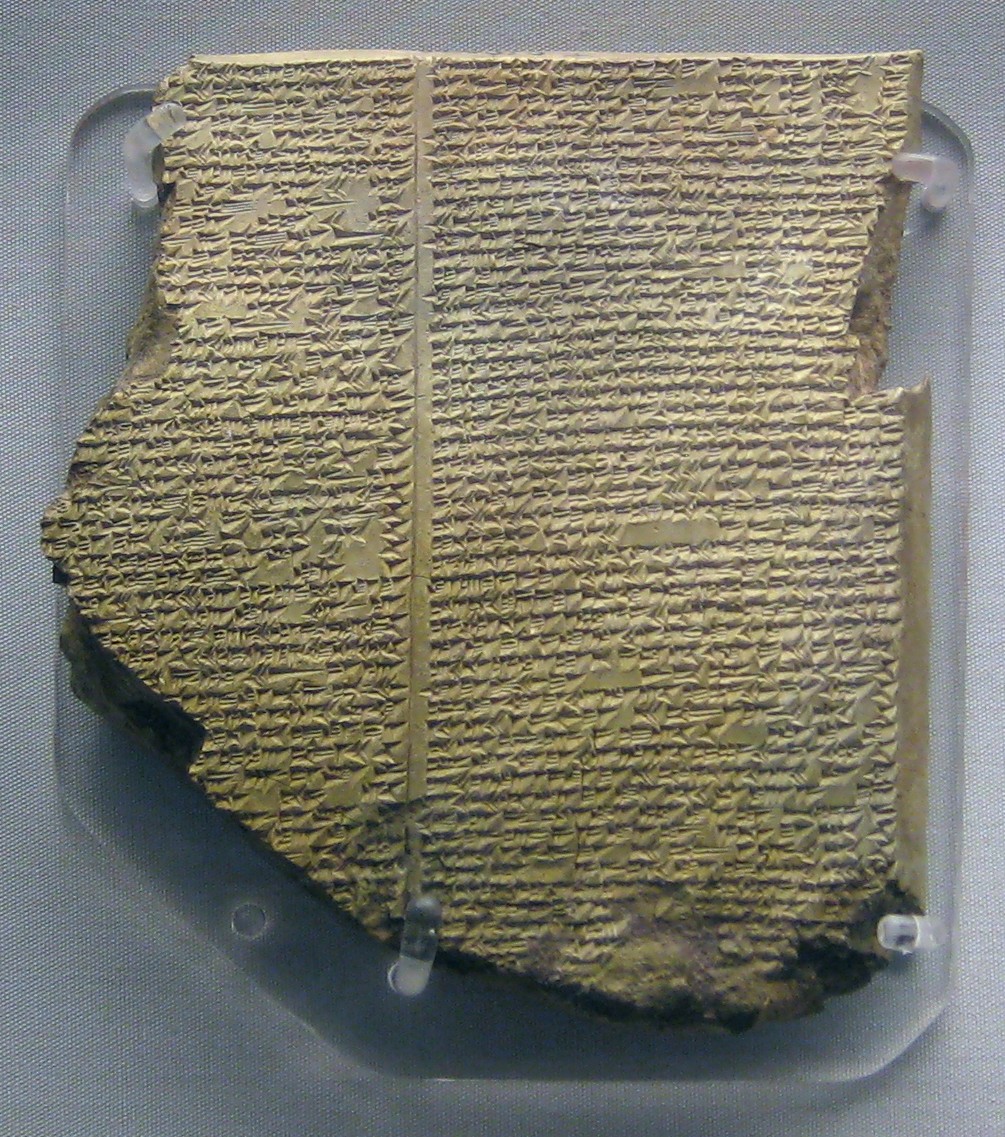

It spake to him the word, 'Rear me, I will save thee!' 'Wherefrom wilt thou save me?' 'A flood will carry away all these creatures: from that I will save thee!'
Julius Eggeling, Satapatha Brahmana 1.8.1.2, Sacred Books of the East vol. 12 (1882). Public domain. The India parallel below uses this same flood.
- Source
- Utnapishtim releases a dove, then a swallow, then a raven; the raven does not come back. He offers a sacrifice and "the gods smelled the sweet savor." (Gilgamesh, Standard Babylonian Tablet XI; paraphrase plus a short phrase, see Foster or George translations)
- Bible
- Genesis 8:21 (KJV): "And the LORD smelled a sweet savour." Noah sends a raven, then a dove three times.
- Egypt
- No flood epic of this kind. The closest is the 'Destruction of Mankind' in the Book of the Heavenly Cow, where Ra nearly wipes out humans.
- What the sources say
- Tablet XI and Genesis 6-9 share an unusually tight sequence of details, including the near-identical 'smelled the sweet savor' line.
- Our connection (interpretation)
- Both preserve one older memory of a real catastrophe, with the Mesopotamian version written down first.
- Where scholars differ
- Scholars agree the parallel is real; most see literary borrowing or a shared tradition rather than proof of a single global flood.
Eridu Genesis and Enki's warning — 85%
- Source
- Ziusudra stands by a wall and hears Enki's warning; a flood sweeps over the land for seven days and seven nights. (Eridu Genesis, ETCSL 1.7.4; paraphrase)
- Bible
- Genesis 6:13-14: God warns Noah and orders the ark.
- Egypt
- None directly.
- What the sources say
- The oldest written flood hero (Ziusudra) is warned by a god sympathetic to humans.
- Our connection (interpretation)
- Enki behaves like a protective patron of humanity against Enlil's decision.
- Where scholars differ
- Not disputed as a parallel; disputed only in what it implies historically.
Humans made from clay plus divine essence — 80%
- Source
- In Atrahasis a god (We-ila) is slain and his flesh and blood are mixed with clay by the birth goddess Nintu so humans can do the gods' labor. (Atrahasis Tablet I; paraphrase, see Lambert & Millard 1969, Dalley 1989)
- Bible
- Genesis 2:7 (KJV): "the LORD God formed man of the dust of the ground, and breathed into his nostrils the breath of life."
- Egypt
- Khnum shapes humans on a potter's wheel (later temple texts, e.g. Esna).
- What the sources say
- Clay-based creation with a divine element appears across all three regions.
- Our connection (interpretation)
- The 'divine blood' detail fits beings who made humans from their own substance, as workers.
- Where scholars differ
- Scholars read 'blood' as a religious idea (humans carry a divine spark), not biology. Sitchin's genetic-engineering reading is not in the texts themselves.
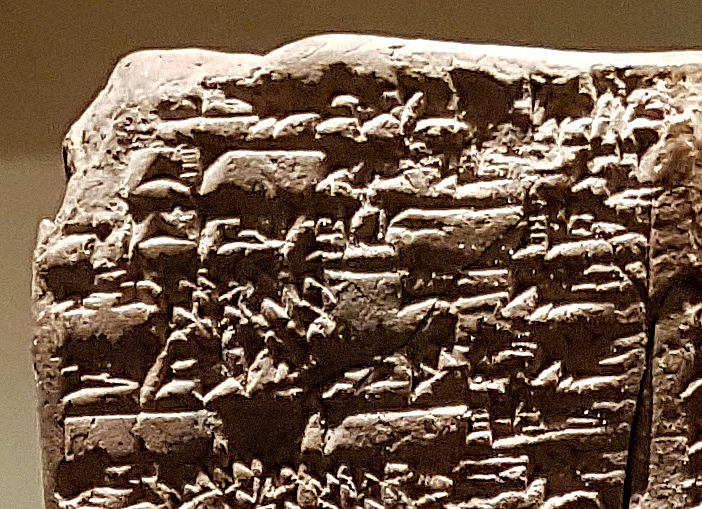
Long reigns before the Flood — 78%

- Source
- "After the kingship descended from heaven, the kingship was in Eridug. In Eridug, Alulim became king; he ruled for 28800 years." (Sumerian King List, ETCSL 2.1.1, lines 1-3)
- Bible
- Genesis 5: ten generations from Adam to Noah; Methuselah lives 969 years (Gen 5:27).
- Egypt
- Manetho (3rd c. BC, preserved via Eusebius/Syncellus) and the Turin King List place dynasties of gods and demigods ruling for thousands of years before Menes.
- What the sources say
- Three cultures record ages of rule by superhuman figures before ordinary kings.
- Our connection (interpretation)
- This points to a real memory of long-lived rulers, not just myth.
- Where scholars differ
- Mainstream view: inflated numbers express prestige or use sexagesimal schemes (28,800 = 8 × 3,600). The Turin list is badly damaged in exactly these sections.
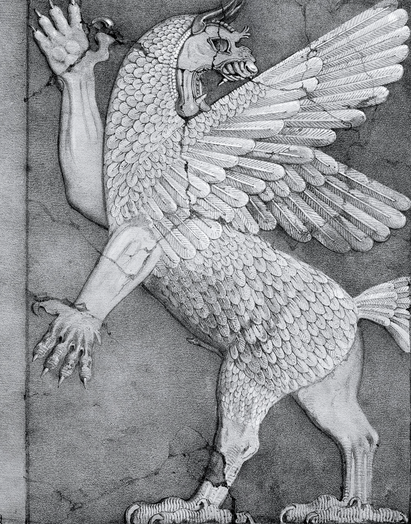
Creation from watery chaos (Enuma Elish) — 62%

- Source
- Marduk splits Tiamat's body, setting half as the sky; earlier, nothing existed but mingled waters, Apsu and Tiamat. (Enuma Elish, Tablets I and IV; paraphrase; Babylonian, not Sumerian)
- Bible
- Genesis 1:2, 6-7: darkness on 'the deep' (tehom); God divides the waters above from below.
- Egypt
- Nun, the primeval waters, from which the first mound rises (Heliopolis/Hermopolis traditions).
- What the sources say
- A primordial water state that gets divided is common to all three.
- Our connection (interpretation)
- Shared cosmology hints at a common original account.
- Where scholars differ
- Many scholars link tehom and Tiamat; others say Genesis 1 deliberately rejects the combat myth.
Babel and confused languages — 58%
- Source
- The 'spell of Nudimmud' describes a time when all lands spoke to Enlil 'in one tongue', until Enki changed speech. (Enmerkar and the Lord of Aratta, ETCSL 1.8.2.3, ~lines 135-155; paraphrase)
- Bible
- Genesis 11:1, 7: 'the whole earth was of one language'; the LORD confounds their language.
- Egypt
- Thoth as giver of languages; no Babel story.
- What the sources say
- A lost single language changed by a god is attested in Sumer.
- Our connection (interpretation)
- Babel's ziggurat-like tower fits Mesopotamia directly.
- Where scholars differ
- Scholars debate whether the Enmerkar passage is past or a wished-for future; the ziggurat link is widely accepted.
Gods/sons of God and human women — 55%
- Source
- Gilgamesh is described as two-thirds god and one-third human. (Gilgamesh, Standard Babylonian Tablet I)
- Bible
- Genesis 6:4 (KJV): "There were giants in the earth in those days... when the sons of God came in unto the daughters of men."
- Egypt
- Pharaohs as sons of Ra; demigod rulers in Manetho.
- What the sources say
- Part-divine rulers appear in all three; only Genesis gives a mixing episode before the Flood.
- Our connection (interpretation)
- The 'sons of God' and Anunnaki could be the same class of long-lived beings.
- Where scholars differ
- Scholars debate 'sons of God' (angels, Sethite line, kings). The Anunnaki identification is interpretive.
The 'gods' as long-lived beings, not universe creators — 50%
- Source
- Atrahasis opens with the younger gods doing hard labor, then striking against Enlil; Enki proposes making humans to take the toil. (Atrahasis Tablet I; paraphrase)
- Bible
- Genesis 6:3: God limits human days to 120 years; Genesis 3:22 'become as one of us.'
- Egypt
- Osiris is killed by Set; gods can age (Ra grows old in the Heavenly Cow text).
- What the sources say
- Mesopotamian gods are portrayed as embodied, mortal-like and hierarchical (Anu, Enlil, Enki).
- Our connection (interpretation)
- Rue's reading: the Anunnaki may have been powerful, long-lived beings rather than creators of the cosmos (the Sitchin line).
- Where scholars differ
- Sitchin's translations (e.g. 'Nibiru' as a planet, 'shem' as rocket) are rejected by Assyriologists and critics such as Michael Heiser; the anthropomorphic-gods point itself is uncontested.
The 'handbag' symbol — 45%
- Source
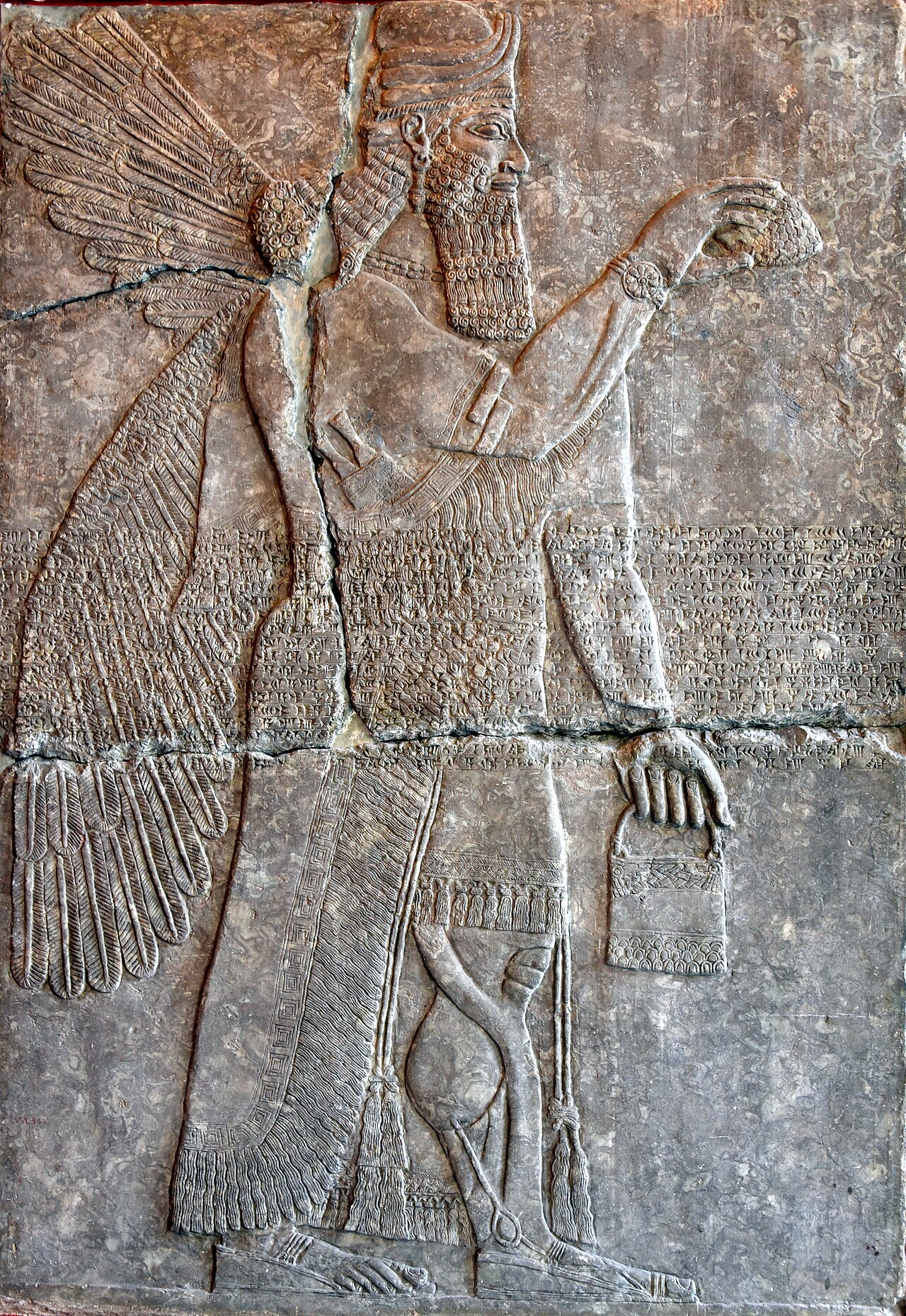
- Neo-Assyrian Apkallu (sage) figures, e.g. the NW Palace of Ashurnasirpal II at Nimrud, 9th c. BC, hold a bucket (banduddû) in one hand and a cone (mullilu) in the other. (Wall reliefs from Nimrud, British Museum and Pergamon Museum; description, not a quotation)
- Bible
- No direct parallel. The Apkallu are the pre-Flood sages of Mesopotamian tradition, which links them loosely to the Genesis 5-6 era.
- Egypt
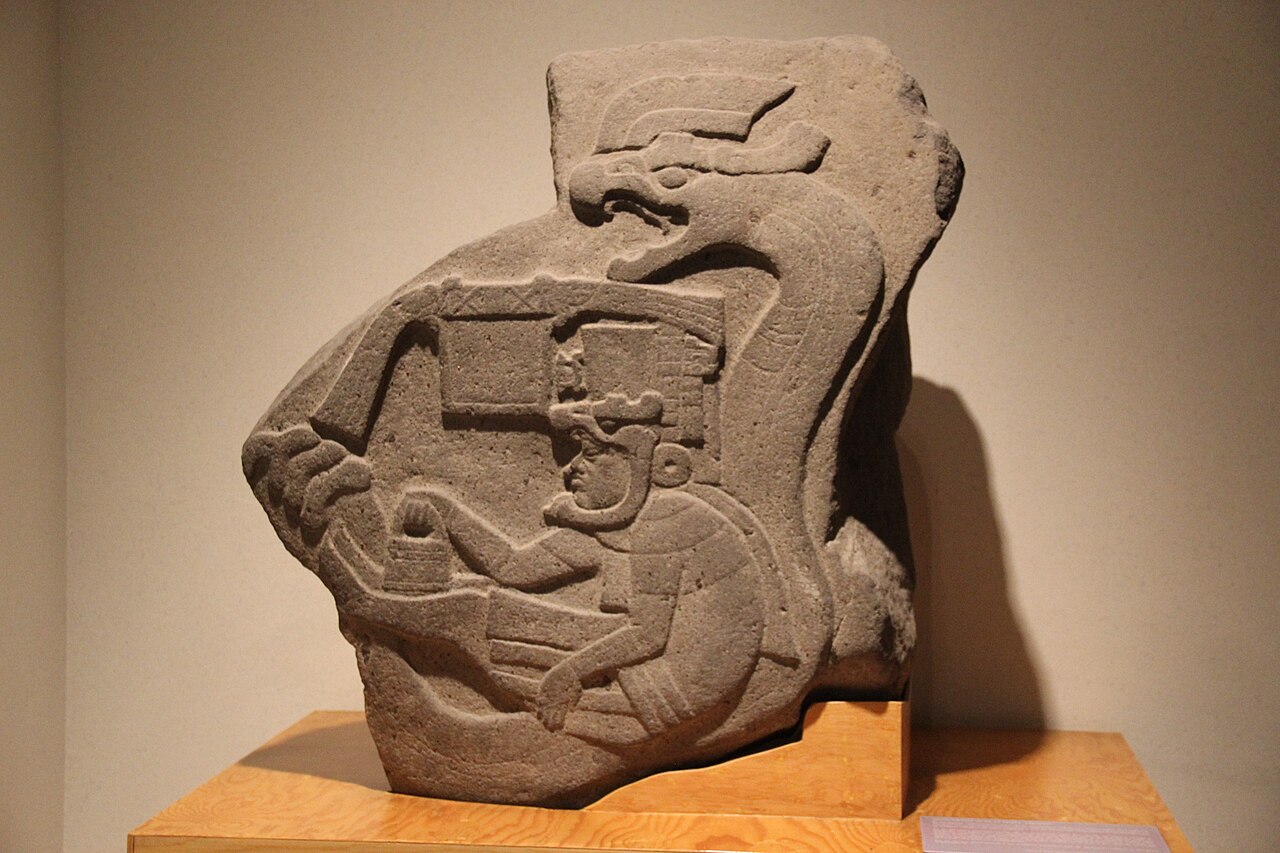
- No good match. Gardiner sign V33 is a 'bag of linen' hieroglyph, a tied cloth bag rather than a handled bucket, and I found no Egyptian figure carrying a bucket and cone. Side note: Olmec La Venta Monument 19 (c. 1200-400 BC) shows a figure holding a small bag beside a feathered serpent.
- What the sources say
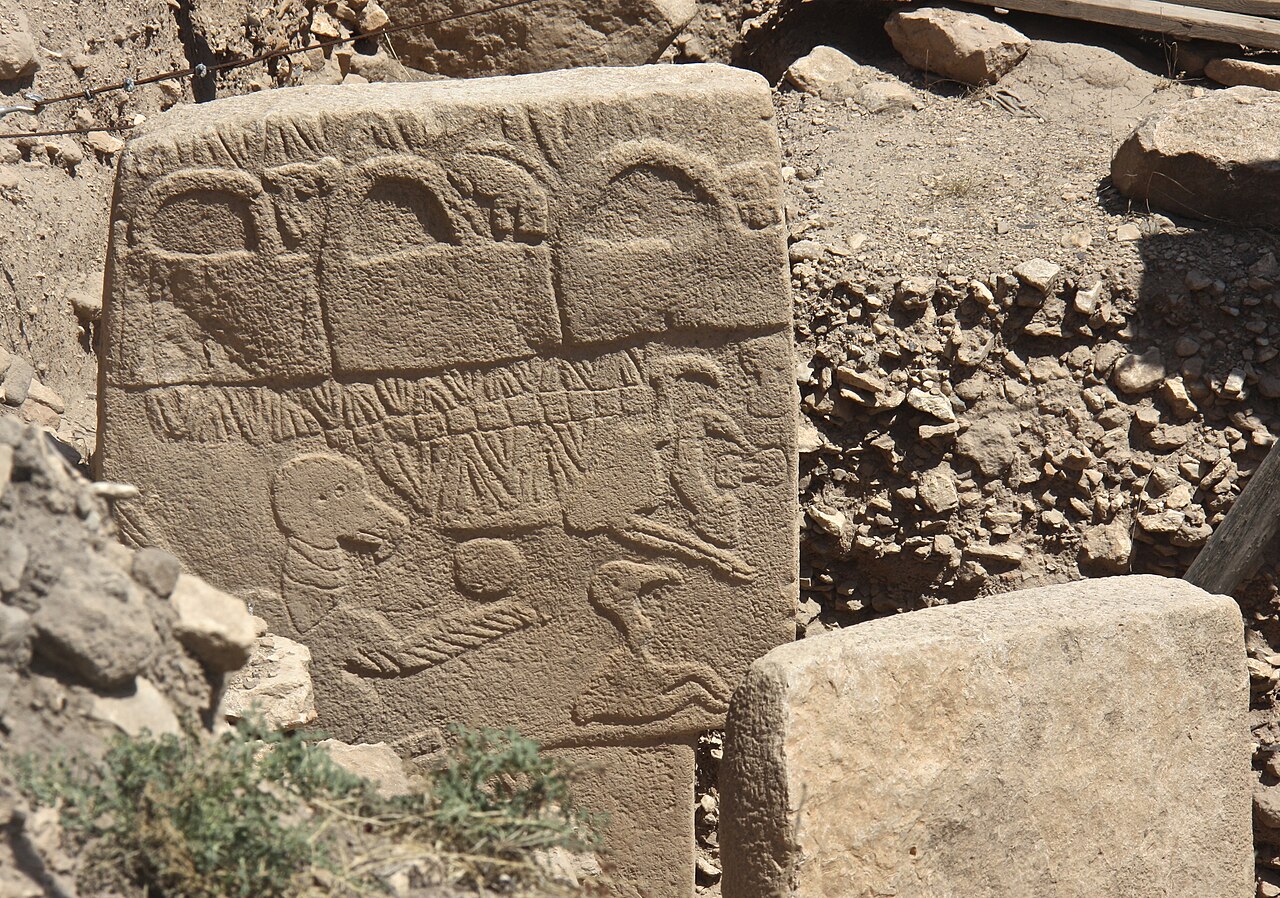
- Göbekli Tepe Pillar 43 (Enclosure D, c. 9600 BC) has three bag-like shapes with handles along its top; Assyrian sages hold a handled bucket thousands of years later.
- Our connection (interpretation)
- The repeated 'handbag' may be a shared symbol of the sages or knowledge-bringers, passed down from a very early source.
- Where scholars differ
- Mainstream reading: the Assyrian bucket held water or another liquid for ritual purification, and the cone was a sprinkler (or a date-palm pollinator). Pillar 43's bags are undeciphered, and most archaeologists treat the resemblance as coincidence of a simple form.




Great Pyramid / Khufu attribution — 40%
- Source
- No Sumerian or Bible parallel.
- Egypt
- Khufu's name appears in red work-gang graffiti in the relieving chambers above the King's Chamber; the Merer papyri (Wadi al-Jarf) log limestone shipments to 'Akhet-Khufu'. The Dixon relic cedar from the Queen's Chamber shaft was radiocarbon-dated to 3341-3094 BC (University of Aberdeen, Dec 2020), roughly 500 years before Khufu.
- What the sources say
- Rue's point is fair: the direct attribution rests mostly on the graffiti plus the Merer papyri, alongside the surrounding Giza cemeteries and workers' town.
- Our connection (interpretation)
- The early cedar date leaves room for an older origin or reuse.
- Where scholars differ
- Aberdeen itself suggested the wood may be old timber (long-lived cedar, reused, or an 'old wood' effect). Claims that Vyse forged the graffiti are rejected by Egyptologists; the Merer papyri were found in 2013 by Pierre Tallet's team.
India and China parallels



And Azâzęl taught men to make swords, and knives, and shields, and breastplates, and made known to them the metals of the earth and the art of working them, and bracelets, and ornaments.
R. H. Charles, The Book of Enoch (Oxford, 1912), 1 Enoch 8:1. Public domain. This is the wording behind the teachers paraphrase.
| Parallel | Match | Reason |
|---|---|---|
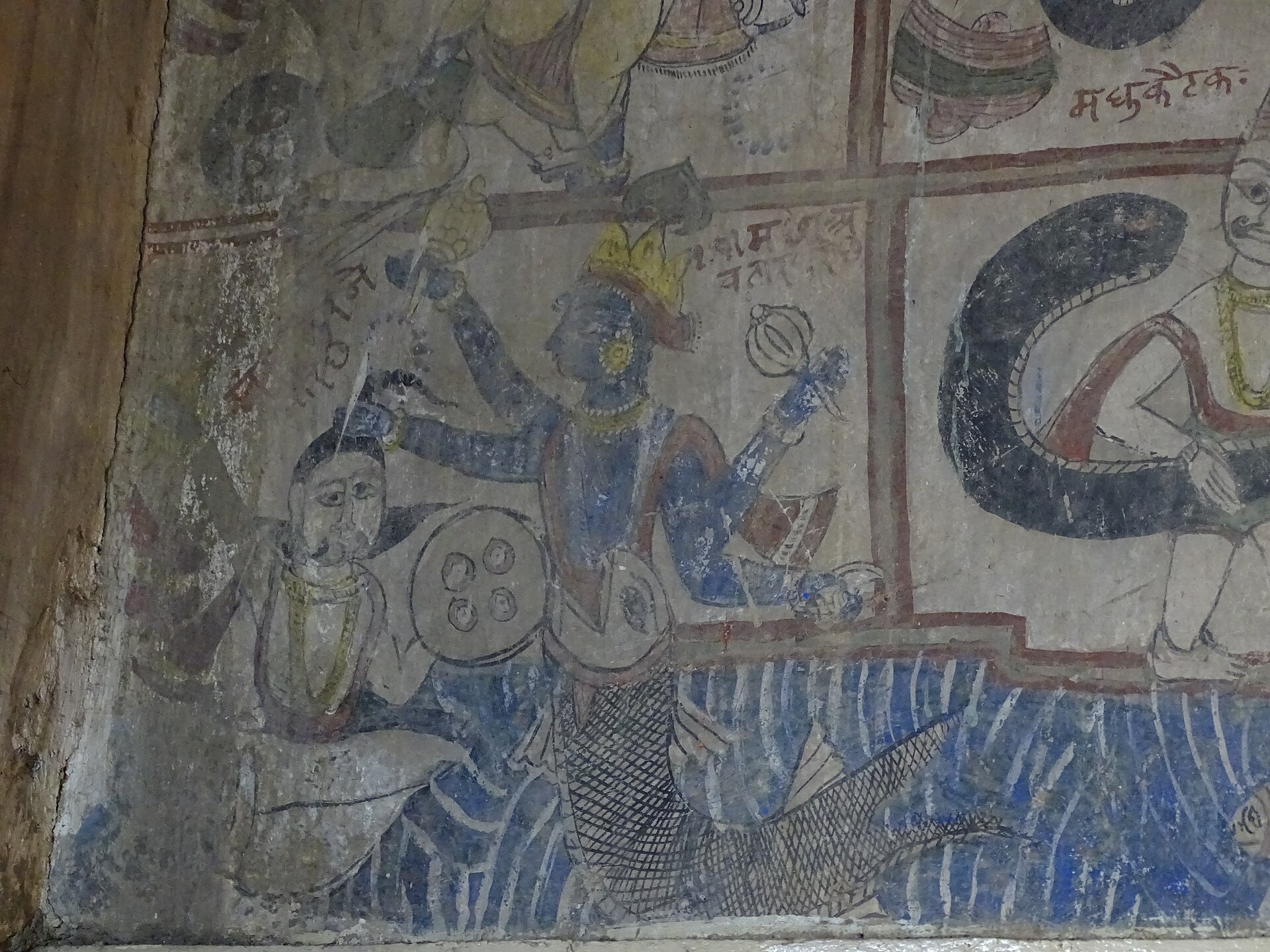
| India: Manu and the fish (Matsya) | 82% | Warned hero, boat, flood, northern mountain, sacrifice; the warner is a fish, not a god. |
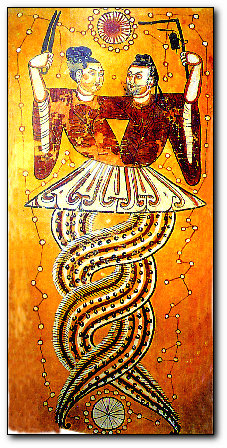
| China: Nüwa makes humans from clay | 78% | Clay-shaped humans by a divine maker; no divine blood or breath. |
| Divine teachers bring civilisation | 72% | Sages teach writing, farming, medicine; clear in Mesopotamia, Enoch, China, looser in India. |
| Long ages before the Flood (India, China) | 65% | Huge early ages, but numbers follow cosmic cycles, not a king list. |
| World made from a giant's body (Purusha, Pangu) | 60% | Cosmos from one body like Tiamat; but not slain chaos monsters. |
| Hybrid beings (nagas, Shan Hai Jing, Apkallu) | 50% | Part-animal wisdom/guardian beings everywhere; forms and roles vary. |
| China: Gun and Yu tame the flood | 45% | Great flood, but no warned survivor or boat; the hero drains it. |
- Manu — Source: Shatapatha Brahmana 1.8.1 (Eggeling, SBE 12): a fish warns Manu and tows his ship to a northern mountain (paraphrase); expanded in Matsya Purana. Parallels Ziusudra/Atrahasis/Utnapishtim/Noah. Scholars: borrowing vs independent origin debated. Our connection: one survivor remembered in four regions.
- Gun and Yu — Source: Shujing, 'Canon of Yao' and 'Tribute of Yu'; Shan Hai Jing juan 18 (Hainei jing, Within the Seas): Gun steals the Supreme God's xirang and is executed; Yu is born from his body (paraphrase; Birrell 1993 renders xirang 'self-renewing soil'). Scholars: a flood-control founding myth. Our connection: a forbidden gift from above, like Enki defying Enlil.
- Nüwa — Source: Fengsu Tongyi (Ying Shao, 2nd c. AD), a lost passage quoted in the Taiping Yulan: Nüwa kneads yellow earth into people (Birrell 1993; paraphrase). Parallels Enki and Ninmah (ETCSL 1.1.2), Atrahasis, Genesis 2:7, Khnum. Scholars: natural idea in pottery cultures; late text.
- Purusha / Pangu — Source: Rigveda 10.90.13 (Griffith), the opening of the verse: "The Moon was gendered from his mind, and from his eye the Sun had birth." Pangu in Xu Zheng's Wuyun linian ji (3rd c. AD). Parallels Tiamat split by Marduk. Scholars: Pangu is late, possibly influenced from outside China.
- Long ages — Source: Puranic Krita Yuga of 1,728,000 years (Manusmriti 1.68-86 gives base ratios); Three Sovereigns and Five Emperors (Shiji 1). Parallels Sumerian King List (241,200 years before the flood), Genesis 5, Turin List/Manetho. Scholars: cosmological arithmetic.
- Hybrids — Source: Berossus (via Alexander Polyhistor, preserved in Eusebius and Syncellus) on Oannes the fish-man teacher; Shan Hai Jing human-animal deities; nagas, Narasimha. Parallels Apkallu, lamassu, cherubim. Scholars: composite forms are symbolic. Our connection: 'teachers from the water'.
- Teachers — Source: 1 Enoch 8:1 (Charles): Azazel taught men to make swords and ornaments; Fuxi (trigrams, nets), Shennong (farming, herbs); Saptarishi. Parallels the seven Apkallu. Scholars: seven-sages parallel striking, contact debated. Our connection: one group of teachers.
Who is who: gods across cultures
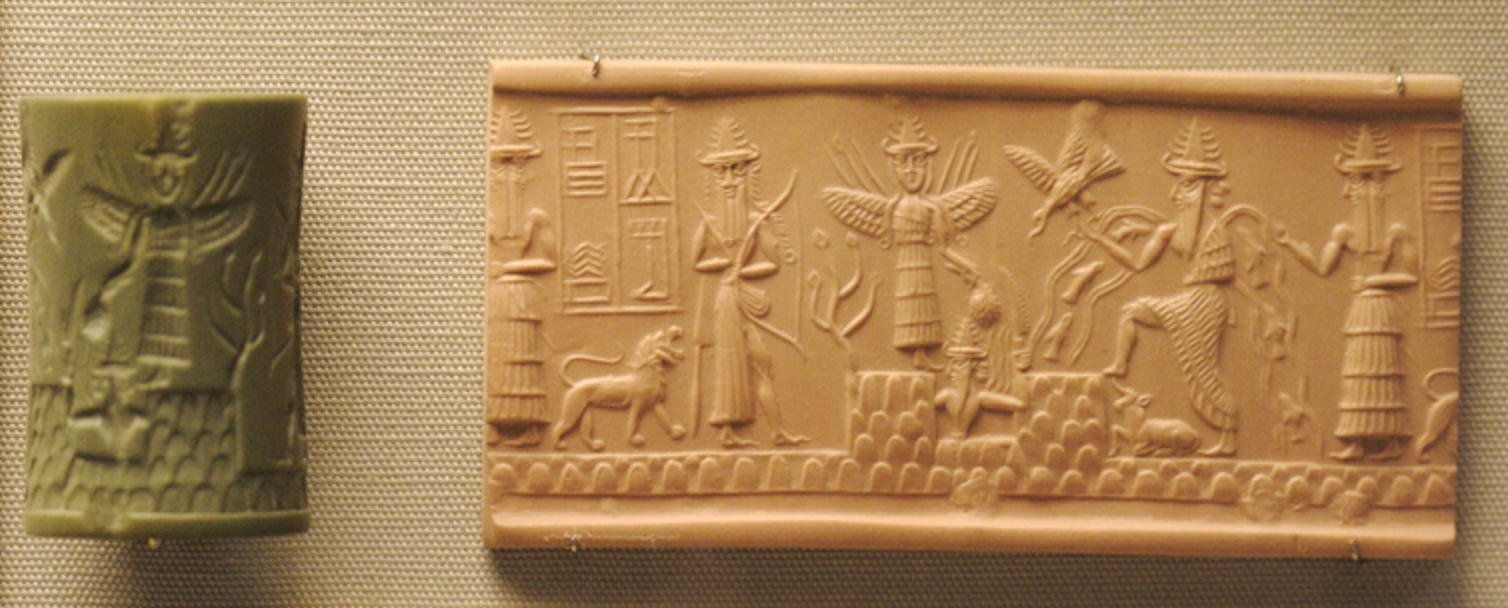

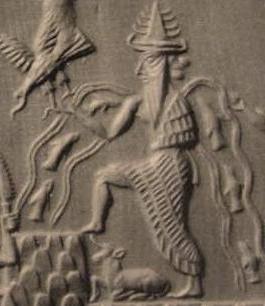


Basis: Scholarly = ancient equation or scholarly consensus; Role-only = same job, no proven link; RUEZALS AKHET connection = our interpretation.
| Role | Sumer | Babylon | Egypt | India | China | Greek | Roman | Norse | Hebrew / OT | Pre-flood | Basis |
|---|---|---|---|---|---|---|---|---|---|---|---|
| Sky father / king | An | Anu | Ra; Amun-Ra | Dyaus Pita; Indra | Shangdi; Jade Emperor | Ouranos; Zeus | Caelus; Jupiter | Odin | El; YHWH | — | Scholarly: An=Anu, Zeus=Jupiter, Dyaus=Zeus (same root); rest role-only |
| Storm / air | Enlil | Enlil; Adad | Set | Indra | Lei Gong | Zeus | Jupiter | Thor | Baal | — | Zeus=Jupiter scholarly; rest role-only |
| Wisdom, water, helper | Enki | Ea | Thoth; Ptah | Varuna; Vishnu | Fuxi; Nüwa | Prometheus; Poseidon | Neptune; Minerva | Mimir | Wisdom (Prov 8) | Oannes / Apkallu | Enki=Ea scholarly; Enki≈Prometheus role-only; Enki=Eden serpent is a RUEZALS AKHET connection |
| Mother goddess | Ninhursag / Ninmah | Mami / Nintu | Isis; Mut | Aditi; Devi | Nüwa; Xiwangmu | Gaia; Rhea | Terra; Ops | Frigg | Asherah (inscriptions) | — | Ninhursag=Mami, Rhea=Ops scholarly |
| Love / war | Inanna | Ishtar | Hathor; Sekhmet | Durga; Lakshmi | Xiwangmu (loose) | Aphrodite; Athena | Venus; Minerva | Freyja | Astarte / Queen of Heaven | — | Inanna=Ishtar, Aphrodite=Venus scholarly |
| Underworld | Ereshkigal; Nergal | Ereshkigal; Nergal | Osiris; Anubis | Yama | Yan Wang | Hades | Pluto / Dis | Hel | Sheol (place) | — | Hades=Pluto; Yan Wang from Yama |
| Sun | Utu | Shamash | Ra | Surya | Xihe's ten suns | Helios; Apollo | Sol | Sól | Shemesh | — | Utu=Shamash, Helios=Sol |
| Moon | Nanna | Sin | Khonsu; Thoth | Chandra / Soma | Chang'e | Selene; Artemis | Luna; Diana | Máni | Yareach | — | Nanna=Sin, Selene=Luna |
| Chaos serpent | Kur (loose) | Tiamat | Apep | Vritra | Gonggong | Typhon | Typhon | Jörmungandr | Leviathan; Rahab | — | Chaoskampf comparison is scholarly; Gonggong role-only |
| Divine son / rising king | Ninurta | Marduk | Horus | Krishna | Yu (loose) | Apollo; Dionysus | Apollo | Baldr | Messiah | — | Role-only; Marduk took Ninurta's role |
| Flood hero | Ziusudra | Atrahasis; Utnapishtim | — | Manu | Yu (drains it) | Deucalion | Deucalion (Ovid) | Bergelmir | Noah | Noah | Ziusudra/Noah/Deucalion/Manu scholarly comparison |
| Fallen / rebel teachers | Apkallu | Apkallu | — | Asuras (loose) | Gun | Prometheus; Titans | Titans | Loki | Sons of God | Watchers, Azazel | Watchers↔Apkallu is a scholarly proposal (Annus 2010); one shared group is a RUEZALS AKHET connection |
Sources: ETCSL; Dalley, Myths from Mesopotamia; Kramer, Sumerian Mythology; Griffith/Doniger Rigveda; Birrell, Chinese Mythology; Britannica.
Old Testament and pre-flood
| Genesis 1-11 | Mesopotamian match | Basis |
|---|---|---|
| Adam (Gen 2-3) | Adapa, sage of Eridu who loses immortality by refusing the food of life (Dalley) | Role-only; widely compared |
| Enoch, seventh from Adam (Gen 5:24) | Enmeduranki, seventh antediluvian king of Sippar, taught divination by the gods (W. G. Lambert) | Scholarly comparison |
| Noah (Gen 6-9) | Ziusudra / Atrahasis / Utnapishtim; Manu | Scholarly |
| Nephilim and sons of God (Gen 6:1-4) | Watchers in 1 Enoch 6-16; Qumran Book of Giants names Gilgamesh and Humbaba among the giants | Scholarly textual link; meaning debated |
| Tower of Babel (Gen 11) | Enmerkar's 'spell of Nudimmud'; ziggurats | Role-only |
| Apkallu and Watchers as one group | Seven pre-flood sages | RUEZALS AKHET connection |
Did AI translate the tablets?
Partly true, but not 'all tablets with ChatGPT'. Specialized AI models (not ChatGPT) now help read and reassemble cuneiform. They have restored lost lines and texts, but nothing so far changes the picture of the Anunnaki or the gods. Assyriologists still check every result.
- 2023, PNAS Nexus (Gutherz, Gordin et al., Tel Aviv & Ariel Univ.): a neural machine translation model for Akkadian to English, scoring roughly 37 BLEU; best on formulaic texts such as royal decrees, weaker on literature, and it can 'hallucinate'.
- LMU Munich's Fragmentarium (electronic Babylonian Library): AI matches fragments; 1,500+ new joins since 2018, including 20 new Gilgamesh pieces filling in detail in 100+ lines, and a Hymn to Babylon unread for about 2,000 years.
- New Gilgamesh detail: in the flood story Utnapishtim 'lavished' drink on the boat builders, who were about to drown (Benjamin Foster's reading).
- 2025 EvaCun shared task (NAACL): LLMs and transformers for Akkadian and Sumerian word analysis; missing-word prediction stayed hard.
- 2026 TabletCraft (ACL workshop): open-source two-way Akkadian-English model; the authors stress that its outputs are approximate and need expert checking.
On the word 'legend'
Rue's point stands as a fair critique: Sumerian king lists, Manetho and Genesis are all written records, yet 'legend' is often applied to their early parts while later parts of the same lists are treated as history. Scholars usually justify the split by whether outside evidence (inscriptions, archaeology) confirms a ruler; for example, Enmebaragesi of Kish, once thought legendary, is attested in his own inscriptions. The honest position is to apply one evidence test to every record.
Sources
- Translating Akkadian to English with neural machine translation (PNAS Nexus, 2023): https://academic.oup.com/pnasnexus/article/2/5/pgad096/7147349
- Hymn to Babylon: readable again thanks to AI (LMU Munich): https://www.lmu.de/en/newsroom/news-overview/news/hymn-to-babylon-readable-again-thanks-to-ai-2ae70bee.html
- How Gilgamesh's missing pieces are found (scripily.com): https://scripily.com/blog/ai-ancient-texts-gilgamesh-fragmentarium
- EvaCun 2025 Shared Task (ACL Anthology): https://aclanthology.org/2025.alp-1.33.pdf
- TabletCraft (arXiv, 2026): https://arxiv.org/html/2608.02609v1
- Electronic Babylonian Library: https://www.ebl.lmu.de/
- Sumerian King List, ETCSL 2.1.1: https://etcsl.orinst.ox.ac.uk/section2/tr211.htm
- Flood story / Eridu Genesis, ETCSL 1.7.4: https://etcsl.orinst.ox.ac.uk/section1/tr174.htm
Citation check
Checked 4 November 2026 against the public texts named here. The story wording was not replaced with new claims.
- Shatapatha Brahmana 1.8.1, Eggeling, Sacred Books of the East vol. 12: a fish warns Manu, the ship is tied to the fish's horn, and they reach the northern mountain. The paraphrase stands. A short public-domain excerpt is shown with the flood.
- Rigveda 10.90.13, Griffith: the quoted sentence is the opening of the verse. The quoted words were not extended.
- Fengsu Tongyi: the yellow-earth passage is missing from the received book and survives as a quotation in the Taiping Yulan. The citation now says that.
- Shan Hai Jing 18 is juan 18, the Hainei jing (Within the Seas). Birrell 1993's English for xirang is "self-renewing soil." The citation now says that. The Shujing passages remain the flood appointment and the survey, separate from the stolen-soil episode.
- 1 Enoch 8:1, R. H. Charles (1912): Azazel teaches swords, shields, and ornaments. The paraphrase stands. A short public-domain excerpt is shown with the India and China parallels.
- Berossus on Oannes comes through Alexander Polyhistor, then Eusebius and Syncellus. The citation no longer stops at Syncellus.
Image credits
- Göbekli Tepe Pillar 43. Göbekli Tepe Pillar 43 ('Vulture Stone'); the three bags run along the top. Photo: Sue Fleckney, CC BY-SA 2.0, via Wikimedia Commons — https://commons.wikimedia.org/wiki/File:Vulture_Stone,_Gobekli_Tepe,_Sanliurfa,_South-east_Anatolia,_Turkey.jpg
- Apkallu with bucket and cone. Winged Apkallu with bucket and cone, Nimrud, 9th c. BC, Pergamon Museum. Photo: Osama Shukir Muhammed Amin FRCP(Glasg), CC BY-SA 4.0, via Wikimedia Commons — https://commons.wikimedia.org/wiki/File:Wall_panel._Human-headed_and_winged_Apkallu_holding_a_bucket_and_cone._From_Nimrud,_Iraq._9th_century_BCE._Pergamon_Museum.jpg
- Gardiner V33. Gardiner V33, bag of linen (Abydos font glyph). George Douros, public domain, via Wikimedia Commons — https://commons.wikimedia.org/wiki/File:Abydos-Bold-hieroglyph-V33.png
- La Venta Monument 19. Side note: La Venta Monument 19, Olmec. Photo: Gary Todd, CC0, via Wikimedia Commons — https://commons.wikimedia.org/wiki/File:Olmec_Monument_19,_La_Venta,_1300-400_BC.jpg
- Weld-Blundell Prism, Alulim of Eridu. The opening of the Sumerian King List on the Weld-Blundell Prism, including Alulim of Eridu. Photo: Gts-tg, CC BY-SA 4.0, via Wikimedia Commons — https://commons.wikimedia.org/wiki/File:Weld-Blundell_Prism,_initial_paragraph_about_rule_of_Alulim_in_Eridu_for_28800_years.jpg
- Gilgamesh Tablet XI, the flood tablet. Neo-Assyrian clay tablet. Epic of Gilgamesh, Tablet 11, story of the flood, from the Library of Ashurbanipal, 7th century BC. Author not named on the Wikimedia Commons file page. CC0, via Wikimedia Commons — https://commons.wikimedia.org/wiki/File:British_Museum_Flood_Tablet.jpg
- Matsya on a temple wall. Matsya figure at Shiv Mandir, Padarshinga, Amreli, Gujarat. Photo: Possible1919, CC BY-SA 4.0, via Wikimedia Commons — https://commons.wikimedia.org/wiki/File:Matsya_Avatar.jpg
- Fuxi and Nüwa. Fuxi and Nüwa. Hanging scroll, color on silk, Xinjiang Uyghur Autonomous Region Museum. Unknown author, public domain, via Wikimedia Commons — https://commons.wikimedia.org/wiki/File:Fuxi_et_N%C3%BCwa.jpg
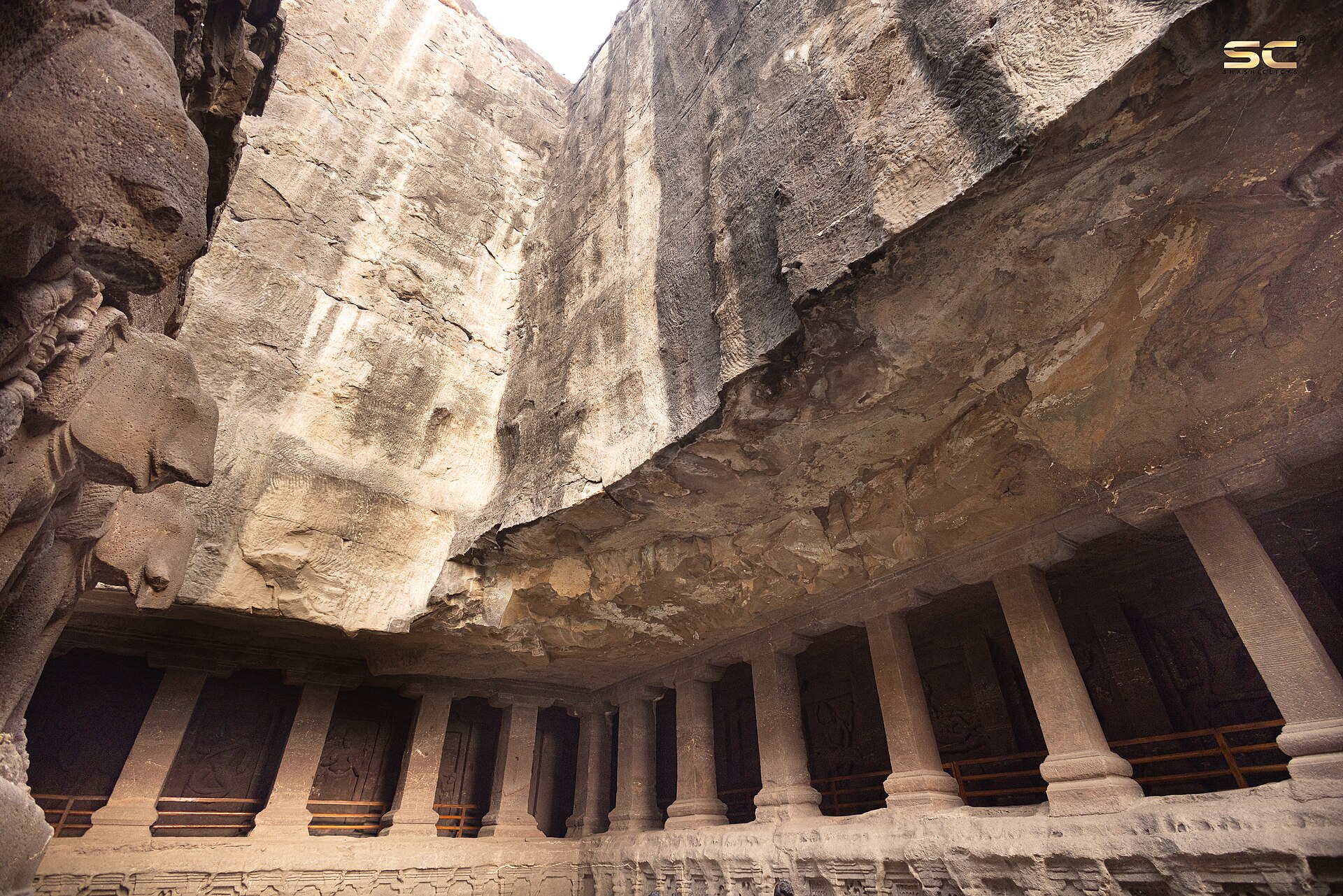
- Kailasa temple, Ellora cave 16. Kailasa temple, Ellora cave 16. Photo: Shashiclicks, CC BY-SA 4.0, via Wikimedia Commons — https://commons.wikimedia.org/wiki/File:Kailasa_Temple.jpg
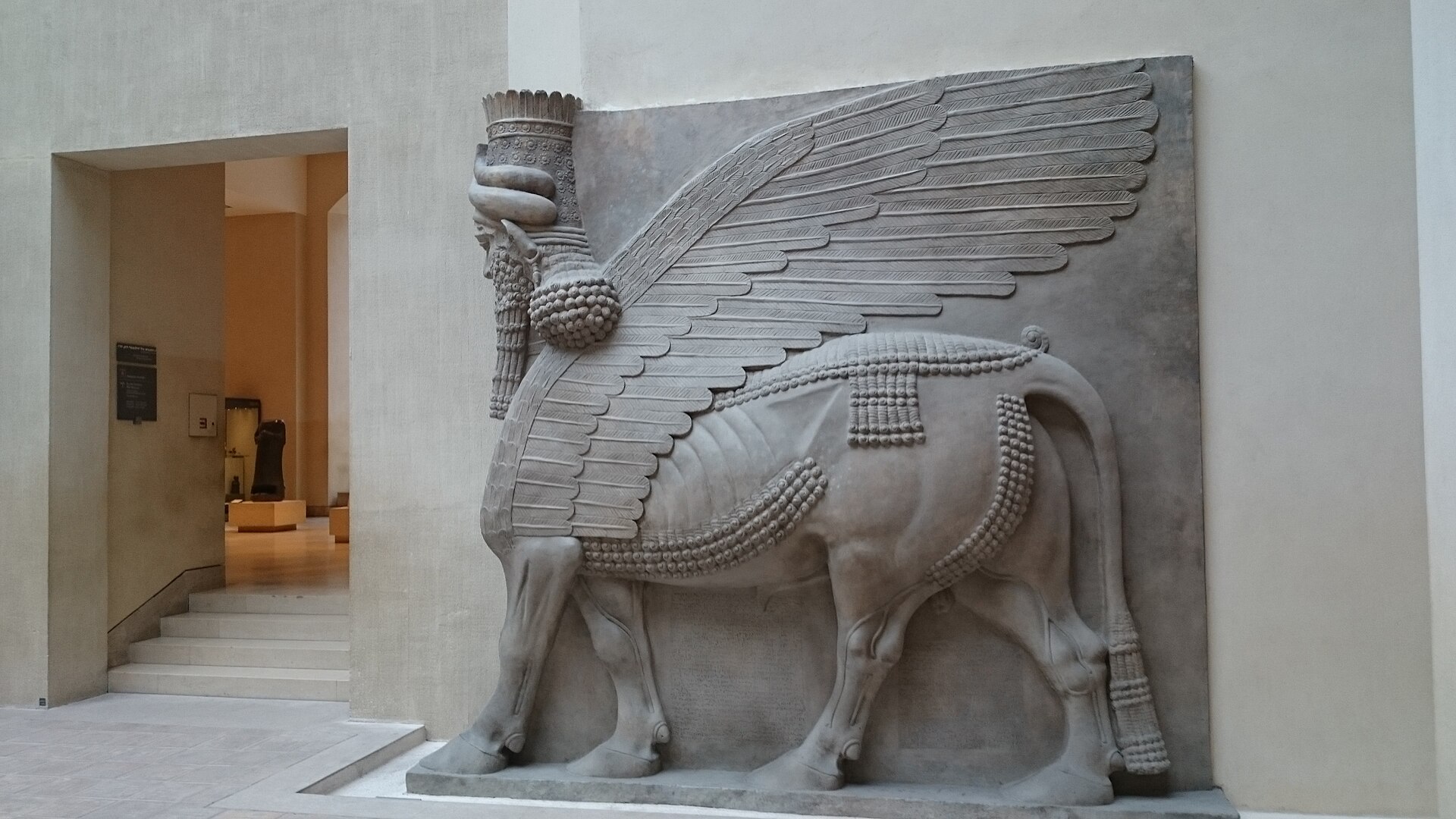
- Assyrian lamassu, Louvre. Assyrian lamassu, Louvre. Photo: Gil Dbd, CC BY-SA 4.0, via Wikimedia Commons — https://commons.wikimedia.org/wiki/File:Lamassu.jpg
- Adda seal, Akkadian period. Adda seal, Akkadian period, about 2300 BC. Photo: Nic McPhee, CC BY-SA 2.0, via Wikimedia Commons — https://commons.wikimedia.org/wiki/File:Adda_Seal_Akkadian_Empire_2300_BC.jpg
- Enki, detail of the Adda seal. Enki, detail of the Adda seal, British Museum 89115. Author not named on the Wikimedia Commons file page. Public domain, via Wikimedia Commons — https://commons.wikimedia.org/wiki/File:Enki(Ea).jpg
- Tiamat and Marduk, a public-domain drawing. Drawing of Tiamat in combat with Marduk. Unknown author, public domain, via Wikimedia Commons — https://commons.wikimedia.org/wiki/File:Tiamat.png