
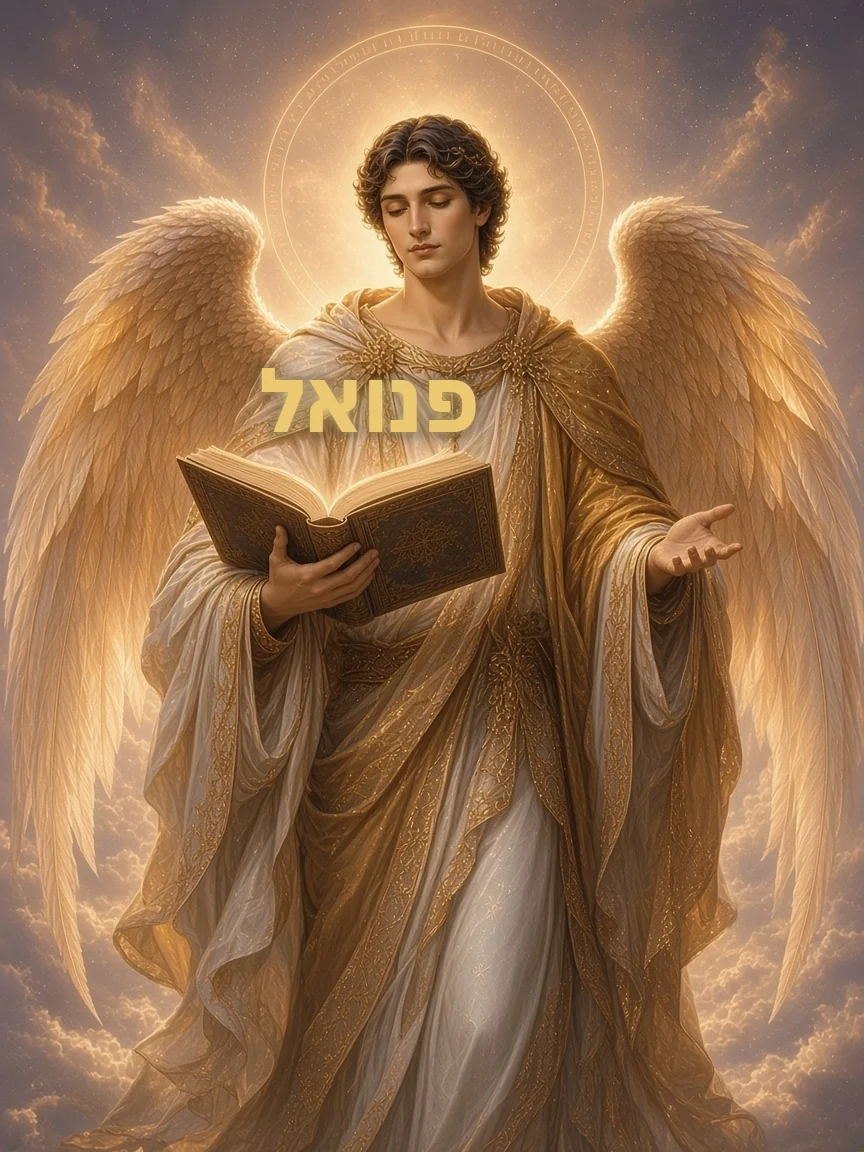
An archangel of 1 Enoch
Phanuel פְּנוּאֵל
Also known as Phanuel · Penuel, “face of God” (the Hebrew form) (sources under “Also known as” below)
Name: “face of God”.
Tracing the name backward
We go backward from the newest source to the oldest dated one, and step back only where a dated text or a published scholarly link anchors the step. Unproven or second-hand links are drawn dashed and marked. Raziel’s full chart is on his page.
Rest the pointer on a section to open it; click to keep it open.Tap a section to open it; tap again to close.
Name originwhat the name means and how it was built
Penu’el, “face of God”: the name Jacob gives the place where he wrestled, “for I have seen God face to face” (Genesis 32:30–31, Peniel/Penuel). It is also a man’s name (1 Chronicles 4:4; 8:25). As an angel, Phanuel appears only in the Similitudes of Enoch.
Earliest sourcesthe name traced backward, with dated anchors
Solid = a link anchored in a dated sourceDashed = unproven, second-hand or a later equationNewest at the top; each step goes back in time. Tap any box to open its anchor.
- c. 50 BCE–70 CE
Phanuel, the fourth angel of the Presence1 Enoch 40:9; 54:6; 71:8–9 (Similitudes)High
Among the four (Michael, Raphael, Gabriel, Phanuel), taking the place Uriel has in 1 Enoch 9; he is set over repentance and the hope of those who inherit eternal life (40:9, paraphrased from Charles 1917). Read The archangels: names and duties (Library, web of references).
before this: a place-name and a man’s name
- date debated
Penuel / PenielGenesis 32:30–31; 1 Chronicles 4:4Medium
A place and a man. Same name, not an angel.
no anchor
The trail endsNo earlier source names an angel PhanuelNo anchor
Rabbinic tradition itself says that “the names of the angels were brought by the Jews from Babylon” (Simeon ben Lakish, Jerusalem Talmud, Rosh Hashanah 1:2 [JE: “Yer. R. H. 54d”]; Genesis Rabbah 48:9; wording of the Jewish Encyclopedia, “Michael”). No text from before the Babylonian exile names any angel.
Also known asother names the sources give
Also known as Phanuel1 · Penuel, “face of God” (the Hebrew form)2
Sources for these names
- 1 Enoch 40:9 (Ge’ez, via Charles 1917)
- Genesis 32:31
Kept off the line: Uriel (whose place Phanuel takes in the list of four; a different angel).
Comparisonssimilar figures, where scholars draw the link
- Uriel. The Similitudes put Phanuel where the Book of the Watchers has Uriel. Scholars read this as a changed list, not one angel under two names.
- Other cultures. None found.
Comparisons are listed only where a scholar makes the link, or are marked as the Hall’s own note. A parallel of role is not a lineage of name.
Further readingbooks in Raziel’s Library and beyond
Unverified and sourceswhat is still to check, and every source
Checked No open unverified claims in this entry beyond those marked dashed in the chart.
Sources
- Charles, The Book of Enoch (1917), in the Library
Hover or tap to turn the card.
- Name
- Phanuel, from the Ge’ez of 1 Enoch via Charles. Penuel, “face of God,” is the Hebrew form of the same elements, used in Genesis 32:31 as a place-name, not as a Hebrew manuscript of this Enoch angel. Ancient1 Enoch 40:9, Charles 1917; Genesis 32:31
- Letters
- פנואל (Pe, Nun, Vav, Aleph, Lamed), the Hebrew form Penuel, painted as such and not as a witness from an Enoch manuscript. HouseHouse lettering of the form already given on this page from Genesis 32:31
- Office
- “The fourth, who is set over the repentance unto hope of those who inherit eternal life, is named Phanuel.” Ancient1 Enoch 40:9, Charles 1917, Hall reader
- With the Head of Days
- He goes in and out of that house with Michael, Raphael and Gabriel, and comes forth with them and the Head of Days. Ancient1 Enoch 71:8, 71:9, 71:13, Charles 1917
- The four
- The Similitudes put Phanuel where the Book of the Watchers has Uriel. Scholars read this as a changed list, not one angel under two names. Ancient1 Enoch 40:9; 71:8–13 compared with 9:1 and 20:2, Charles 1917
- Sefer Raziel (Paniel)
- The Book of the Angel Raziel lists a Paniel (פניאל) for Elul in one calendar and for Sivan in another, and again in a list with Nuriel and Suriel. The Hall does not identify Raziel’s Paniel with the Phanuel of the Similitudes; the forms are cited side by side. RevivalSefer Raziel, Hall English, 1701 tradition, Book of the Zodiac
- Agrippa, Hygromanteia, Key of Solomon, Book of Giants, 4 Ezra
- Not attested under Phanuel in the Hall copies. HouseHall English panels of Agrippa 1651; Hygromanteia (Heeg); Mathers Key of Solomon 1889; Book of Giants, Hall reader; 2 Esdras / 4 Ezra as cited for Uriel, which does not name Phanuel
- Colour, incense, metal, feast
- Not attested. HouseNo source on this shelf names a planet, colour, incense, metal or feast for him. The Renaissance card on this page shows an oil lamp; that is the card, not a cited office
- Pronoun
- The Hall honours him as “he.” HouseHouse; the cards already say “he”
Persona: as the books describe him
The books give Phanuel no body and no face; he is known by what he does. In the Similitudes, after Enoch asks the names of the four presences, the angel of peace says: “This first is Michael, the merciful and long-suffering: and the second, who is set over all the diseases and all the wounds of the children of men, is Raphael: and the third, who is set over all the powers, is Gabriel: and the fourth, who is set over the repentance unto hope of those who inherit eternal life, is named Phanuel” (1 Enoch 40:9, Charles 1917). He stands again with Michael, Raphael and Gabriel as they go in and out of the house of the Head of Days (71:8–9, 13). Ancient
The Similitudes put Phanuel where the Book of the Watchers has Uriel. Scholars read this as a changed list, not one angel under two names. The name itself reaches us in Ge’ez, via Charles. Penuel, “face of God,” is the Hebrew form of the same elements, used in Genesis 32:31 as a place-name; it is not a Hebrew manuscript of this Enoch angel. The Book of the Angel Raziel (Hall English, 1701 tradition) lists a Paniel (פניאל) for Elul in one calendar, and for Sivan in another; Paniel also stands in a list with Nuriel and Suriel. The Hall does not identify Raziel’s Paniel with the Phanuel of the Similitudes; the forms are cited side by side. Revival Agrippa, the Hygromanteia, the Key of Solomon, the Book of Giants and 4 Ezra on this shelf do not name Phanuel. The Hall honours him as “he.” House
Still to find
- A Hebrew or Aramaic witness that names this Enoch angel (the Ge’ez, via Charles 1917, is the Hall’s text; Penuel in Genesis 32:31 is a place-name).
- Whether Raziel’s Paniel (פניאל) is ever identified with Phanuel by a published scholar the Hall can cite; it is not identified here.