
2 Enoch 33–39 (short recension) — House translation
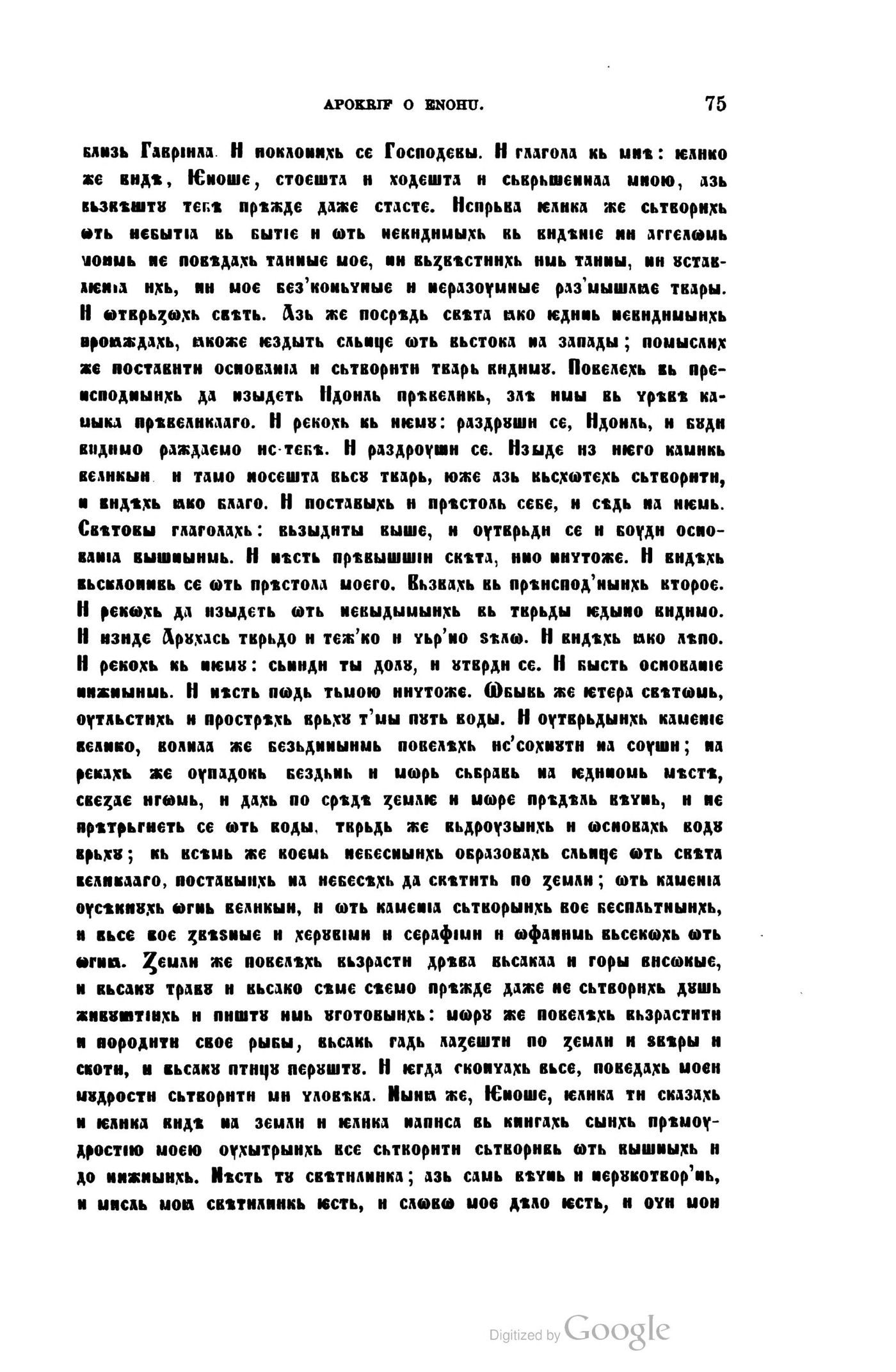
Witness: Belgrade NBS MS 151 (16th c., destroyed WWII) printed by St. Novaković, Starine XVI (1884) pp. 75-77
Scan: https://archive.org/details/starine_knjiga_16-17-18-jazu (PDM); starine16-leaf87.jpg, leaf88.jpg, leaf89.jpg
Method: Read by eye from 1884 page images (archive.org OCR unusable), normalised spelling; compared with Morfill 1896 (and its B notes) and Bonwetsch 1922 short-recension text + apparatus; House English; uncertain readings marked.
33:1-2
Witness status: ABSENT from this witness. Morfill n.: 'B omits verses 1, 2'. The 7,000-year passage exists only in the long recension (Popov 1880 Khludov MS 1679, Sokolov 1910 Belgrade MS 321 - neither available online today).
Morfill/Charles 1896: Then also I established the eighth day. Let the eighth be the first after My work, and let the days be after the fashion of seven thousand. Let there be at the beginning of the eighth thousand a time when there is no computation, and no end; neither years, nor months, nor weeks, nor days, nor hours. [n. Sok.: 'And let the eighth day be for a beginning in the likeness of eight thousand. So concerning the first day of My rest, and also the eighth day of My rest, let them return continually.' Margin of Sok.'s MS: 'the beginning of unrighteousness [sic], the time without end, neither years, nor months, nor weeks, nor days, nor hours.']
Bonwetsch 1922: (Längere Redaktion) Am achten Tag aber setzte ich denselben achten Tag, daß er sei der erste, der ersterschaffene meines Nichttuns, und daß sie gewandelt werden zum Bild des siebenten Tausends, und der achte werde zum Anfang der (acht) Tausende. Wie vom ersten Tag der Woche, so auch der achte Tag der Woche sollen beständig wiederkehren.
House translation: [SECONDARY - from Morfill and Bonwetsch, not from a Slavonic witness] And on the eighth day I set that same eighth day to be the first, the first-made of my rest; and let the days turn in the pattern of the seventh thousand, and let the eighth be the beginning of the thousands. As the first day of the week, so the eighth day of the week shall return without ceasing. [Sokolov's MS adds in the margin:] a time without end, with neither years nor months nor weeks nor days nor hours.
- Timeline reading: each creation day = 1,000 years; 6,000 years of the world, a 7th-thousand rest, and an 8th 'day' outside counted time. Morfill cites the same scheme in Jubilees 4:30, Irenaeus Adv. Haer. V.28.3, Augustine De Civ. XXII.30.
- Bonwetsch's 'der erste, der ersterschaffene meines Nichttuns' (first-created of my not-working) is closer to the Slavonic than Morfill's 'the first after My work'.
- Morfill's 'beginning of unrighteousness' in the margin note is almost certainly a misreading (неправды for нечисленое/безчисленное?) [unverified - Slavonic not seen].
- UPGRADE PATH: re-translate 33:1-2 from Sokolov 1910 (RSL, PD) when its PDF endpoint works, or from Popov 1880 if a scan is found.
33:3-4
Slavonic (1884 print, normalised): Нынѣ же, Єноше, єлика ти сказахь и єлика видѣ на земли и єлика написа въ книгахь сихь, прѣмѹдростию моєю оухытрихь все сътворити, сътворивь ѿ вышнихь и до нижьнихь. Нѣсть тѹ свѣтилника; азь самь вѣчнь и нерѹкотвор'нь, и мисль моꙗ свѣтилникь єсть, и слово мое дѣло єсть, и очи мои сьглєдають вьсе. Аште призираю на вьсе, то стоить, аште ли же ѿвраштѹ се, то все потребить се.
Morfill/Charles 1896: And now, Enoch, what things I have told thee, and what thou hast understood, and what heavenly things thou hast seen, and what thou hast seen upon the earth, and what thou hast written in books, by My wisdom all these things I devised so as to create them, and I made them from the highest foundation to the lowest, and to the end. And there is no counsellor nor inheritor of My works. I am the eternal One, and the One not made with hands: My thought is without change, My wisdom is My counsellor and My word is reality; and My eyes see all things, if I look to all things they stand fast. If I turn away My face, all are in need of Me. [n.: 'Lamp, B'; 'My thought is a lamp, B']
Bonwetsch 1922: (see apparatus) ... und nicht ist ein Berater ... wenn ich aber mein Angesicht abwende ...
House translation: And now, Enoch, all that I have told you, all that you saw on the earth, and all that you wrote in these books — by my wisdom I contrived to make it all, and I made it from the highest to the lowest. There is no lamp there; I myself am eternal and not made by hands, and my thought is a lamp, and my word is deed, and my eyes look upon all things. If I look upon all things, they stand; but if I turn myself away, all of it is destroyed.
- Print reads свѣтилника 'lamp' where the long recension has свѣтника 'counsellor' (Morfill notes 'Lamp, B'). One letter apart; the House text keeps the witness: 'There is no lamp there … my thought is a lamp.' God's thought itself is the light.
- Morfill 'if I turn away My face, all are in need of Me' vs this witness: все потребить се 'everything is destroyed/consumed' - stronger, and matches Ps 104:29.
- This witness has no 'what heavenly things thou hast seen' and no 'to the end'.
- сихь: print сынхь with the ч/у-type ambiguity; read сихъ 'these' [uncertain].
33:5-7
Slavonic (1884 print, normalised): Положи ѹмь свои, Єноше, и познаи глаголюштаго тебѣ, и възми книги ꙗже написа. И даю ти Семила аггела и Расѹила и възведшаго къ мнѣ. И сьниди на землю, и скажи сыномь своимь єлика глаголахь къ тебѣ и єлика видѣ ѿ нижьнꙗго небеси и до прѣстола моего. Вьса воиньства азь сътворихь; нѣсть противлꙗен се мнѣ, или не покарꙗен се. Вьси покарꙗють се моемѹ єдиновластию, работають моеи власти.
Morfill/Charles 1896: And now pay attention, Enoch, and know thou who is speaking to thee, and do thou take the books which thou thyself hast written. And I give thee Samuil and Raguil who brought thee to Me. [n.: 'Semil and Rasuil, B'] And go with them upon the earth, and tell thy sons what things I have said to thee, and what thou hast seen from the lowest heaven up to My throne. For I have created all the hosts, and all the powers, and there is none that opposes Me, or is disobedient to Me. For all are obedient to My sole power, and labour for My rule alone.
Bonwetsch 1922: Und ich gebe dir die Engel Semeel und Rasuel, die dich zu mir heraufgeführt haben ... Alle Heerscharen habe ich geschaffen, und nicht ist, der sich mir widersetzt oder nicht untertan ist; alle sind untertan meiner Alleinherrschaft und dienen meiner alleinigen Herrschaft.
House translation: Set your mind, Enoch, and know the One who speaks to you, and take the books that you wrote. And I give you the angel Semil, and Rasuil, who led you up to me. Go down to the earth and tell your sons all that I have spoken to you and all that you saw, from the lowest heaven up to my throne. All the hosts I made; none sets himself against me or fails to submit. All submit to my sole rule and serve my power.
- Angel names as printed: Семила / Расѹила (Semil, Rasuil). Long recension: Samuil and Raguil. Keep both; Rasuil vs Raguil is a г/с confusion in transmission.
- єдиновластию 'sole rule, monarchy' (Bonwetsch 'Alleinherrschaft').
33:8-12
Slavonic (1884 print, normalised): Даи же имь книги рѹкописаниꙗ твоего, чедомь чеда и оужикомь оужики и родь въ родь, ꙗко ходатаи, Єноше, моего воеводы Михаила, заньѥ рѹкописание твое и роукописание ѿтьць твоихь, Адама и Сита, не потребить се до вѣка послѣдьнꙗго, ꙗко азь заповѣдахь аггеломь моимь Ѡрьюхѹ и Марьюхѹ, ꙗкоже поставихь на земли хар'тию, и повелѣвати врѣменомь да сьнаб'деть [сic; ed.: съблюдеть] и рѹкописание ѿтьць твоихь да сьблюдеть, да не погибнеть въ потопѣ иже азь сътворю въ родѣ твоемь.
Morfill/Charles 1896: [n. B:] Let the children give them to the children ... As being the messenger Enoch of my captain Michael. Because that thy writings and the writings of thy fathers, Adam and Sit, (because these) will not be required till the last age, I have ordered my angels, Oriokh and Mariokh, to give orders to guard in season the writings which I have placed upon the earth, and that they should guard the writings of thy fathers, so that what I have wrought in thy family may not be lost.
Bonwetsch 1922: Denn ich gebe dir als Mittler, Henoch, meinen Archistrategen Michael, weil deine Handschrift und die Handschrift deiner Väter, Adams und Seths, nicht sollen vernichtet werden bis zum letzten Aeon, da ich geboten habe meinen Engeln Arioch und Marioch, welche ich gesetzt habe auf die Erde, sie zu bewahren [app.: 'chraniti ju: chartiju V'] ... damit sie nicht vernichtet werde in der kommenden Sintflut.
House translation: Give them the books of your handwriting — children to children, kin to kin, generation to generation — for you, Enoch, are as an envoy of my commander Michael; because your handwriting and the handwriting of your fathers, Adam and Seth, shall not be destroyed until the last age. For I have commanded my angels Oriukh and Mariukh, as I set the charter [хартия] upon the earth, to command the times to keep it, and to keep the handwriting of your fathers, that it may not perish in the Flood which I will make in your generation.
- хар'тию: the print really reads 'charter / written sheet' (Greek χάρτης), where other MSS read храниті ю 'to guard it' (Bonwetsch app.: 'chraniti ju: chartiju V'). Our witness agrees with V. House keeps 'charter' - the guardian angels keep a written charter on earth.
- Angel names as printed: Ѡрьюхъ and Марьюхъ (Oriukh, Mariukh); Morfill A: Ariukh and Pariukh; Bonwetsch: Arioch and Marioch.
- Editor's footnote 1 (Novaković): сьнаб'деть 'is without doubt a misprint/scribal error for' съблюдеть ('let it keep'). Followed.
- оужикомь оужики 'kinsmen to kinsmen' (Bonwetsch 'Blutsverwandten').
- ходатаи ... воеводы Михаила: Morfill's B note renders 'the messenger Enoch of my captain Michael' - i.e. Enoch is Michael's envoy, not Michael Enoch's. Our print supports Morfill's B note, against Bonwetsch's 'ich gebe dir als Mittler … Michael' (that is the other MSS).
34:1-3
Slavonic (1884 print, normalised): Азь бо вѣмь злобѹ чловѣчю, ꙗко не понесѹть ꙗр'ма иже въздвигохь имь, ни сѣють сѣмень, ꙗже дахь имь, нь ѿврьгоше ꙗрьмь мои, и ꙗрьмь инь въсприимѹть, и всѣють сѣмена пѹстош'наꙗ, и поклонеть се богомь сѹєтнымь и ѿрынѹть мое єдиньствие, и вьса земли сьгрозить се неправдами, ѡбидами и прѣлюбодѣиствии и идолослѹжении. Тогда и азь наведѹ потопь на землю, и земли съкрѹшить се въ тьмение велико.
Morfill/Charles 1896: For I know the wickedness of men that they will not bear the yoke which I have put upon them, nor sow the seeds which I have given them, but will cast off My yoke and accept another, and sow vain seeds and bow to vain gods, and deny Me the only God. And they will fill all the world with wickedness ... [n.: 'Unjust deeds and harlotries and services of idols, B'] And on this account I will bring a deluge upon the earth and I will destroy all, and the earth shall be destroyed in great corruption.
Bonwetsch 1922: ... und die ganze Erde wird verkehrt werden durch Taten der Ungerechtigkeit und der Kränkung und durch Unzucht und Götzendienst. Alsdann führe ich eine Sintflut auf die Erde, und die ganze Erde selbst wird in großen Schlamm zertrümmert werden.
House translation: For I know the wickedness of man: they will not bear the yoke I raised upon them, nor sow the seed I gave them, but they cast off my yoke and take up another yoke, and sow empty seeds, and bow to vain gods and throw away my oneness; and the whole earth will be shaken with injustices, wrongs, adulteries and idol-service. Then I will bring a flood upon the earth, and the earth will be crushed into a great mire.
- сьгрозить се: Bonwetsch app. lists sogrözitsja B¹ / sügrozitsje V; our print = сьгрозить се 'will be shaken / thrown into terror'.
- тьмение 'mire, mud' (Bonwetsch 'Schlamm'); Morfill's 'corruption' is a paraphrase. CORRECTION: the earth is crushed into great mud.
- ѿрынѹть мое єдиньствие 'reject my oneness' (Bonwetsch 'verwerfen meine Einzigkeit') — Morfill's 'deny Me the only God'.
35:1-3
Slavonic (1884 print, normalised): И ѡставлю мѹжа праведнаа сь вьсемь домомь єго, иже сътворить по воли моеи. И ѿ сѣмене ихь въстанеть родь инь послѣдь [?] многь и несыть ѕѣло. Тогда въ възводе рода того ꙗветь се книги рѹкописаниꙗ твоего и ѿтьць твоихь, имь же стражие земли, и покажѹть є мѹжемь вѣр'нымь, и скажѹть родѹ томѹ, и прославеть въ послѣд'къ паче иже прьвѣє.
Morfill/Charles 1896: And I will leave a righteous man of thy race, with all his house who shall act according to My will. From their seed after some time will be raised up a numerous generation, but of these, many will be very insatiable. Then on the extinction of that family, I will show them the books of thy writings, and of thy fathers, and the guardians of them on earth will show them to the men who are true ... and they shall tell to another generation, and these having read them, shall be glorified at last more than before.
Bonwetsch 1922: Und ich lasse überbleiben einen gerechten Mann von deinem Geschlecht mit seinem ganzen Hause ... Und aus seinem Samen wird aufstehen ein anderes letztes Geschlecht, ein großes und überaus unersättlich. Alsdann beim Herausführen jenes Geschlechts werden offenbar werden die Bücher deiner Handschrift und deiner Väter, da die Wächter der Erde sie zeigen werden treuen Männern ...
House translation: And I will leave a righteous man with all his house, who will act according to my will. And from their seed will arise another generation, a later one, numerous and exceedingly insatiable. Then, at the raising-up of that generation, the books of your handwriting and of your fathers will be revealed — by those who are the guardians of the earth — and they will show them to faithful men, and they will tell that generation, and in the end they will be glorified more than at the first.
- CORRECTION vs Morfill: въ възводѣ рода того = 'at the bringing-up / raising of that generation' (Bonwetsch 'beim Herausführen'), not 'on the extinction of that family'. The books are revealed when the late generation arises, not when it dies out.
- This witness lacks 'of thy race' (Morfill n.: A B om.).
- послѣдь: print по-слѣды/послѣдь at line break [uncertain]; Bonwetsch 'letztes', VB¹ 'hernach'.
- Timeline value: Flood → Noah's line → a late, insatiable generation → the Enoch books re-emerge through the 'guardians of the earth' (Oriukh and Mariukh of 33:11).
36:1-2
Slavonic (1884 print, normalised): Нынѣ же, Єноше, даю ти рокь прѣжданиꙗ .л. дьни сътворити въ домѹ твоемь; глаголи сыномь своимь, вьсе иже єсть хранеи срьдце свое, да прочтѹть и разѹмѣють ꙗко нѣсть Бога развѣ мене. И по .л. дьнии азь послю аггелы мое по тебѣ, и възмѹть те ѿ земле и ѿ сыновь твоихь, єлико по воли моеи.
Morfill/Charles 1896: And now, Enoch, I give thee a period of thirty days to work in thy house. And tell thou thy sons [n.: 'B adds all that thou guardest in thy heart'] ... that they read and understand, how there is no other God beside Me ... And after thirty days, I will send My angels for thee, and they shall take thee from the earth, and from thy sons, according to My will.
Bonwetsch 1922: Jetzt aber, Henoch, gebe ich dir eine bestimmte Zeit des Termins, dreißig Tage, zu verbringen in deinem Hause, und sage deinen Söhnen ... und jedem, welcher ist sein Herz behütend, damit sie durchlesen und erkennen, daß nicht ist ein Gott außer mir. Und nach dreißig Tagen werde ich meine Engel nach dir senden ...
House translation: And now, Enoch, I give you a set term of thirty days to spend in your house. Tell your sons — everyone who keeps his heart — that they may read and understand that there is no God but me. And after thirty days I will send my angels for you, and they will take you from the earth and from your sons, as is my will.
- .л. = Cyrillic numeral 30.
- рокь прѣжданиꙗ 'term of waiting' (Bonwetsch app. 'rok prezädanija').
- вьсе иже єсть хранеи срьдце свое: this witness's addition (Morfill: 'B adds all that thou guardest in thy heart'); read as 'everyone who guards his heart'.
37-38
Witness status: Ch. 38 is absent from this witness (Morfill: 'B omits entire chapter'). Ch. 37 (the cold angel) is not here: this witness places it inside ch. 39 (see 39:8 below), as Morfill and Bonwetsch both note.
39:1-2, 6-7
Heading in print: Поѹчение Єнохово къ сыномь своимь — The Instruction of Enoch to his sons
Slavonic (1884 print, normalised): Азь бо пѹштень єсмь ѿ ѹсть господнихь къ вамь глаголати вамь єлико єсть и єлико бѹдеть до дьне сѹд'нꙗго. И нынѣ, чеда моꙗ, не ѿ оусть своихь вѣштаю вамь дьньсь, нь ѿ оусть господнихь. Вы же оубо слышасте глаголы мое изь оусть моихь, азь же слышахь глаголы господние ꙗко громь великь непрѣстаннымь метежемь ѡблакь; азь же видѣхь ѡбꙗтие господне без'мѣр'но и без'прикладно, ємѹже нѣсть кон'ца.
Morfill/Charles 1896: [n. B:] I was sent of late to tell you from the lips of the Lord what things are, and what shall be before the day of judgement. And now, my children, I do not speak to you from my own lips, but from the lips of the Lord ... You therefore hear the words of my lips, but I have heard the words of the Lord, like great thunder, with continual agitation of the clouds. ... I have seen the measureless and harmonious form of the Lord. To Him there is no end.
Bonwetsch 1922: Denn ich bin gesandt, von dem Mund des Herrn heute zu euch ... Ihr nun hört meine Worte, ich aber hörte die Worte des Herrn, wie einen großen Donner mit unaufhörlichem Werfen der Wolken. [app.: 'ich aber sah — ist' hier VB¹] ... ich aber sah den Umfang des Herrn ohne Maß und unvergleichlich, des kein Ende ist.
House translation: For I am sent from the mouth of the Lord to you, to tell you all that is and all that will be until the day of judgment. And now, my children, I do not speak to you today from my own mouth, but from the mouth of the Lord. You have heard my words from my mouth; but I heard the words of the Lord like great thunder with the unceasing hurling of the clouds; and I saw the compass of the Lord, measureless and beyond compare, which has no end.
- This witness omits 39:3-5 (the Lord's face like glowing iron, eyes like sunbeams, right hand filling heaven) and moves the 'measureless compass' line up here, exactly as Bonwetsch's apparatus records for V and B¹.
- ѡбꙗтие 'embrace, compass, circumference' (print ѡбѣти at a damaged/ambiguous spot; Bonwetsch 'Umfang', objatie). Morfill 'form' is a paraphrase. [reading ѡбꙗтие uncertain from image]
- метежь 'hurling / turmoil' (Bonwetsch 'Werfen (Verwirrung)').
39:8 + 37:1-2 (as placed in this witness)
Slavonic (1884 print, normalised): Нынѣ словеса моꙗ слышите, бесѣдѹ ѡ цари земльнѣмь: боꙗзнино и бѣдно стати прѣдь лицемь цара земльнꙗго, страшно и бѣдно єсть, заньѥ воля цареꙗ сьмрьть, и воля єсть царева животь; или знои великы. Нь възва Господь єдиного ѿ аггель старѣишꙗго грозѣ, и постави оу мене, и видѣние аггела того снѣгь, а рѹцѣ ємѹ ледь, и оустѹди лице мое, заньѥ не трьпѣхь зноꙗ великааго и страха ѡного. И тако глагола Господь къ мнѣ.
Morfill/Charles 1896: And now, my children, listen to the discourses of your earthly father. It is terrible and awful to stand before the face of an earthly prince ... because the will of the prince is death and the will of the prince is life; how much more ... before the face of the Lord of lords ... Who can endure this never-ending terror? [37, bracketed:] And God called one of His greatest angels, terrible and awful, and placed him by me, and the appearance of that angel was like snow, and his hands were like ice ... and my face was chilled ...
Bonwetsch 1922: ... zu stehen aber vor dem Angesicht des Königs der Könige, wer wird bestehen den endlosen Schmerz oder die große Hitze? — XXXVII Aber es rief der Herr einen von den obersten Engeln, einen schrecklichen, und stellte ihn zu mir. Und das Aussehen jenes Engels Schnee, und seine Hände Eis, und er machte erkalten mein Angesicht, weil ich nicht ertrug die große Hitze ... Und so sprach der Herr alle seine Worte zu mir.
House translation: Now hear my words, a discourse about an earthly king: it is fearful and perilous to stand before the face of an earthly king — terrible and perilous, because the king's will is death and the king's will is life; [how much more before the King of kings —] or the great heat? But the Lord called one of the eldest angels, a terrible one, and set him beside me; and the appearance of that angel was snow, and his hands ice, and he cooled my face, because I could not bear the great heat and that terror. And so the Lord spoke to me.
- The 'King of kings' clause is missing in this print; the line jumps to 'or the great heat' (Bonwetsch app.: B¹ 'Und es ward auf mich e. große Hitze'). Bracketed words are supplied from the other MSS. [lacuna]
- старѣишꙗго грозѣ: 'of the eldest, a terrible one' (Bonwetsch app.: groze BVB¹).
- Structural finding: the cold angel (ch. 37 in the long recension) cools Enoch's face here, in Enoch's own retelling to his sons — which makes narrative sense (it explains why his face can be looked upon) and supports the short recension being the more coherent, possibly earlier, form.
Verification: First read + targeted zoom on ambiguous lines (Grok Bot, AI-assisted). Needs a second reader.