
Chinese shelf · Pu Songling · 聊齋志異 · Giles I · Tale 1
考城隍 · Examination for the Post of Guardian AngelKao Chenghuang · Giles 1880, vol. 1, no. I
Public domain. Pu Songling (1640–1715). Translated by Herbert A. Giles, 1880. Giles sometimes shortened or softened passages, so the two columns do not always match line for line.
Chinese 文言
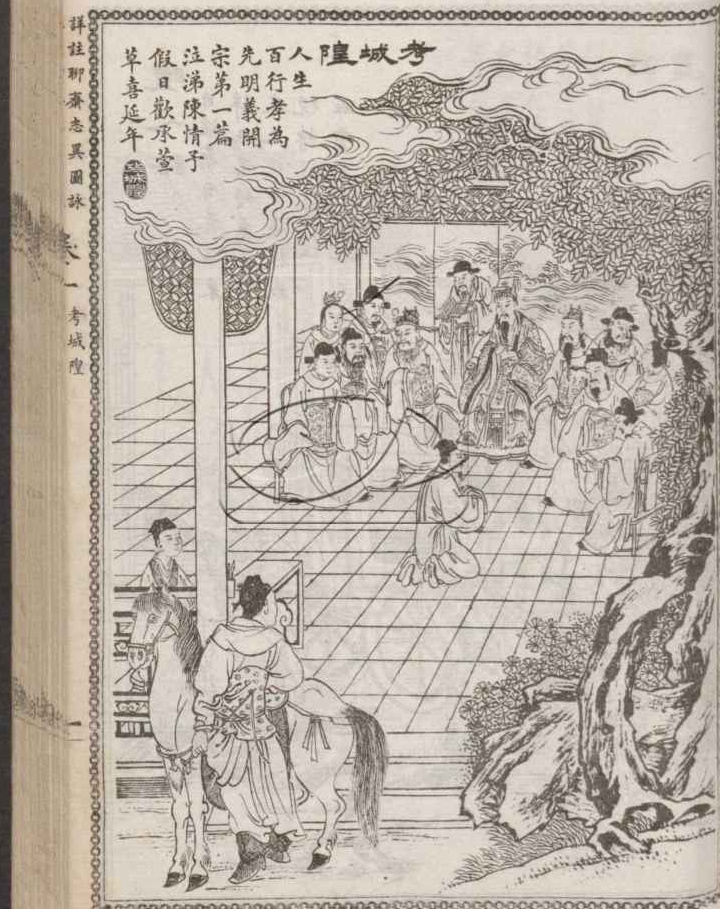
予姊夫之祖,宋公諱燾,邑廩生。一日,病臥,見吏持牒牽白顛馬來,云:「請赴試。」公言:「文宗未臨,何遽得考?」吏不言,但敦促之。公力疾乘馬從去,路甚生疎,至一城郭,如王者都。移時,入府廨,宮室壯麗,上坐十餘官,都不知何人,惟關壯繆可識。簷下設几墩各二,先有一秀才坐其末,公便與連肩。几上各有筆札,俄題紙飛下,視之,八字云:「一人二人,有心無心。」二公文成,呈殿上,公文中有云:「有心為善,雖善不賞;無心為惡,雖惡不罰。」
諸神傳讚不已,召公上,諭曰:「河南缺一城隍,君稱其職。」公方悟,頓首泣曰:「辱膺寵命,何敢多辭!但老母七旬,奉養無人,請得終其天年,惟聽錄用。」上一帝王像者,即令「稽母壽籍。」有長鬚吏,捧冊翻閱一過,白「有陽算九年。」共躊躇間,關帝曰:「不妨令張生攝篆,九年瓜代,可也。」乃謂公「應即赴任,今推仁孝之心,給假九年,及期,當復相召。」又勉勵秀才數語,二公稽首並下,秀才握手,送諸郊野,自言:長山張某,以詩贈別,都忘其詞,中有「有花有酒春常在,無燭無燈夜自明」之句。公既騎,乃別而去,及抵里,豁若夢寤。
時卒已三日。母聞棺中呻吟,扶出半日,始能語。問之長山,果有張生於是日死矣。後九年,母果卒,營葬既畢,浣濯入室而歿。其岳家居城中西門內,忽見公鏤膺朱幩,輿馬甚眾,登其堂,一拜而行,相共驚疑,不知其為神,奔訊鄉中,則已歿矣。公有自記小傳,惜亂後無存,此其略耳。
English Giles 1880
My eldest sister’s husband’s grandfather, named Sung Tao, was a graduate.37 One day, while lying down from indisposition, an official messenger arrived, bringing the usual notification in his hand and leading a horse with a white forehead, to summon him to the examination for his master’s degree. Mr. Sung here remarked that the Grand Examiner had not yet come, and asked why there should be this hurry. The messenger did not reply to this, but pressed so earnestly that at length Mr. Sung roused himself, and getting upon the horse rode with him. The way seemed strange, and by-and-by they reached a city which resembled the capital of a prince. They then entered the Prefect’s yamên,38 the apartments of which were beautifully decorated; and there they found some ten officials sitting at the upper end, all strangers to Mr. Sung, with the exception of one whom he recognised to be the God of War.39 In the verandah were two tables and two stools, and at the end of one of the former a candidate was already seated, so Mr. Sung sat down alongside of him. On the table were writing materials for each, and suddenly down flew a piece of paper with a theme on it, consisting of the following eight words:—“One man, two men; by intention, without intention.” When Mr. Sung had finished his essay, he took it into the hall. It contained the following passage: “Those who are virtuous by intention, though virtuous, shall not be rewarded. Those who are wicked without intention, though wicked, shall receive no punishment.” The presiding deities praised this sentiment very much, and calling Mr. Sung to come forward, said to him, “A Guardian Angel is wanted in Honan. Go you and take up the appointment.” Mr. Sung no sooner heard this than he bowed his head and wept, saying, “Unworthy though I am of the honour you have conferred upon me, I should not venture to decline it but that my aged mother has reached her seventh decade, and there is no one now to take care of her. I pray you let me wait until she has fulfilled her destiny, when I will hold myself at your disposal.” Thereupon one of the deities, who seemed to be the chief, gave instructions to search out his mother’s term of life, and a long-bearded attendant forthwith brought in the Book of Fate. On turning it over, he declared that she still had nine years to live; and then a consultation was held among the deities, in the middle of which the God of War said, “Very well. Let Mr. graduate Chang take the post, and be relieved in nine years’ time.” Then, turning to Mr. Sung, he continued, “You ought to proceed without delay to your post; but as a reward for your filial piety, you are granted a furlough of nine years. At the expiration of that time you will receive another summons.” He next addressed a few kind words to Mr. Chang; and the two candidates, having made their kotow, went away together. Grasping Mr. Sung’s hand, his companion, who gave “Chang Ch‘i of Ch‘ang-shan” as his name and address, accompanied him beyond the city walls and gave him a stanza of poetry at parting. I cannot recollect it all, but in it occurred this couplet:—
“With wine and flowers we chase the hours,
In one eternal spring:
No moon, no light, to cheer the night—
Thyself that ray must bring.”
Mr. Sung here left him and rode on, and before very long reached his own home; here he awaked as if from a dream, and found that he had been dead three days,40 when his mother, hearing a groan in the coffin, ran to it and helped him out. It was some time before he could speak, and then he at once inquired about Ch‘ang-shan, where, as it turned out, a graduate named Chang had died that very day.
Nine years afterwards, Mr. Sung’s mother, in accordance with fate, passed from this life; and when the funeral obsequies were over, her son, having first purified himself, entered into his chamber and died also. Now his wife’s family lived within the city, near the western gate; and all of a sudden they beheld Mr. Sung, accompanied by numerous chariots and horses with carved trappings and red-tasselled bits, enter into the hall, make an obeisance, and depart. They were very much disconcerted at this, not knowing that he had become a spirit, and rushed out into the village to make inquiries, when they heard he was already dead. Mr. Sung had an account of his adventure written by himself; but unfortunately after the insurrection it was not to be found. This is only an outline of the story.
Giles’s notes
- The tutelar deity of every Chinese city. ↩
- That is, he had taken the first or bachelor’s degree. I shall not hesitate to use strictly English equivalents for all kinds of Chinese terms. The three degrees are literally, (1) Cultivated Talent, (2) Raised Man, and (3) Promoted Scholar. ↩
- The official residence of a mandarin above a certain rank. ↩
- The Chinese Mars. A celebrated warrior, named Kuan Yü, who lived about the beginning of the third century of our era. He was raised after death to the rank of a God, and now plays a leading part in the Chinese Pantheon. ↩
- Catalepsy, which is the explanation of many a story in this collection, would appear to be of very common occurrence amongst the Chinese. Such, however, is not the case; in which statement I am borne out by my friend, Dr. Manson, of Amoy, who, after many years’ practice among the natives of that port, and also of Formosa, informs me that he has never even heard of a single instance of this strange complaint. ↩
English: Herbert A. Giles, Strange Stories from a Chinese Studio, vol. 1 (London: Thos. de la Rue, 1880), public domain, text via Project Gutenberg #43627. Footnotes are Giles’s. Chinese: 蒲松齡《聊齋志異》, public domain, text via Chinese Wikisource (modern editors’ glosses and the Qing commentaries are left out, and variant readings follow the first reading given).