
A field guide to the holy angels
The Biology of the Angels
What an angel is, how the old books describe each kind, and where every one of them is named, gathered from the books in Raziel’s Library™. This is a field guide to the heavenly host, and nothing here is made up: every line gives the book it comes from.
Begin here
Raziel, the angel of the secrets of God
His name, the old books that name him (the Targum on Ecclesiastes, Pesikta Rabbati, the Slavonic Enoch, the Book of Raziel and Agrippa), his stat block and every passage.
Read Raziel’s page →
Raziel speaks
“I have come to make you understand pure utterances and great wisdom.” Raziel to Adam, Sefer Raziel HaMalakh (Amsterdam 1701), scan p. 11; Hall verified translation.
The Hall keeps the angels with reverence. They are presented here as they appear in ancient works and in art: as the books describe them, not as a creed.
The word “angel”
Hebrew מַלְאָךְ (mal’akh) means “messenger”, from a root meaning “to send”. When Jewish scholars put the scriptures into Greek (the Septuagint, 3rd–2nd c. BCE) they wrote ἄγγελος (angelos), also “messenger”; Latin made it angelus, and English “angel”. Ge’ez has mal’ak, Syriac mal’akha, Arabic مَلَك (malak, plural malā’ika). Ancient
Not every holy being is a “messenger”
Many are named for what they are. Seraphim are “burning ones” (Isaiah 6:2). Cherubim guard Eden (Genesis 3:24) and the mercy seat (Exodus 25:18–22). Ophanim are “wheels” (Ezekiel 1:15–21). Hayyot are the “living creatures” (Ezekiel 1:5). The ‘irin are “watchers” (Daniel 4:13, 17). In 1 Enoch 20 the holy angels “who watch” are Uriel, Raphael, Raguel, Michael, Saraqael and Gabriel. Ancient
How to read an angel’s page
Each angel has a stat block, filled from the books in Raziel’s Library. Its rows are: order and choir, station, letters and divine name, psalm or word, domain, gifts, shadow, heaven (planet), degrees, days and hours, colours, metal, incense, seal, direction, the people the angel guided, and feast days. Below the block come the angel’s persona (how the books describe them), every passage where they appear, in each language we have, and their blessings and prayers.
Each line carries a tag showing how old its source is, so you can tell ancient witness from later lore:
Why the tags matter
Lists of incense, colours, metals and hours for named angels mostly come from Renaissance grimoires and the 19th-century occult revival (Lenain 1823, Mathers 1889, the Golden Dawn), not from scripture. The Hall keeps them, because they are part of the lore, but marks them. Where no old book gives an attribute, the page says so instead of inventing one.
The orders of angels
Pseudo-Dionysius, writing about 500, arranges the angels in three triads, nearest to God first (Celestial Hierarchy VI–IX). Ancient
Traditions differ. Dionysius puts Virtues before Powers; Lenain (1823) counts Powers before Virtues, as the column shows. Gregory the Great (Homily 34, 591) gives the same nine with the middle choirs in another order. Agrippa’s Hebrew names do not match the Greek one for one: he gives “Seraphim” as the Hebrew name of the Powers and “Cherubim” for the Angels. Lenain’s numbers are checked on the manuscript for 17–24 only so far.
The Hebrew orders in Agrippa III.10
Agrippa’s Hebrew names for the nine orders, in the order of the table, with his own glosses from the English of 1651 (Book III, chapter 10). Read the chapter in Raziel’s Library. Renaissance
- Haioth ha-Kadosh
- “Creatures of holiness”: Agrippa’s Hebrew name for the Seraphim, through which Eheia, at Kether, “bestows the gift of being to all things”.
- Ophanim
- “Forms or wheels”: Agrippa’s Hebrew name for the Cherubim, at Hochma (wisdom), whose intelligence is Raziel, “the ruler of Adam”.
- Aralim
- “Great Angels mighty and strong”: Agrippa’s Hebrew name for the Thrones, at Binah (understanding).
- Hasmalim
- Agrippa’s Hebrew name for the Dominations, at Hesed (clemency or goodness), “fashioning the Images of bodyes”.
- Seraphim
- Agrippa’s Hebrew name for the Powers, at Geburah (power), which “draweth forth the Elements”. Not the Seraphim of the first triad.
- Malachim
- “That is Angels”: Agrippa’s Hebrew name for the Virtues, at Tiphereth (beauty), into the sphere of the Sun.
- Elohim
- “That is Gods”: Agrippa’s Hebrew name for the Principalities, at Netzach (victory), into the sphere of Venus.
- Bene Elohim
- “The sons of God” (Agrippa: Ben Elohim): his Hebrew name for the Archangels, at Hod (praise), into the sphere of Mercury.
- Cherubim
- Agrippa’s Hebrew name for the order of Angels, at Yesod (foundation): “the order of Angels, whom the Hebrews name Cherubim”.
The first triad: Seraphim, Cherubim, Thrones
In the Hall’s translation of chapter VII (Basel O III 5, Eriugena’s Latin): the Seraphim burn, the Cherubim are full of knowledge, and the Thrones bear God. Eriugena calls the Thrones sedes, “seats”, and deiferi, “God-bearing”. Ancient
The second and third triads
The middle triad rules and orders; the last is nearest to us. Dionysius gives each nation its presiding angel and names “the distinguished Michael as Ruler of the Jewish people” (IX, Parker 1894, pp. 34–35). Ancient
The synaxis of the holy archangels, in a tenth-century book
From the 1907 public-domain facsimile of the Menologion of Basil II (Vat.gr.1613). The official 1907 caption is “La sinassi dei ss. Arcangeli,” 8 November.

The many-eyed: seraphim, living creatures and wheels
Seraphim
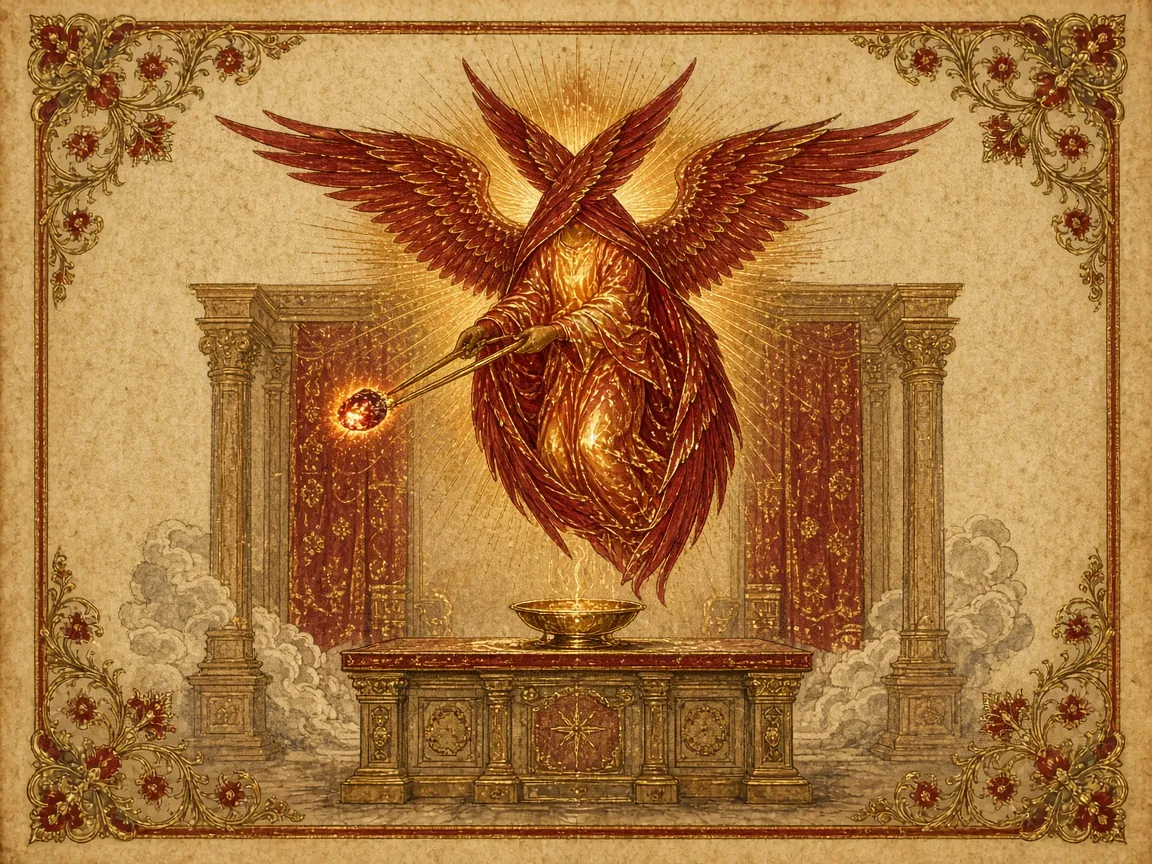
“Each one had six wings; with twain he covered his face, and with twain he covered his feet, and with twain he did fly” (Isaiah 6:2, KJV). One flies to the prophet with a live coal from the altar (6:6), and the Talmud identifies that seraph as Michael (Berakhot 4b). Ancient
Hayyot, the living creatures
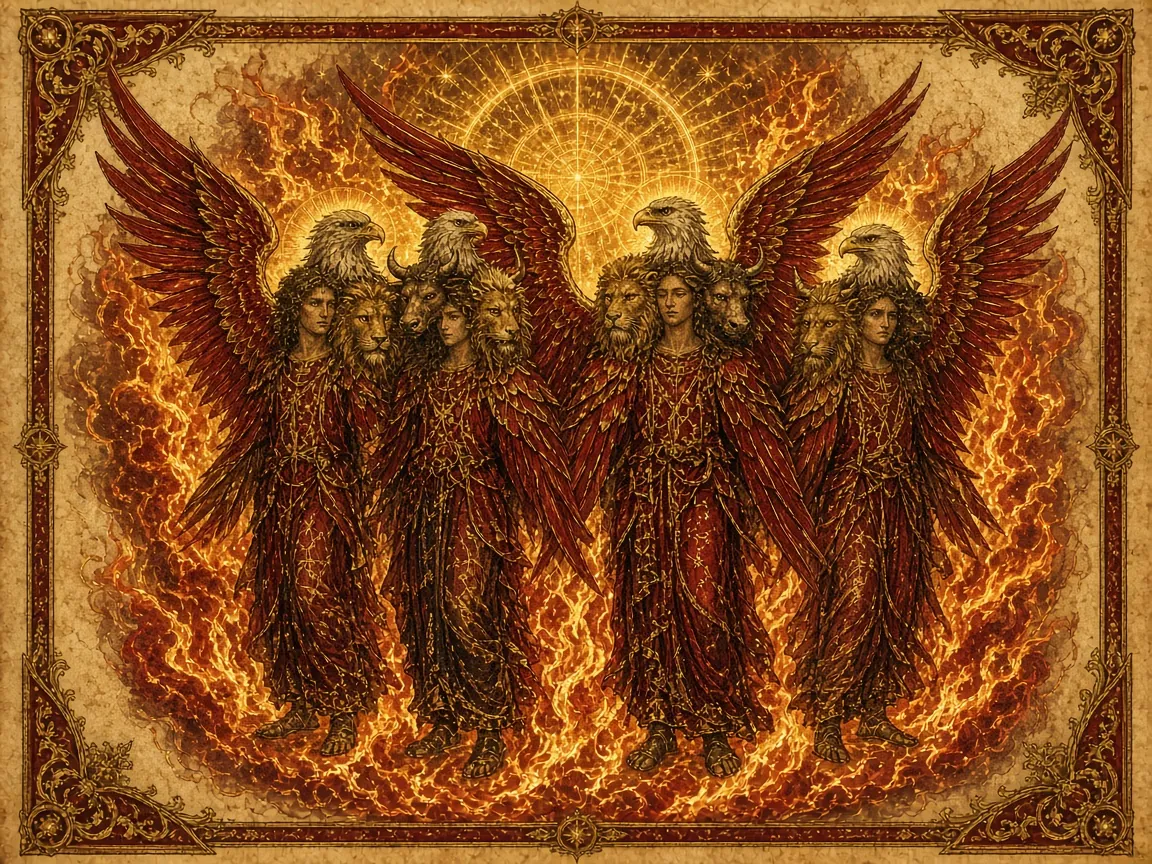
Four creatures with four faces each, of a man, a lion, an ox and an eagle (Ezekiel 1:5–10). In Revelation 4:6–8 they are “full of eyes before and behind” and have six wings. Ancient
Ophanim, the wheels
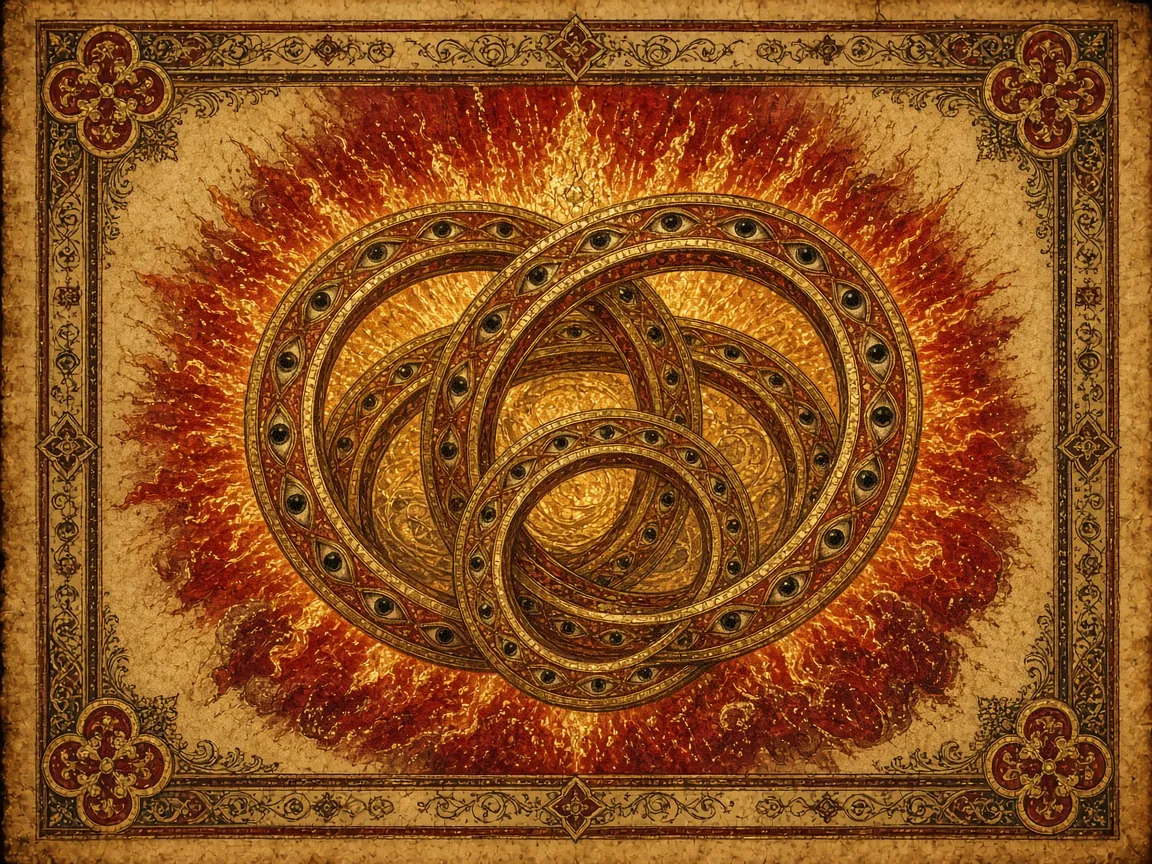
Wheels within wheels beside the creatures, “their rings were full of eyes round about them four” (Ezekiel 1:18). In 10:12 the cherubim’s whole body, back, hands and wings are full of eyes. 1 Enoch 71:7 sets Seraphim, Cherubim and Ophanim around the throne. Ancient
Cherubim
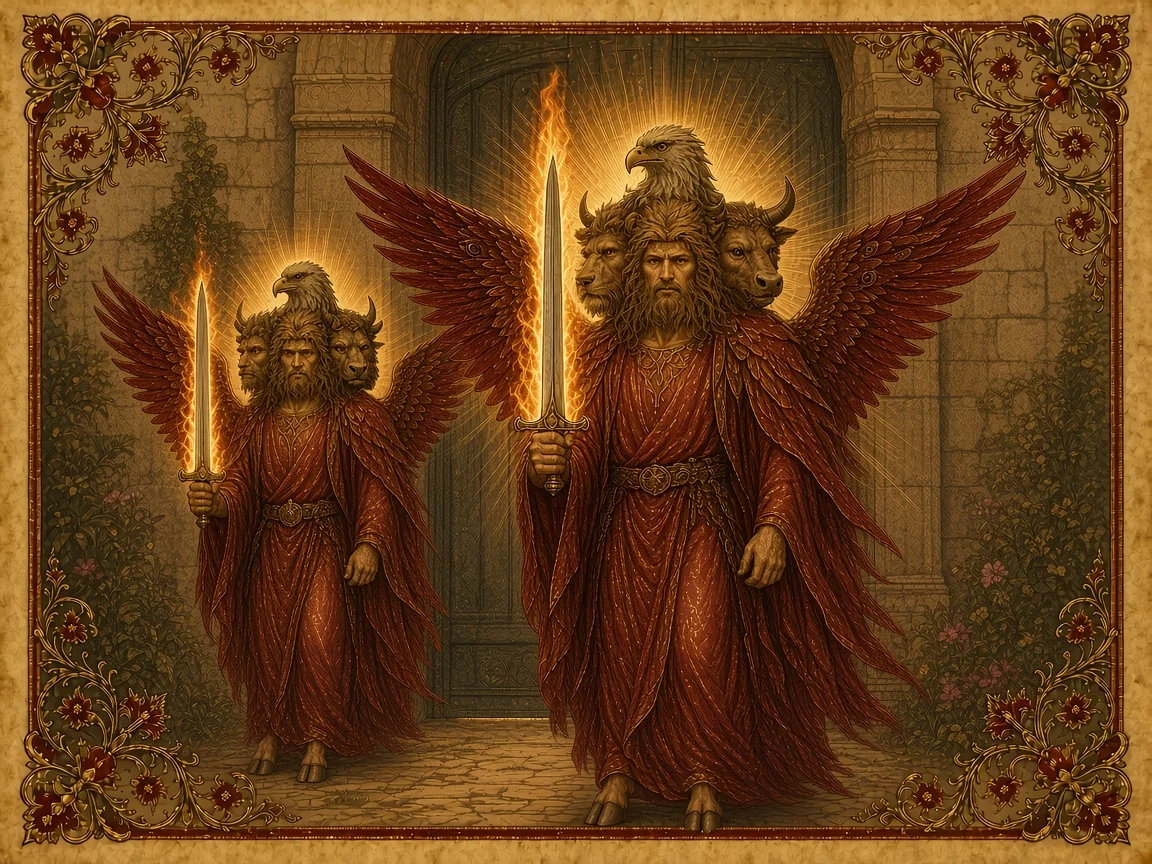
Guardians with a flaming sword at the east of Eden (Genesis 3:24), and golden figures on the mercy seat (Exodus 25:18–22). Ezekiel 10:20 says the living creatures he saw “were the cherubims”. Ancient
The Watchers (Grigori)
Daniel’s Aramaic calls a holy messenger an ‘ir, a “watcher”: “a watcher and an holy one came down from heaven” (Daniel 4:13 KJV; 4:10 Aramaic). Ancient
The Watchers in 1 Enoch
In 1 Enoch 6 two hundred Watchers descend on Mount Hermon “in the days of Jared”, bound by an oath under their leader Semjaza (Charles 1917). They take wives, teach forbidden arts (ch. 7–8) and father the giants. In chapter 10 the Lord sends Michael to bind Semjaza and his companions. Read the whole story in the Hall’s 1 Enoch (Ge’ez and English) and the Book of Giants. Ancient
Other witnesses
Jubilees 4:15 says the angels first came down in Jared’s days to teach the children of men to do judgment and uprightness. The Slavonic 2 Enoch calls the Watchers Grigori, from Greek egrēgoroi. That chapter (18) is in the long version, which the Hall has not yet translated. Ancient
Winged and heavenly beings across the world
Many peoples speak of beings of the sky who carry messages, guard, or bring thunder and blessing. These are their own sacred beings with their own names and meanings, and the Hall does not call them “angels”. They are set here beside each other to compare them, not to merge them. House
Mesopotamia: the apkallu
The seven sages before the Flood. In Neo-Assyrian palace reliefs (Nimrud, 9th c. BCE) they appear as winged protective spirits, some eagle-headed, guarding doorways. Ancient
Persia: Amesha Spentas and fravashis
In Zoroastrian scripture the Amesha Spentas, “bounteous immortals”, and the yazatas serve Ahura Mazda, and each soul has a guardian fravashi. Reading the winged Faravahar of Persepolis as a fravashi is a later interpretation; its first meaning is still debated. Ancient
Greece: daimones
In Plato’s Symposium (202e) a daimōn is an in-between being who “interprets and carries” human things to the gods and divine things to people. Ancient
Islam: the malā’ika
God made the angels “messengers having wings, two, three and four” (Qur’an 35:1). The hadith says they were created from light (Ṣaḥīḥ Muslim 2996). Jibrīl and Mīkāl are named in Qur’an 2:98. Isrāfīl of the trumpet comes from tradition, not the Qur’an. Ancient Medieval
India and China: apsaras and gandharvas
Celestial dancers and musicians of Hindu and Buddhist lore. At the Dunhuang caves the flying feitian fill the Buddhist heavens with music. Ancient Medieval
North America: the Thunderbird
A powerful sky being in the traditions of many Indigenous Nations. Among them are Northwest Coast peoples such as the Kwakwaka’wakw, and the Anishinaabe, whose thunder beings (animikiig) make the thunder with their wings. The Hall uses only sources the Nations or public-domain ethnographers have published (Boas 1897; Densmore 1929, both on the to-acquire list), and does not reproduce ceremony. To learn more, start with the Nations’ own cultural centres, such as the U’mista Cultural Centre. Revival
Ethiopia: Michael of the twelfth
The Ethiopian church keeps 1 Enoch in its Bible and honours the archangel Michael on the twelfth day of every month. See the Michael page. Medieval
The seventy-two and the ten
The 72 angels of the Name
Seventy-two three-letter names from Exodus 14:19–21, each with its psalm, choir, degrees and hours. Start with 17 · Lauviah (Goth).
The 10 archangels
One for each Sephirah, after Agrippa III.10: Metatron, Raziel, Zaphkiel, Zadkiel, Camael, Raphael, Haniel, Michael, Gabriel and the tenth.
Raziel
Angel of the secrets of God, who gave Adam the book.
Michael
“Who is like God?” The great prince of Daniel 12:1.
Gallery of the angels
Thirty-one images of angels and kindred beings, from Assyrian reliefs to Doré. Each one is public domain or openly licensed and credited, and links to its source. Tap an image to see it full size with its full record. More will be added as the field guide grows, along with House art drawn from the manuscripts in the Library, which will always be labelled as House art.
The archangels

Raphael (Raffaello Sanzio), 1518, Musée du Louvre. Via Wikimedia Commons.
Public domain Renaissance

Guido Reni, c. 1635, Santa Maria della Concezione, Rome. Via Wikimedia Commons.
Public domain Renaissance

Albrecht Dürer, Apocalypse woodcut, 1498; National Gallery of Art, Washington. Via Wikimedia Commons.
CC0 Renaissance

Byzantine icon, 12th century, St Catherine’s Monastery, Sinai. Via Wikimedia Commons.
Public domain Medieval

Silos Beatus, scribe Petrus, c. 1091–1109; British Library Add MS 11695, ff. 147v–148. Via Wikimedia Commons.
Public domain Medieval

Francesco Botticini, c. 1470, Uffizi, Florence. Via Wikimedia Commons.
Public domain Renaissance

Fra Angelico, 1425–26, Museo del Prado. Via Wikimedia Commons.
Public domain Medieval

Rembrandt, 1637, Louvre. Via Wikimedia Commons.
Public domain Renaissance
Angels of scripture and art

Novgorod icon, 12th century, Russian Museum, St Petersburg. Via Wikimedia Commons.
Public domain Medieval

Melozzo da Forlì, c. 1480, Vatican Pinacoteca (from Santi Apostoli). Via Wikimedia Commons.
Public domain Renaissance

Giotto, 1304–06, Scrovegni Chapel, Padua. Via Wikimedia Commons.
Public domain Medieval

English or French master, c. 1395–99, National Gallery, London. Via Wikimedia Commons.
Public domain Medieval

Gustave Doré, 1855. Via Wikimedia Commons.
Public domain Revival

William Blake, c. 1805, British Museum. Via Wikimedia Commons.
Public domain Revival
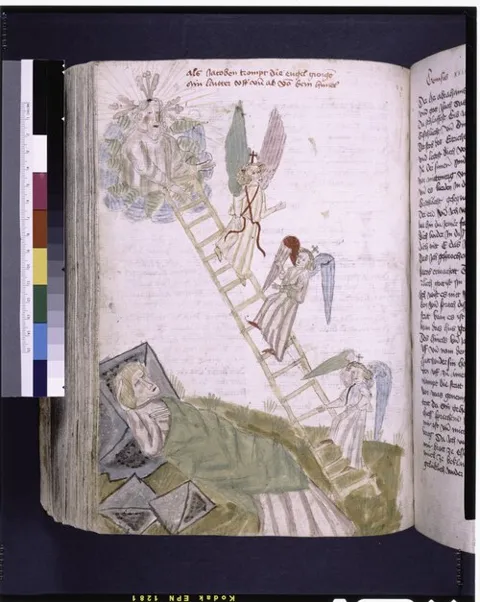
Illuminated initial, c. 1445, New York Public Library. Via Wikimedia Commons.
Public domain Medieval
The orders: seraphim, cherubim, wheels and choirs

Mosaic, 11th century, Nea Moni monastery, Chios. Via Wikimedia Commons.
Public domain Medieval

Post-Byzantine fresco, 16th century, Meteora. Via Wikimedia Commons.
Public domain Renaissance

Church icon, Kratovo, 1836. Via Wikimedia Commons.
Public domain Revival

Fra Angelico (workshop), c. 1450, Museo di San Marco, Florence. Via Wikimedia Commons.
Public domain Medieval

Hildegard of Bingen, Scivias, Rupertsberg codex (12th c.; facsimile). Via Wikimedia Commons.
Public domain Medieval

Gustave Doré, 1868, for Dante’s Paradiso. Via Wikimedia Commons.
Public domain Revival

After Herrad of Landsberg, 12th c.; Bastard copy 1839. Via Wikimedia Commons.
Public domain Medieval
The fallen and the Watchers

Pieter Bruegel the Elder, 1562, Royal Museums of Fine Arts, Brussels. Via Wikimedia Commons.
Public domain Renaissance

Gustave Doré, 1866, for Milton’s Paradise Lost. Via Wikimedia Commons.
Public domain Revival
Winged beings of the wider world

al-Qazwīnī, ʿAjāʾib al-makhlūqāt, early 15th-century copy. Via Wikimedia Commons.
Public domain Medieval
_Winged_Feline_and_Cow;_b)_Two_Winged_Angels,_Folio_from_a_Manuscript_of_Al-Qazwini%27s_Ajaib_Al-Makhluqat_LACMA_M.88.213.8a-b.jpg)
ʿAjāʾib al-makhlūqāt manuscript, c. 1570. Via Wikimedia Commons.
Public domain Renaissance

Neo-Assyrian relief, reign of Ashurnasirpal II, 883–859 BCE. Via Wikimedia Commons.
CC0 Ancient

Achaemenid relief, 6th–5th c. BCE; photo: Napishtim. Via Wikimedia Commons.
CC BY-SA 3.0 Ancient

Mogao Caves mural, Dunhuang. Via Wikimedia Commons.
Public domain Medieval

Thunderbird Park, Victoria, B.C.; photo: Michal Klajban, 2018. Via Wikimedia Commons.
CC BY-SA 4.0 House
Raziel’s book

Amsterdam, 1701. Via Wikimedia Commons.
Public domain Renaissance
Questions
What is an angel?
The word comes from Greek angelos, “messenger”, which the Septuagint used for Hebrew mal’akh, also “messenger”. In the old books an angel is a being sent from God; other holy beings, such as seraphim, cherubim, ophanim and Watchers, are named for what they are rather than what they do.
What are the nine choirs of angels?
Pseudo-Dionysius (c. 500) arranges them in three triads: Seraphim, Cherubim, Thrones; Dominions, Virtues, Powers; Principalities, Archangels, Angels.
Who are the 72 angels of the Shemhamphorash?
Seventy-two names of three Hebrew letters drawn from Exodus 14:19–21, printed by Reuchlin in 1517 and given angel forms by Agrippa (1533) and Lenain (1823), each with a psalm verse.
Who are the ten archangels?
The Hall follows Agrippa’s Three Books of Occult Philosophy (III.10), which sets one archangel over each of the ten Sephiroth: Metatron, Raziel, Zaphkiel, Zadkiel, Camael, Raphael, Haniel, Michael, Gabriel, and for the tenth the soul of Messiah or Metatron, whom later lists replace with Sandalphon.
Who were the Watchers?
Daniel 4 calls a holy messenger an ‘ir, “watcher”. In 1 Enoch 6–16 two hundred Watchers descend on Mount Hermon in the days of Jared, led by Semjaza, and are judged.
Sources and method
The Hall quotes only public-domain or openly licensed texts and images, and credits each one. House translations are marked. Where the traditions differ, each page shows the variants side by side. Full source lists are on each angel’s page; the passages files are kept as data for the Hall.