
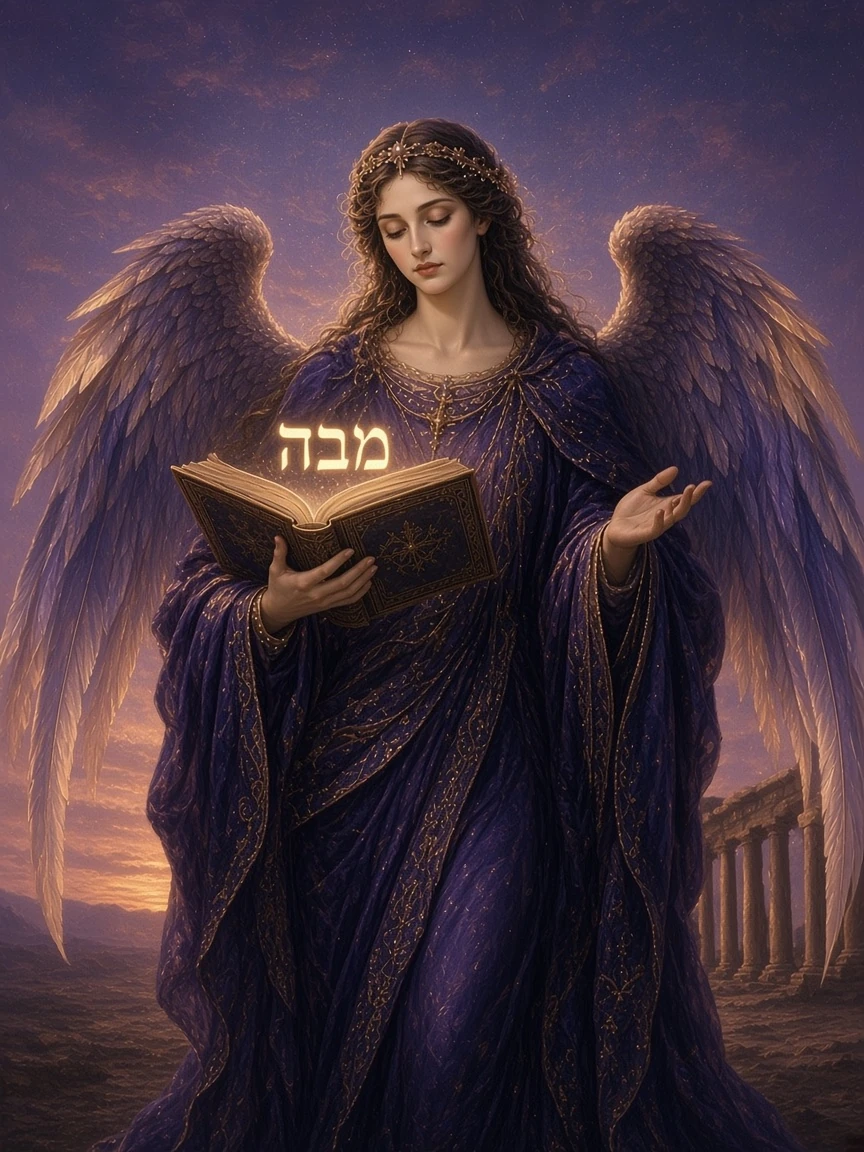
55th of the 72 · Choir of Principalities
Mebahiah מבה
Also known as Mebahiah1 · Alay2 · מבהיה (Mebahiah)3 · מבה (the three letters)4
Sources for these names
- 1. Lenain, La Science cabalistique (1823), typographic reissue p. 84 (the running French is the reissue’s, not a letter-by-letter reading of BIU Santé Ms 5365): the 55th entry, “Mebahiah”
- 2. Ibid.: “Il correspond au nom Alay, d'agrès la langue des peuples d'Ormuz” (the reissue prints “d'agrès”; surrounding entries have “d'après”)
- 3. Angel form of the triad מבה: Exodus 14:19–21 by the rule in Agrippa III.25 and Reuchlin, De arte cabalistica (1517); House corpus, The Seventy-Two Names
- 4. Exodus 14:19–21 by Rashi’s rule (on Sukkah 45a); Reuchlin 1517, Book III
Name: the triad מבה with an angelic ending.
Tracing the name backward
We go backward from the newest source to the oldest dated one, and step back only where a dated text or a published scholarly link anchors the step. Unproven or second-hand links are drawn dashed and marked. Raziel’s full chart is on his page.
Rest the pointer on a section to open it; click to keep it open.Tap a section to open it; tap again to close.
Name originwhat the name means and how it was built
One of the 72 “names” read out of Exodus 14:19–21. The triad מבה is taken letter by letter from the three verses; Renaissance Christian kabbalists (Reuchlin 1517; Agrippa 1533) turned each triad into an angel by adding -el or -iah.
- Choir Principalities
- Degrees of the zodiac 271°–275°
- Psalm verse Ps 102:13 Vulg. Ps 101:13
From Lenain (1823), as set out in the Sanctuary’s table of the 72.
Earliest sourcesthe name traced backward, with dated anchors
Solid = a link anchored in a dated sourceDashed = unproven, second-hand or a later equationNewest at the top; each step goes back in time. Tap any box to open its anchor.
- 1823
MebahiahLenain, La Science cabalistique (Paris 1823; BIU Santé Ms 5365)Medium
Lenain gives each of the 72 a choir, five degrees of the zodiac and a psalm verse, as listed in the Sanctuary’s table of the 72.
older
- 1652–1654
the 72 in a circleKircher, Oedipus Aegyptiacus II.1Medium
Kircher draws the 72 names as a great circle. Unverified for this name until the Hall reads Kircher’s plate.
older
- 1533 (English 1651)
MebahiahAgrippa, Three Books of Occult Philosophy III.25, table of the 72High
The table of the 72 angels, each formed by adding -el or -iah to a triad of letters. Read Agrippa, De occulta philosophia, Cologne 1533 (Library).
older
- 1517
the triad becomes an angel’s nameJohannes Reuchlin, De arte cabalistica, Book IIIHigh
The oldest dated source the Hall relies on for the angel-names of the 72 (as on the Sanctuary’s Lauviah page). Before this there are only the letters.
the letters, not yet an angel
- 11th c.
מבה as one of the 72 namesRashi on Sukkah 45aHigh
Rashi explains the 72 names as read from the three verses of Exodus 14:19–21, “each of 72 letters”: the first letter of the first verse, the last of the middle verse and the first of the last, “and so on in this order”; the first name is והו (Hall translation; Sefaria).
read out of three verses
- the verses themselves
Exodus 14:19–21three verses of 72 letters eachHigh
Letter 55 of verse 19, letter 55 counted from the end of verse 20, and letter 55 of verse 21, by Rashi’s rule. Hall check Computed from the Hebrew consonantal text of Exodus 14:19–21 (Sefaria, “Tanach with Text Only”; 72 letters in each verse): letter 55 of verse 19 is מ, letter 55 from the end of verse 20 is ב, letter 55 of verse 21 is ה (final forms normalised). All 72 triads in the Sanctuary table match this count. Read Exodus in Gutenberg Bible: Exodus, Psalms and more (Library).
no anchor
The trail endsNo angel named Mebahiah before Reuchlin (1517)No anchor
Before the Renaissance there are the letters and the method, but no angel of this name.
Also known asother names the sources give
Also known as Mebahiah1 · מבה (the three letters)2
Sources for these names
- Lenain 1823 (Sanctuary table of the 72)
- Exodus 14:19–21 by Rashi’s rule (on Sukkah 45a)
Comparisonssimilar figures, where scholars draw the link
- The decans (House note). Lenain gives each of the 72 five degrees of the zodiac (72 × 5 = 360), so two of them make one 10° decan, the old Egyptian star-division (Neugebauer & Parker). That is arithmetic and the Hall’s own note, not a scholar’s identification.
Comparisons are listed only where a scholar makes the link, or are marked as the Hall’s own note. A parallel of role is not a lineage of name.
Further readingbooks in Raziel’s Library and beyond
Unverified and sourceswhat is still to check, and every source
Unverified
- Unverified Kircher plate not yet read for this name
Sources
- Rashi on Sukkah 45a (Sefaria)
- Reuchlin, De arte cabalistica (1517), Book III
- Agrippa, Three Books of Occult Philosophy III.25 (1533; English 1651)
- Kircher, Oedipus Aegyptiacus (1652–54)
- Lenain, La Science cabalistique (1823)
Hover or tap to turn the card.
- Name
- Mebahiah, “Eternal God” (Dieu éternel); called Alay RevivalLenain 1823, typographic reissue p. 84: “Il correspond au nom Alay, d'agrès la langue des peuples d'Ormuz”
- Letters
- מבה (Mem, Bet, He) → מבהיה RenaissanceExodus 14:19–21, letter 55 of each verse (v.20 backward); Reuchlin 1517; House corpus
- Number
- 55 of 72 RenaissanceReuchlin 1517 III; Agrippa III.25 table (English 1651: “Mebahiah”)
- Order
- Principalities, the seventh choir in Lenain’s reckoning (angels 49–56) RevivalLenain 1823 (at the 49th genius, applying through the 56th): “appartiennent au 7e. ordre des anges, que les orthodoxes appellent le chœur des principautés”
- Word (psalm)
- Psalm 102:13 (Hebrew numbering; KJV 102:12; Vulgate 101:13): “But thou, O Lord, endurest for ever: and thy memorial to all generations.” AncientHebrew WLC; Douay-Rheims (the House has not yet issued its own rendering). Lenain quotes the Latin Tu autem Domine in æternum permanes : et memoriale tuum in generationem as “the 13th verse of psalm 101”
- Domain
- Morals and religion; she influences those who protect it with all their power, and propagate it by every possible means RevivalLenain 1823, typographic reissue p. 84: “Ce génie domine sur la morale et la religion ; il influe sur ceux qui la protègent de tout leur pouvoir, et la propagent par tous les moyens possibles.”
- Gifts
- For consolation, and for those who desire to have children RevivalLenain 1823, typographic reissue p. 84: “Il est bon pour avoir des consolations, et pour ceux qui désirent d'avoir des enfants.”
- Those born under her
- Will be distinguished by their good works, their piety, and by their zeal to fulfill their duties toward God and men RevivalLenain 1823, typographic reissue p. 84: “La personne qui est née sous cette influence se distinguera par ses bienfaits, sa piété, et par son zèle à remplir ses devoirs envers Dieu et les hommes.”
- Shadow
- Lenain’s “contrary genius” is the enemy of truth; it influences all those who want to destroy religion and the princes who protect it, so as to hinder the great work of the regeneration of the human race. This is a separate spirit, not Mebahiah RevivalLenain 1823, typographic reissue p. 84: “Le génie contraire est l'ennemi de la vérité ; il influe sur tous ceux qui veulent détruire la religion et les princes qui la protègent, afin d'empêcher le grand-œuvre de la régénération du genre humain.”
- Heaven
- Jupiter; the 28th decan, genie Smat RevivalLenain 1823, typographic reissue p. 84
- Degrees
- 271°–275° of the zodiac RevivalLenain 1823 (5° to each of the 72)
- Days
- 13 May, 24 July, 4 October, 15 December, 25 February RevivalLenain 1823, typographic reissue p. 84
- Hour
- From 6:00 to 6:20 in the evening; the request is spoken with the divine names and the psalm verse RevivalLenain 1823, typographic reissue p. 84. Unlike some other entries, this one does not say “every day” or “fasting.”
- Colours
- No source gives Mebahiah a colour. Through Jupiter: celestial blue, and tin for the metal (inference) HouseMathers, The Key of Solomon the King (1889), introduction table and Book I, chapter 18, on the Hall Solomonic shelf, applied by the Hall through Lenain’s “sous l'influence de Jupiter.” Not a colour named for her in Lenain or in Agrippa’s table of the 72.
- Incense
- None attested for Mebahiah herself. RevivalNot in Lenain. Mathers’ Key of Solomon, Book II, chapter 10 (Hall), gives a general sweet perfume for good spirits (incense, aloes, nutmeg, gum benjamin, musk); it is not a Jupiter list and does not name her. Agrippa I.44, which the Hall used for Lauviah’s Sun fumes, is not in the English panels on this shelf, so no planetary incense is set down here. Modern angel-dictionary lists are not used.
- Seal
- Her three letters מבה, as the triad is formed in Reuchlin and Agrippa. The Hall has not yet read Kircher’s plate for this name. The “seals” of the 72 sold today are modern RenaissanceReuchlin 1517; Agrippa III.25. Kircher, Oedipus Aegyptiacus II.1 (1653), remains unverified for this name, as the lineage section already says.
- The letters in Sefer Raziel
- The Book of the Angel Raziel on this shelf writes of the triad מבה, the same three letters borne also by 14 · Mebahel. One Hall English passage of the First Operation: “MBH [מבה] — its form KRVDY [כרודי]; he is the great prince, for the LORD called him ‘my beloved’” (Song 5:10). These are words about the Name’s letters, not a use of the later angel-name Mebahiah. RevivalHall English, from the 1701 tradition, Book of the Angel Raziel, pp. 65–72. The print is 1701; the underlying tradition is older and is not dated here. shem72: the triad מבה is also no. 14.
- Also on the shelves
- Agrippa III.25 (English 1651) lists the name Mebahiah in the Schemhamphorse table and gives no further office. The Goetia’s seventy-two spirits are a different list; her name is not among them. The Hygromanteia, the Testament of Solomon and Sefer Yetzirah on this shelf do not name her. Zohar and Bahir are not on the Hall shelves. Kircher’s plate remains unverified for this name. RevivalHall text search, 26 Nov 2026; see Team D source survey.
- Feast
- None in any calendar; Lenain’s five days above RevivalLenain 1823
Persona: as the books describe her
The books give Mebahiah no body and no face; she is known by what she does. Lenain sets her among the Principalities, “the seventh order of angels, which the orthodox call the choir of Principalities,” a sentence he writes at the 49th genius and applies through the 56th. Her verse says that the Lord endures for ever, and his memorial to all generations (Psalm 102:13, Hebrew numbering; Vulgate 101:13). She is good for consolation, and for those who desire to have children. She rules over morals and religion, and influences those who protect it with all their power and propagate it by every possible means. The person born under her will be distinguished by their good works, their piety, and by their zeal to fulfill their duties toward God and men (Lenain 1823). Revival
The name Alay comes from Lenain, who gives each angel a divine name “in the language of” a people. For her it is Alay, “after the language of the peoples of Ormuz” (typographic reissue, p. 84; the reissue prints “d'agrès”). The Hall honours her as “she”, as the Sanctuary card already does. Lenain writes “il”, because French génie is masculine. House
The same three letters מבה are also those of 14 · Mebahel. The Book of the Angel Raziel (Hall English, 1701 tradition) speaks of that triad as a Name, not as the later angel Mebahiah: “he is the great prince, for the LORD called him ‘my beloved.’” A second passage on the same letters ties them to the name of Meṭaṭron. These are not added to her Lenain office; they are cited so the older Hebrew book on this shelf is not left unread. Revival
No colour is given for her in Lenain. Through Lenain’s planet Jupiter, the Hall notes the Key of Solomon on this shelf: celestial blue, and tin for the metal (Mathers 1889, introduction and I.18). House The Key does not name her. Neither do the Goetia, the Hygromanteia, the Testament of Solomon or Sefer Yetzirah as they stand here. Zohar and Bahir are not on the Hall shelves.