
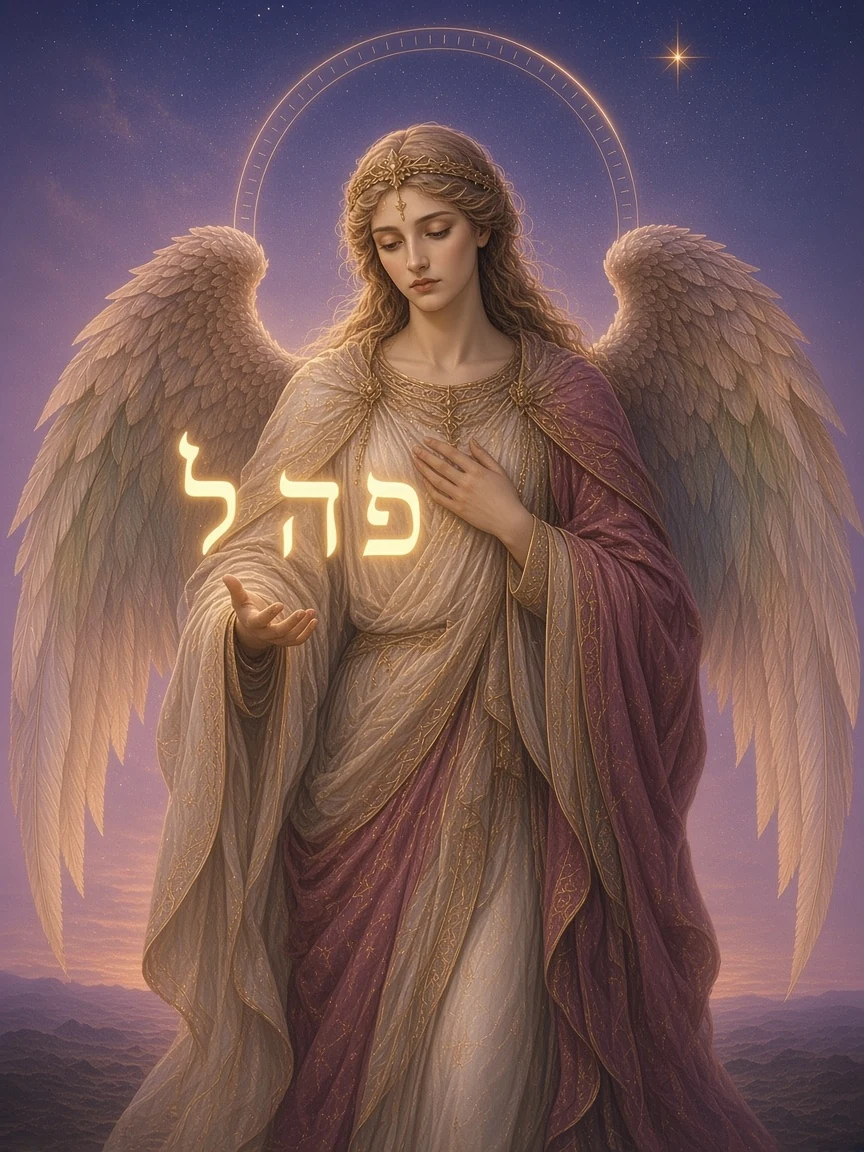
The 72 angels of the Name · number 20 · Thrones
Pahaliah פהל
Also known as Pahaliah · פהל (the three letters) (sources under “Also known as” below)
Name: the triad פהל with an angelic ending.
Tracing the name backward
We go backward from the newest source to the oldest dated one, and step back only where a dated text or a published scholarly link anchors the step. Unproven or second-hand links are drawn dashed and marked. Raziel’s full chart is on his page.
Rest the pointer on a section to open it; click to keep it open.Tap a section to open it; tap again to close.
Name originwhat the name means and how it was built
One of the 72 “names” read out of Exodus 14:19–21. The triad פהל is taken letter by letter from the three verses; Renaissance Christian kabbalists (Reuchlin 1517; Agrippa 1533) turned each triad into an angel by adding -el or -iah.
- Choir Thrones
- Degrees of the zodiac 96°–100°
- Psalm verse Ps 116:4 Vulg. Ps 114:4
From Lenain (1823), as set out in the Sanctuary’s table of the 72.
Earliest sourcesthe name traced backward, with dated anchors
Solid = a link anchored in a dated sourceDashed = unproven, second-hand or a later equationNewest at the top; each step goes back in time. Tap any box to open its anchor.
- 1823
PahaliahLenain, La Science cabalistique (Paris 1823; BIU Santé Ms 5365)Medium
Lenain gives each of the 72 a choir, five degrees of the zodiac and a psalm verse, as listed in the Sanctuary’s table of the 72.
older
- 1652–1654
the 72 in a circleKircher, Oedipus Aegyptiacus II.1Medium
Kircher draws the 72 names as a great circle. Unverified for this name until the Hall reads Kircher’s plate.
older
- 1533 (English 1651)
PahaliahAgrippa, Three Books of Occult Philosophy III.25, table of the 72High
The table of the 72 angels, each formed by adding -el or -iah to a triad of letters. Read Agrippa, De occulta philosophia, Cologne 1533 (Library).
older
- 1517
the triad becomes an angel’s nameJohannes Reuchlin, De arte cabalistica, Book IIIHigh
The oldest dated source the Hall relies on for the angel-names of the 72 (as on the Sanctuary’s Lauviah page). Before this there are only the letters.
the letters, not yet an angel
- 11th c.
פהל as one of the 72 namesRashi on Sukkah 45aHigh
Rashi explains the 72 names as read from the three verses of Exodus 14:19–21, “each of 72 letters”: the first letter of the first verse, the last of the middle verse and the first of the last, “and so on in this order”; the first name is והו (Hall translation; Sefaria).
read out of three verses
- the verses themselves
Exodus 14:19–21three verses of 72 letters eachHigh
Letter 20 of verse 19, letter 20 counted from the end of verse 20, and letter 20 of verse 21, by Rashi’s rule. Hall check Computed from the Hebrew consonantal text of Exodus 14:19–21 (Sefaria, “Tanach with Text Only”; 72 letters in each verse): letter 20 of verse 19 is פ, letter 20 from the end of verse 20 is ה, letter 20 of verse 21 is ל (final forms normalised). All 72 triads in the Sanctuary table match this count. Read Exodus in Gutenberg Bible: Exodus, Psalms and more (Library).
no anchor
The trail endsNo angel named Pahaliah before Reuchlin (1517)No anchor
Before the Renaissance there are the letters and the method, but no angel of this name.
Also known asother names the sources give
Also known as Pahaliah1 · פהל (the three letters)2
Sources for these names
- Lenain 1823 (Sanctuary table of the 72)
- Exodus 14:19–21 by Rashi’s rule (on Sukkah 45a)
Comparisonssimilar figures, where scholars draw the link
- The decans (House note). Lenain gives each of the 72 five degrees of the zodiac (72 × 5 = 360), so two of them make one 10° decan, the old Egyptian star-division (Neugebauer & Parker). That is arithmetic and the Hall’s own note, not a scholar’s identification.
Comparisons are listed only where a scholar makes the link, or are marked as the Hall’s own note. A parallel of role is not a lineage of name.
Further readingbooks in Raziel’s Library and beyond
Unverified and sourceswhat is still to check, and every source
Unverified
- Unverified Kircher plate not yet read for this name
Sources
- Rashi on Sukkah 45a (Sefaria)
- Reuchlin, De arte cabalistica (1517), Book III
- Agrippa, Three Books of Occult Philosophy III.25 (1533; English 1651)
- Kircher, Oedipus Aegyptiacus (1652–54)
- Lenain, La Science cabalistique (1823)
Hover or tap to turn the card.
- Name
- Pahaliah, “God the Redeemer” (Dieu rédempteur); called Tios Revival Lenain 1823, p. 58: “Il correspond au saint nom Tios, d’après langue des Moscovites”
- Letters
- פהל (Pe, He, Lamed) → פהליה Renaissance Exodus 14:19–21, letter 20 of each verse (v. 20 backward); Reuchlin 1517
- Number
- 20 of 72 Renaissance Reuchlin 1517 III; Agrippa III.25 table (English 1651: Pahaliah)
- Order
- Thrones, the third choir (angels 17–24) Revival Lenain 1823, in the 17th entry: through the 24th, “chœur des Trônes”
- Word (psalm)
- The sources do not name the same verse. Reuchlin and the Hall Shem 72 table give Psalm 116:4 (Vulg. 114:4): “And I called upon the name of the Lord. O Lord, deliver my soul.” (Douay-Rheims). Lenain 1823, p. 58, says the 2nd verse of psalm 119, and quotes Domine libera animam meam a labiis iniquis, et a linguâ dolosâ — that Latin is Vulgate Psalm 119:2 (Hebrew/KJV 120:2). Ancient Conflict cited side by side; neither reading is dropped
- Domain
- Religion, theology and morals; he influences chastity and piety, and those whose vocation is for the ecclesiastical state Revival Lenain 1823, p. 58
- Gifts
- Against the enemies of religion, and to convert peoples to Christianity Revival Lenain 1823, p. 58. The wording is Lenain’s; it is not softened
- Those born under him
- Not attested. Lenain’s entry for the 20th has no “la personne qui est née sous cette influence” sentence House Lenain 1823, p. 58, checked; left blank rather than filled
- Shadow
- Lenain’s “contrary genius” rules irreligion, apostates, libertines and renegades. This is a separate spirit, not Pahaliah Revival Lenain 1823, p. 58
- Heaven
- Venus; the tenth decan, genie Sothis; degrees 95°–100° Revival Lenain 1823, p. 58 (the printed text spells the genie Sothis; the 19th entry spelled Sotis)
- Days
- 8 April, 19 June, 30 August, 10 November, 21 January Revival Lenain 1823, p. 58, “lesquels correspondent à l’influence de Vénus”
- Hour
- From 6:20 to 6:40 in the morning Revival Lenain 1823, p. 58
- Colours
- No source gives Pahaliah a colour. Lenain places the days under Venus, but names no colour for him House Not attested
- Incense
- None for Pahaliah himself House Not attested in Lenain, Agrippa’s 72 table, or Reuchlin
- Seal
- His three letters פהל, as printed by Reuchlin and set by Kircher in the 72-names plate (1653). The “seals” of the 72 sold today are modern Renaissance Reuchlin 1517; Kircher, Oedipus Aegyptiacus II.1 (1653)
- Feast
- None in any calendar; Lenain’s five days above Revival Lenain 1823
Persona: as the books describe him
The books give Pahaliah no body and no face; he is known by what he does. Lenain sets him among the Thrones (angels 17–24). He is “God the Redeemer.” He rules religion, theology and morals, and influences chastity and piety, and those whose vocation is for the ecclesiastical state. He serves against the enemies of religion, and to convert peoples to Christianity — Lenain’s own wording (1823, p. 58). His entry has no sentence on what those born under him will love. Revival
The name Tios comes from Lenain, “after the language of the Muscovites” (p. 58). The Sanctuary’s existing card already speaks of Pahaliah as “he”. Lenain writes “il”, because French génie is masculine. The psalm assigned to him is not the same in every book: see the stat block. House
On the other shelves
Each source holds only part of the picture. What follows was read on the Hall’s own shelves, or marked as not attested when it was not found. Nothing here is invented.
- Sefer Raziel ha-Malakh (Amsterdam 1701; Hall English from the scan, Book of the Angel Raziel, pp. 55–64 and 65–72) glosses the three letters פהל as a Name, not as a portrait of the later angel. It “teaches about two agents, one within the other,” and “that the mercies of the LORD are constant, since they are one within the other.” A later page: its form “points to two Being-names and the name of Ehyeh with three letters themselves”; and “פהל points that the mercies of the Holy One, blessed be He, are always.” Revival 1701 printing of older kabbalistic material; Hall translation
- Agrippa III.25 (English 1651, Hall library): lists him as Pahaliah among the seventy-two angels “bearing the name of God, Schemhamphorse.” The table gives the name only. Renaissance
- Reuchlin 1517 and the Hall Shem 72 table: the triad, and Psalm 116:4 (Vulg. 114:4) — which is not the verse Lenain quotes. Renaissance
- Kircher, Oedipus Aegyptiacus II.1 (1653), the 72-names plate: the three letters. Renaissance
- Sefer Yetzirah and the Testament of Solomon (Hall Jewish-mysticism shelf): no entry under the name Pahaliah. House Not attested
- Key of Solomon (Penn Ms. Codex 1673 and Mathers 1889) and the Hygromanteia: no per-angel office, likes, colour or incense for Pahaliah. House Not attested
- The Lemegeton / Goetia (Hall): a different list of seventy-two spirits. Pahaliah is not among them. The two lists are not to be mixed. House
- The Zohar and the Bahir are not yet on the Hall shelves as readable editions. No passage on Pahaliah was taken from them. Unverified Not held; not attested here