
Chinese shelf · Pu Songling · 聊齋志異 · Giles III · Tale 3
畫壁 · The Painted WallHua bi · Giles 1880, vol. 1, no. III
Public domain. Pu Songling (1640–1715). Translated by Herbert A. Giles, 1880. Giles sometimes shortened or softened passages, so the two columns do not always match line for line.
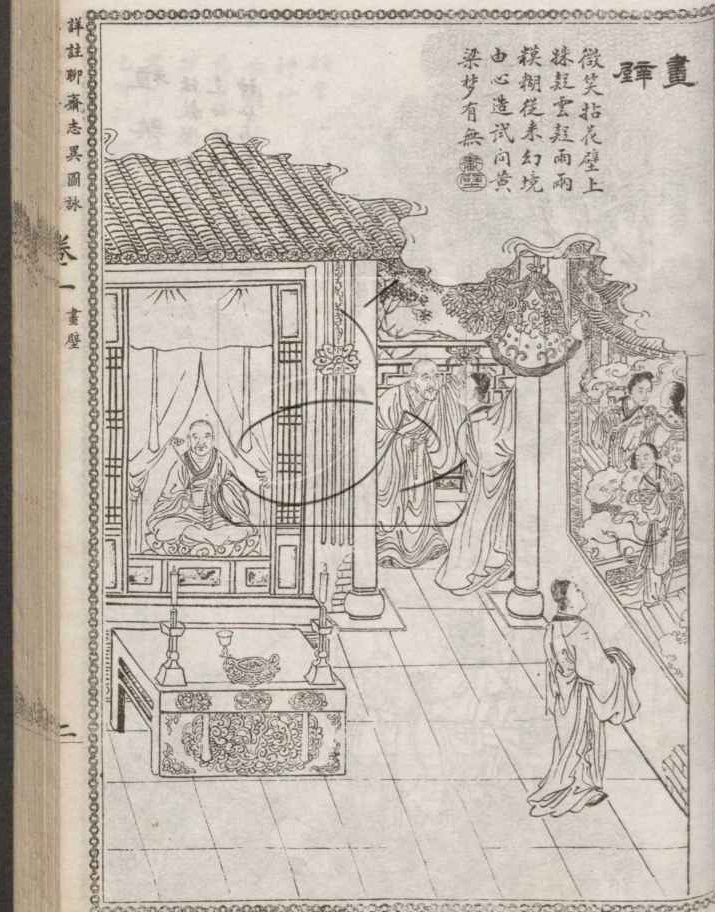
Chinese 文言
江西孟龍潭與朱孝廉客都中,偶涉一蘭若,殿宇禪舍,俱不甚弘敞,惟一老僧掛褡其中。見客入,肅衣出迓,導與隨喜。殿中塑誌公像,兩壁圖繪精妙,人物如生,東壁畫散花天女,內一垂髫者拈花微笑,櫻唇欲動,眼波將流。朱注目久,不覺神搖意奪,恍然凝想,身忽飄飄如駕雲霧,已到壁上。見殿閣重重,非復人世,一老僧說法座上,偏袒繞視者甚,朱亦雜立其中。
少間,似有人暗牽其裾,回視則垂髫兒囅然,竟去履即從之,過曲欄入一小舍,次且不敢前。女回首舉手中花,遙遙作招狀,乃趨之,舍內寂無人。遽擁之,亦不甚拒,遂與狎好。既而閉戶去,囑朱「勿欬」,夜乃復至,如此二日。女伴覺之,共搜得生。戲謂女曰:「腹內小郎已許大,尚髮蓬蓬學處子耶?」共捧簪珥,促令上鬟,女含羞不語。一女曰:「妹妹姊姊,吾等勿久住,恐人不歡。」群笑而去。
朱視女髻雲高簇,鬟鳳低垂,比垂髫時尤艷絕也。四顧無人,漸入猥褻,蘭麝熏心。樂方未艾,忽聞吉莫靴鏗鏗甚厲,縲鎖鏘然,旋有紛囂騰辨之聲。女驚起,與朱竊窺,則見金甲使者,黑面如漆,綰鎖挈槌,眾女環繞之。使者曰:「全未?」答言:「已全。」使者曰:「如有藏匿下界人,即共出首,勿貽伊戚。」又同聲言「無。」使者反身愕顧,似將搜匿,女大懼,面如死灰,張皇謂朱曰:「可急匿榻下!」乃啟壁上小扉猝遁去。朱伏不敢少息。俄聞靴聲至房內,復出,未幾,煩喧漸遠,心稍安,然戶外輒有往來語論者。朱跼蹐既久,覺耳際蟬鳴,目中火出,景狀殆不可忍,惟靜聽以待女歸,竟不復憶身之何自來也。
時孟龍潭在殿中,轉瞬不見朱,疑以問僧,僧笑曰:「往聽說法去矣。」問:「何處?」曰:「不遠。」少時,以指彈壁而呼曰:「朱檀越何久遊不歸?」旋見壁間畫有朱像,傾耳佇立,若有聽察。僧又呼曰:「游侶久待矣。」遂飄忽自壁而下,灰心木立,目瞪足耎。孟大駭,從容問之,蓋方伏榻下,聞叩聲如雷,故出房窺聽也。共視拈花人,螺髻翹然,不復垂髫矣。朱驚拜老僧,而問其故,僧笑曰:「幻由人生,老僧何能解?」朱氣結而不揚,孟心駭而無主,即起歷階而出。
異史氏曰:幻由人生,此言類有道者。人有淫心,是生褻境;人有褻心,是生怖境。菩薩點化愚蒙,千幻並作,皆人心所自動耳。老僧婆心切,惜不聞其言下大悟,披髮入山也。
English Giles 1880
A Kiang-si gentleman, named Mêng Lung-t‘an, was lodging at the capital with a Mr. Chu, M.A., when one day chance led them to a certain monastery, within which they found no spacious halls or meditation chambers, but only an old priest in deshabille. On observing the visitors, he arranged his dress and went forward to meet them, leading them round and showing whatever there was to be seen. In the chapel they saw an image of Chih Kung, and the walls on either side were beautifully painted with life-like representations of men and things. On the east side were pictured a number of fairies, among whom was a young girl whose maiden tresses were not yet confined by the matron’s knot. She was picking flowers and gently smiling, while her cherry lips seemed about to move, and the moisture of her eyes to overflow. Mr. Chu gazed at her for a long time without taking his eyes off, until at last he became unconscious of anything but the thoughts that were engrossing him. Then, suddenly, he felt himself floating in the air, as if riding on a cloud, and found himself passing through the wall,44 where halls and pavilions stretched away one after another, unlike the abodes of mortals. Here an old priest was preaching the Law of Buddha, surrounded by a large crowd of listeners. Mr. Chu mingled with the throng, and after a few moments perceived a gentle tug at his sleeve. Turning round, he saw the young girl above-mentioned, who walked laughing away. Mr. Chu at once followed her, and passing a winding balustrade arrived at a small apartment beyond which he dared not venture further. But the young lady, looking back, waved the flowers she had in her hand as though beckoning him to come on. He accordingly entered and found nobody else within. Then they fell on their knees and worshipped heaven and earth together,45 and rose up as man and wife, after which the bride went away, bidding Mr. Chu keep quiet until she came back. This went on for a couple of days, when the young lady’s companions began to smell a rat and discovered Mr. Chu’s hiding-place. Thereupon they all laughed and said, “My dear, you are now a married woman, and should leave off that maidenly coiffure.” So they gave her the proper hair-pins and head ornaments, and bade her go bind her hair, at which she blushed very much but said nothing. Then one of them cried out, “My sisters, let us be off. Two’s company, more’s none.” At this they all giggled again and went away.
Mr. Chu found his wife very much improved by the alteration in the style of her hair. The high top-knot and the coronet of pendants were very becoming to her. But suddenly they heard a sound like the tramping of heavy-soled boots, accompanied by the clanking of chains and the noise of angry discussion. The bride jumped up in a fright, and she and Mr. Chu peeped out. They saw a man clad in golden armour, with a face as black as jet, carrying in his hand chains and whips, and surrounded by all the girls. He asked, “Are you all here?” “All,” they replied. “If,” said he, “any mortal is here concealed amongst you, denounce him at once, and lay not up sorrow for yourselves.” Here they all answered as before that there was no one. The man then made a movement as if he would search the place, upon which the bride was dreadfully alarmed, and her face turned the colour of ashes. In her terror she said to Mr. Chu, “Hide yourself under the bed,” and opening a small lattice in the wall, disappeared herself. Mr. Chu in his concealment hardly dared to draw his breath; and in a little while he heard the boots tramp into the room and out again, the sound of the voices getting gradually fainter and fainter in the distance. This reassured him, but he still heard the voices of people going backwards and forwards outside; and having been a long time in a cramped position, his ears began to sing as if there was a locust in them, and his eyes to burn like fire. It was almost unbearable; however, he remained quietly awaiting the return of the young lady without giving a thought to the why and wherefore of his present position.
Meanwhile, Mêng Lung-t‘an had noticed the sudden disappearance of his friend, and thinking something was wrong, asked the priest where he was. “He has gone to hear the preaching of the Law,” replied the priest. “Where?” said Mr. Mêng. “Oh, not very far,” was the answer. Then with his finger the old priest tapped the wall and called out, “Friend Chu! what makes you stay away so long?” At this, the likeness of Mr. Chu was figured upon the wall, with his ear inclined in the attitude of one listening. The priest added, “Your friend here has been waiting for you some time;” and immediately Mr. Chu descended from the wall, standing transfixed like a block of wood, with starting eyeballs and trembling legs. Mr. Mêng was much terrified, and asked him quietly what was the matter. Now the matter was that while concealed under the bed he had heard a noise resembling thunder and had rushed out to see what it was.
Here they all noticed that the young lady on the wall with the maiden’s tresses had changed the style of her coiffure to that of a married woman. Mr. Chu was greatly astonished at this and asked the old priest the reason.
He replied, “Visions have their origin in those who see them: what explanation can I give?” This answer was very unsatisfactory to Mr. Chu; neither did his friend, who was rather frightened, know what to make of it all; so they descended the temple steps and went away.
Giles’s notes
English: Herbert A. Giles, Strange Stories from a Chinese Studio, vol. 1 (London: Thos. de la Rue, 1880), public domain, text via Project Gutenberg #43627. Footnotes are Giles’s. Chinese: 蒲松齡《聊齋志異》, public domain, text via Chinese Wikisource (modern editors’ glosses and the Qing commentaries are left out, and variant readings follow the first reading given).