
Japanese shelf · Ō no Yasumaro · 古事記 · Volume I · Section 4
Courtship of the Deities the Male-Who-Invites and the Female-Who-InvitesChamberlain 1882, vol. I (上巻), sect. IV
Public domain. Ō no Yasumaro, 712. Translated by Basil Hall Chamberlain, 1882. Yasumaro’s own notes are in small type in the Japanese column. Chamberlain’s notes follow the English.
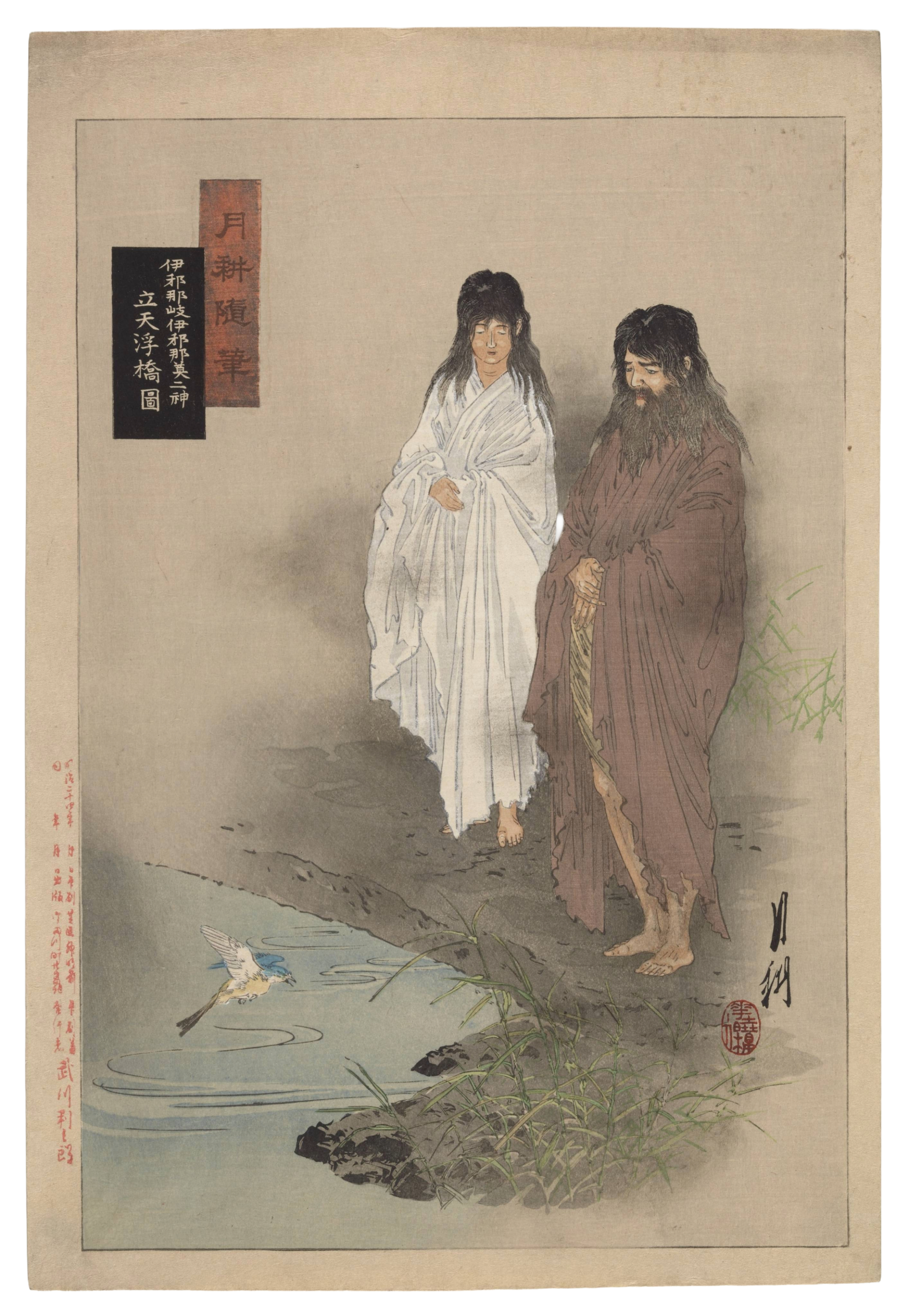
Japanese 原文
於是問其妹伊耶那美命曰:「汝身者如何成?」答曰:「吾身者,成々不成合處一處在。」尒伊耶那岐命詔:「我身者,成々而(成)餘處一處在。故以此吾身成餘處,刺塞汝身不成合處而以爲生成國土,生奈何?(訓生云宇牟。下效此)」伊耶那美命答曰:「然善。」尒伊耶那岐命詔:「然者,吾与汝行廻逢是天之御柱,而為美斗能麻具波比。(此七字以音)」如此之期,乃詔:「汝者自右廻逢,我者自左廻逢。」約竟以廻時,伊耶那美命先言:「阿那迩夜志愛(上)袁登古袁!(此十字以音。下效此)」後伊耶那岐命言:「阿那迩夜志愛(上)袁登賣袁!」各言竟之後,告其妹曰:「女人先言不良。」雖然,久美度迩(此四字以音)興而生子水蛭子。此子者入葦船而流去。次生淡嶋,是亦不入子之例。
於是二柱神議云:「今吾所生之子不良,猶宜白天神之御所。」即共參上,請天神之命。尒天神之命以,布斗麻迩尒(上)(此五字以音)卜相而詔之:「因女先言而不良,亦還降改言。」故尒降,更往廻其天之御柱如先。於是伊耶那岐命先言:「阿那(迩)夜志愛袁登賣袁!」後妹伊耶那美命言:「阿那迩夜志愛袁登古袁!」
English Chamberlain 1882
Having descended from Heaven onto this island, they saw to the erection[1] of an heavenly august pillar, they saw to the erection of an hall of eight fathoms[2]. Tunc quæsivit [Augustus Mas-Qui-Invitat] a minore sorore Augustâ Feminâ-Qui-Invitat: “Tuum corpus quo in modo factum est?” Respondit dicens: “Meum corpus crescens crevit, sed una pars est quæ non crevit continua.” Tunc dixit Augustus Mas-Qui-Invitat: “Meum corpus crescens crevit, sed est una pars quæ crevit euperflua. Ergo an bonum erit ut hanc corporis mei partem quæ crevit superflua in tui corporis partem quæ non crevit continua inseram, et regionea procreem?” Augusta Femina-Quæ-Invitat respondit dicens: “Bonum erit.” Tunc dixit Augustus Mas-Qui-Invitat: “Quod quum ita sit, ego et tu, hanc cœlestem augustam columnam circumenutes mutuoque occurrentes, augustarum [i.e. privatarum] partium augustam coitionem faciemus.”[3] Hâc pactione factâ, dixit [Augustus Mas-Qui-Invitat]: “Tu a dexterâ circumeuns occurre; ego a sinistrâ occurram.” Absolutâ pactione ubi circumierunt, Augusta Femina-Qui-Invitat primum inquit: “O venuste et amabilis adolescens!” Deinde Augustus Mas-Qui-Invitat inquit: “O venusta et amabilis virgo!” Postquam singuli orationi finem fecerunt, [Augustus Mas-Qui-Invitat] locutus est sorori, dicens: “Non decet feminam primum verba facere.” Nihilominus in thalamo [opus procreationis] inceperunt, et filium [nomine] Hirudinem[4] [vel Hirudini similem] pepererunt. This child they placed in a boat of reeds, and let it float away. Next they gave birth to the Island of Aha.[5] This likewise is not reckoned among their children[6].
Chamberlain’s notes
- The original of this quasi-causative phrase, of which there is no other example in Japanese literature so far as the translator’s reading goes, is interpreted by Motowori in the sense of the English locution to which it literally corresponds, and it has here been rendered accordingly, though with considerable hesitation. Hirata does not approve of Motowori’s view; but then the different text which he here adopts imposes on him the necessity of another interpretation. (See his “Exposition of the Ancient Histories,” Vol. II, pp. 39–40.) ↩
- The original word hiro (written 尋) is defined as the distance between the hands when the arms are outstretched. The word rendered “hall” may also be translated “palace.”—The text of the parallel passage of the “Chronicles” is “they made the Island of Onogoro the central pillar of the land,”—a statement which seems more rational and more in accordance with general tradition than that of these “Records.” ↩
- This is Hirata’s view of the import of the somewhat obscure original (see his “Exposition of the Ancient Histories,” Vol. II, pp. 61–64). Motowori’s interpretation is: “auguste in thalamo coibimus.” ↩
- The name in the original is Hiru-go, an instance of the fortuitous verbal resemblances occasionally found between unrelated languages. ↩
- Literally “foam.” It is supposed to have been an islet near the island of Ahaji in the province of Sanuki. ↩
- Hiru-go was not so reckoned, because he was a failure. ↩
English: Basil Hall Chamberlain, Ko-ji-ki, or Records of Ancient Matters (supplement to the Transactions of the Asiatic Society of Japan, 1882), public domain, text via English Wikisource (proofread from the 1882 printing). Footnotes are Chamberlain’s. Japanese: 太安萬侶『古事記』, public domain, text via Chinese Wikisource (古事記/序文 and 上卷・中卷・下卷), based on the Shinpukuji manuscript; modern editors’ variant notes are left out, and where the source gives a choice of character the first reading is used. Yasumaro’s own phonetic and kun notes are kept in small type. The Japanese is divided to follow Chamberlain’s 180 sections as closely as the sources allow; some passages could not be split any finer, so a short run of sections may share one Japanese column.