
Japanese shelf · Ō no Yasumaro · 古事記 · Volume I · Section 5
Birth of the Eight Great IslandsChamberlain 1882, vol. I (上巻), sect. V
Public domain. Ō no Yasumaro, 712. Translated by Basil Hall Chamberlain, 1882. Yasumaro’s own notes are in small type in the Japanese column. Chamberlain’s notes follow the English.
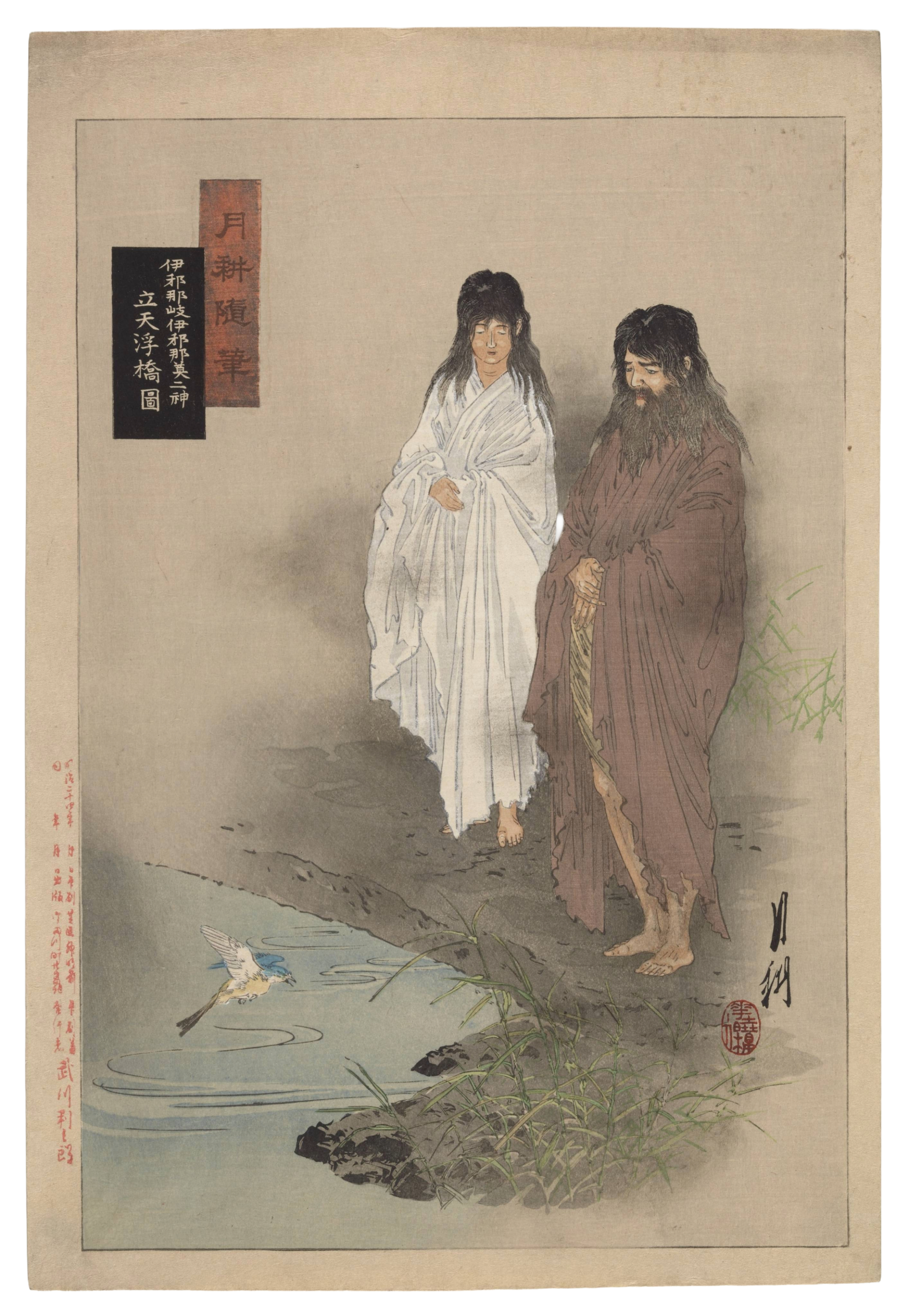
Japanese 原文
如此言竟而御合生子:淡道之穗之狹別嶋(訓別云和氣。下效此)。次生,伊豫之二名嶋。此嶋者身一而有面四,每面有名。故伊豫國謂愛(上)比賣(此三字以音。下效此也),讚岐國謂飯依比古,粟國謂大宜都比賣(此四字以音),土左國謂建依別。次生,隱伎之三子嶋,亦名天之忍許吕別(許吕二字以音)。次生,筑紫嶋。此嶋亦身一而有面四,每面有名。故筑紫國謂白日別,豊國謂豊日別,肥國謂建日向日豊久士比泥別(自久至泥以音),熊曾國謂建日別(曾字以音)。次生,伊伎嶋,亦名謂天比登都柱(自比至都以音。訓天如天)。次生,津嶋,亦名謂天之狹手依比賣。次生,佐度嶋。次生,大倭豊秋津(嶋),亦名謂天御虛空豊秋津根別。故因此八嶋先所生,謂大八嶋國。然後還坐之時,生吉備兒嶋,亦名謂建日方別。次生,小豆嶋,亦名謂大野手(上)比賣。次生,大嶋,亦名謂大多麻(上)流別(自多至流以音)。次生,女嶋,亦名謂天一根(訓天如天)。次生,知訶嶋,亦(名)謂天之忍男。次生,兩兒嶋,亦名謂天兩屋(自吉備兒嶋至天兩屋嶋并六嶋)。
English Chamberlain 1882
Hereupon the two Deities took counsel, saying: “The children to whom we have now given birth are not good. It will be best to announce this in the august place[1] of the Heavenly Deities.” They ascended forthwith to Heaven and enquired of Their Augustnesses the Heavenly Deities. Then the Heavenly Deities commanded and found out by grand divination,[2] and ordered them, saying: “They were not good because the woman spoke first. Descend back again and amend your words.” So thereupon descending back, they again went round the heavenly august pillar as before. Thereupon his Augustness the Male-Who-Invites spoke first: “Ah! what a fair and lovely maiden!” Afterwards his younger sister Her Augustness the Female-Who-Invites spoke: “Ah! what a fair and lovely youth!” Tali modo quum orationi finem fecerant, auguste coierunt et pepererunt a child, the Island of Ahaji, Ho-no-sa-wake.[3] Next they gave birth to the Island of Futa-na in Iyo.[4] This island has one body and four faces, and each face has a name. So the Land of Iyo is called Lovely-Princess;[5] the Land of Sanuki[6] is called Prince-Good-Boiled-Rice;[7] the Land of Aha is called the Princess-of-Great-Food;[8] the Land of Tosa[9] is called Brave-Good-Youth.[10] Next they gave birth to the Islands of Mitsu-go[11] near Oki,[12] another name for which [islands] is Heavenly-Great-Heart-Youth.[13] Next they gave birth to the island of Tsukushi.[14] This island likewise has one body and four faces,[15] and each face has a name. So the Land of Tsukushi is called White-Sun-Youth;[16] the Land of Toyo[17] is called Luxuriant-Sun-Youth;[18] the Land of Hi is called Brave Sun-Confronting-Luxuriant-Wondrous-Lord-Youth;[19] the Land of Kumaso is called Brave-Sun-Youth.[20] Next they gave birth to the Island of Iki,[21] another name for which is Heaven’s One-Pillar.[22] Next they gave birth to the Island of Tsu,[23] another name for which is Heavenly-Hand-net-Good-Princess.[24] Next they gave birth to the Island of Sado.[25] Next they gave birth to Great-Yamato-the-Luxuriant-Island-of-the-Dragon-Fly,[26] another name for which is Heavenly-August-Sky-Luxuriant-Dragon-fly-Lord-Youth. The name of “Land-of-the Eight-Great-Islands”[27] therefore originated in these eight islands having been born first. After that, when they had returned,[28] they gave birth to the Island of Ko [-zhima][29] in Kibi,[30] another name for which [island] is Brave-Sun-Direction-Youth. Next they gave birth to the Island of Adzuki,[31] another name for which is Oho-Nu-De-Hime. Next they gave birth to the Island of Oho [-shima],[32] another name for which is Oho-Tamaru-Wake. Next they gave birth to the Island of Hime,[33] another name for which is Heaven’s-One-Root. Next they gave birth to the Island of Chika,[34] another name for which is Heavenly-Great-Male. Next they gave birth to the Island[s] of Futa-go,[35] another name for which is Heaven’s-Two-Houses. (Six islands in all from the Island of Ko in Kibi to the Island of Heaven’s-Two-Houses.)
Chamberlain’s notes
- The characters 御所, here translated “august place” (the proper Chinese signification is “imperial place”) are those still in common use to denote the Mikado’s palace. ↩
- For an elaborate account of the various methods of divination practised by the Ancient Japanese see Note 5 to Mr. Satow’s translation of the “Service of the Gods of Wind at Tatsuta” in the “Transactions of the Asiatic Society of Japan,” Vol. VII, Pt. IV, p. 425 et seq. “The most important mode of divination practised by the primitive Japanese was that of scorching the shoulder-blade of a deer over a clear fire, and finding omens in the cracks produced by the heat.” ↩
- Aha-ji signifies “foam-way,” i.e., “the way to Foam (Aha)-Island,” on account, it is said, of its intermediate position between the mainland and the province of Aha in what is in modern parlance the Island of Shikoku. The author of the “Chronicles of Old Affairs” fancifully derives the name from a haji “my shame.” The etymology of Ho-no-sa-wake is disputed; but Hirata, who in the body of Vol. III of his “Exposition of the Ancient Histories” had already expended much ingenuity in discussing it, gives the most satisfactory interpretation that has yet been proposed in a postscript to that volume, where he explains it to signify “Rice-ear-True-Youth.” Wake (sometimes waki or waku) is a word of frequent occurrence in the names of gods and heroes. Whether it really signifies “youth,” as Hirata believes and as it is most natural to suppose, or whether Motowori’s guess that it is an Honorific title corrupted from waga kimi ye (lit. “my prince elder brother,” more freely “lord”) remains undecided. When it is used as a “gentile name,” the translator renders it by “lord,” as that in such cases is its import apart from the question of derivation. Sa, rendered “true,” may almost be considered to have dwindled down to a simple Honorific.—It is this little island which is said by the author of the “Chronicles” to have been the caul with which the great island of Yamato was born. Ahaji and Ho-no-sa-wake must be understood to be alternative names, the latter being what in other cases is prefaced by the phrase “another name for whom.” ↩
- Futa-na is written with characters signifying “two names,” and Motowori’s derivation from futa-narabi, “two abreast,” does not carry conviction. The etymology of Iyo is quite uncertain. It is here taken as the name of the whole island called in modern times Shikoku; but immediately below we find it in its usual modern acceptation of one of the four provinces into which that island is divided. A similar remark applies to Tsukushi a little further on. ↩
- Ye-hime. For the rendering of hiko and hime as “prince” and “princess” see Introduction, p. xvi. ↩
- Probably derived, as Hirata shows, from saho-ki, “pole-trees,” a tribute of poles having anciently been paid by that province. Motowori adopts the unusual reading of the name given in the “Japanese Words Classified and Explained,” viz. Sanugi, with the last syllable nigori’ed. ↩
- Ihi-yori-hiko. The translator, though with some hesitation, follows Motowori in looking on yori as a contraction of yoroshi, “good.” The character used for it in the original is 依. ↩
- Oho-ge-tsu-hime. Remember that aha signifies not only “foam” but “millet,” so that we need not be astonished to find that the alternative designation of the island so designated is that of a food-goddess. ↩
- Etymology uncertain, only fanciful derivations being proposed by the native philologists. ↩
- Take-yori-wake. ↩
- Mitsu-go signifies “triplets,” lit., “three children.” The three islets intended are Ama-no-shima, Mukafa-no-shima and Chiburi-no-shima. ↩
- Oki probably here signifies “offing,” which is its usual acceptation. ↩
- Ame-no-oshi-koro-wake. The syllables oshi, which recur in the names of many gods and heroes, are rendered “great” in accordance with Motowori’s plausible conjecture that they are an abbreviation of ohoshi (“great,” not “many” as in the later language). The translation of koro by “heart” follows a conjecture of Hirata’s (Motowori acknowledged that he could make nothing of the word), according to which it is taken to be an abbreviated form of kokoro, “heart.” ↩
- None but fanciful derivations of this word are suggested by the native philologists. ↩
- A note to the edition of 1687 says: “Should the word ‘four’ be changed to ‘five’?” For most texts enumerate five countries in this passage with slight variations in the names, Himuka (Hiuga), which it certainly seems strange to omit, being the fourth on the list with the alternative name of Toyokuzhi-hine-wake, while the alternative name of Hi is Haya-hi-wake. Motowori argues that an enumeration of four agrees better with the context, while Moribe in his Critique on Motowori’s Commentary decides in favour of the five. There are thus texts and authorities in favour of both views. ↩
- Shira-bi-wake. ↩
- Toyo means “luxuriant” or “fertile.” Hi appears to signify “fire” or “sun.” Kumaso is properly a compound, Kuma-so, as the district is often mentioned by the simple name of So. Kuma signifies “bear,” and Motowori suggests that the use of the name of this the fiercest of beasts as a prefix may be traced to the evil reputation of that part of the country for robbers and outlaws. He quotes similar compounds with kuma in support of this view. ↩
- Toyo-bi-wake. ↩
- Take-hi-mukahi-toyo-kuzhi-hine-wake. The interpretation of this name follows Motowori, ↩
- Take-bi-wake. ↩
- Etymology uncertain, but there seems reason to suppose that the name was originally pronounced Yiki or Yuki. ↩
- Ame-hito-tsu-bashira. ↩
- Tsu (Tsu-shima) means “port,” “anchorage,” a name probably given to this island on account of its being the midway halting-place for junks plying between Japan and Korea. ↩
- Ame-no-sade-yori-hime. The interpretation of sade (rendered “hand-net”) is uncertain. The translator has followed that sanctioned by an ode in Vol. I of the “Collection of a Myriad Leaves” and by a passage in the “Japanese Words Classified and Explained.” Hirata takes sa to be an Honorific and te to be the usual word for “hand,” while Motowori gives up the name in despair. ↩
- Etymology uncertain. ↩
- Oho-yamato-toyo-aki-dzu-shima (the original of the alternative personal name is Ama-no-mi-sora-toyo-aki-dzu-ne-wake). The etymology of Yamato is much disputed. Mabuchi, in his “Addenda to the Commentary on the Collection of a Myriad Leaves,” derives the name from yama-to, “mountain-gate.” Motowori, in a learned discussion to be found in his “Examination of the Synonyms of Japan,” pp. 24–27, proposes three other possible derivations, viz. yama-to, “mountain-place,” yama-to (supposed to stand for yama-tsubo and to mean “mountain-secluded”), and yama-utsu (utsu being a supposititious Archaic form of uchi), “within the mountains.” Other derivations are yama-to (山外), “without the mountains,” yama-ato, “mountain-traces” and yama-todomi, “mountains stopping,” i.e. (as Moribe, who proposes it, explains), “far as the mountains can be seen.” Another disputed point is whether the name of Yamato which here designates the Main Island of the Archipelago, but which in the common parlance of both ancient and modern times is the denomination on the one hand of the single province of Yamato and on the other of the whole Empire of Japan, originally had the wider application or the more restricted one. Motowori and the author of the “Exposition of the Foreign Notices of Japan” seem to the present writer to make out the case in favour of the latter view. Motowori supposes the name to have denoted first a village and then a district, before being applied to a large province and finally to the entire country. The “Island of the Dragon-fly” is a favourite name for Japan in the language of the Japanese poets. It is traced to a remark of the Emperor Jim-mu, who is said to have compared the shape of the country round Mount Hohoma to “a dragon-fly drinking with its tail.” Conf. also the tradition forming the subject of Sec. CLVI of the present translation. ↩
- Oho-ya-shima-kuni. A perhaps still more literal English rendering of this name would be “Land of the Grand Eight Islands” or “Grand Land of the Eight Islands,” for the word oho must be regarded rather as an Honorific than as actually meant to convey an idea of size. ↩
- “To the Island of Onogoro,” says Motowori; but we are not told that the god and goddess had ever left it. ↩
- Ko means “infant” or “small.” The original of the alternative personal name is Take-hi-gata-wake. Gata (or, without the nigori, Kata) here and in other names offers some difficulty. The translator renders it by the equivalent of the usual Japanese signification of the character 方, “direction,” with which it is written. ↩
- Etymology uncertain. ↩
- Adzuki is writen with the characters 小豆, which signify a kind of bean (the Phaseolus radiatus); but it is possible that they represent the sound, and not the sense, of the name. In the alternative personal name oho signifies “great,” and hime “princess,” while the syllables nu-de are of altogether uncertain interpretation. Motowori suggests that nu may mean “moor” and de (for te) “clapper-bell.” ↩
- I.e., Great Island. The word tamaru in the alternative personal name is so obscure that not even any plausible conjecture concerning it has been ventured and the name is therefore of necessity left untranslated. ↩
- Hime signifies “princess” or “maiden.” The original of the alternative personal name is Ame-hito-tsu-ne. ↩
- Etymology uncertain. Motowori would take the name in a Plural sense as standing for the modern islands of Hirado and Go-tō (Goto). The original of the alternative personal name is Ame-no-oshi-wo, in which as usual, oshi is supposed to represent ohoshi (大), “great.” ↩
- Futa-go means “twins.” The original of the alternative personal name is Ame-futa-ya. ↩
English: Basil Hall Chamberlain, Ko-ji-ki, or Records of Ancient Matters (supplement to the Transactions of the Asiatic Society of Japan, 1882), public domain, text via English Wikisource (proofread from the 1882 printing). Footnotes are Chamberlain’s. Japanese: 太安萬侶『古事記』, public domain, text via Chinese Wikisource (古事記/序文 and 上卷・中卷・下卷), based on the Shinpukuji manuscript; modern editors’ variant notes are left out, and where the source gives a choice of character the first reading is used. Yasumaro’s own phonetic and kun notes are kept in small type. The Japanese is divided to follow Chamberlain’s 180 sections as closely as the sources allow; some passages could not be split any finer, so a short run of sections may share one Japanese column.