
Japanese shelf · Ō no Yasumaro · 古事記 · Chamberlain 1882
古事記 · KojikiRecords of Ancient Matters · preface and 180 sections
Public domain. Compiled by Ō no Yasumaro in 712 and presented to Empress Genmei. Translated by Basil Hall Chamberlain, 1882. The Japanese follows the Shinpukuji-line wording; Chamberlain’s section numbers are kept, and a few neighbouring sections share one Japanese column when the sources cannot be split any finer.
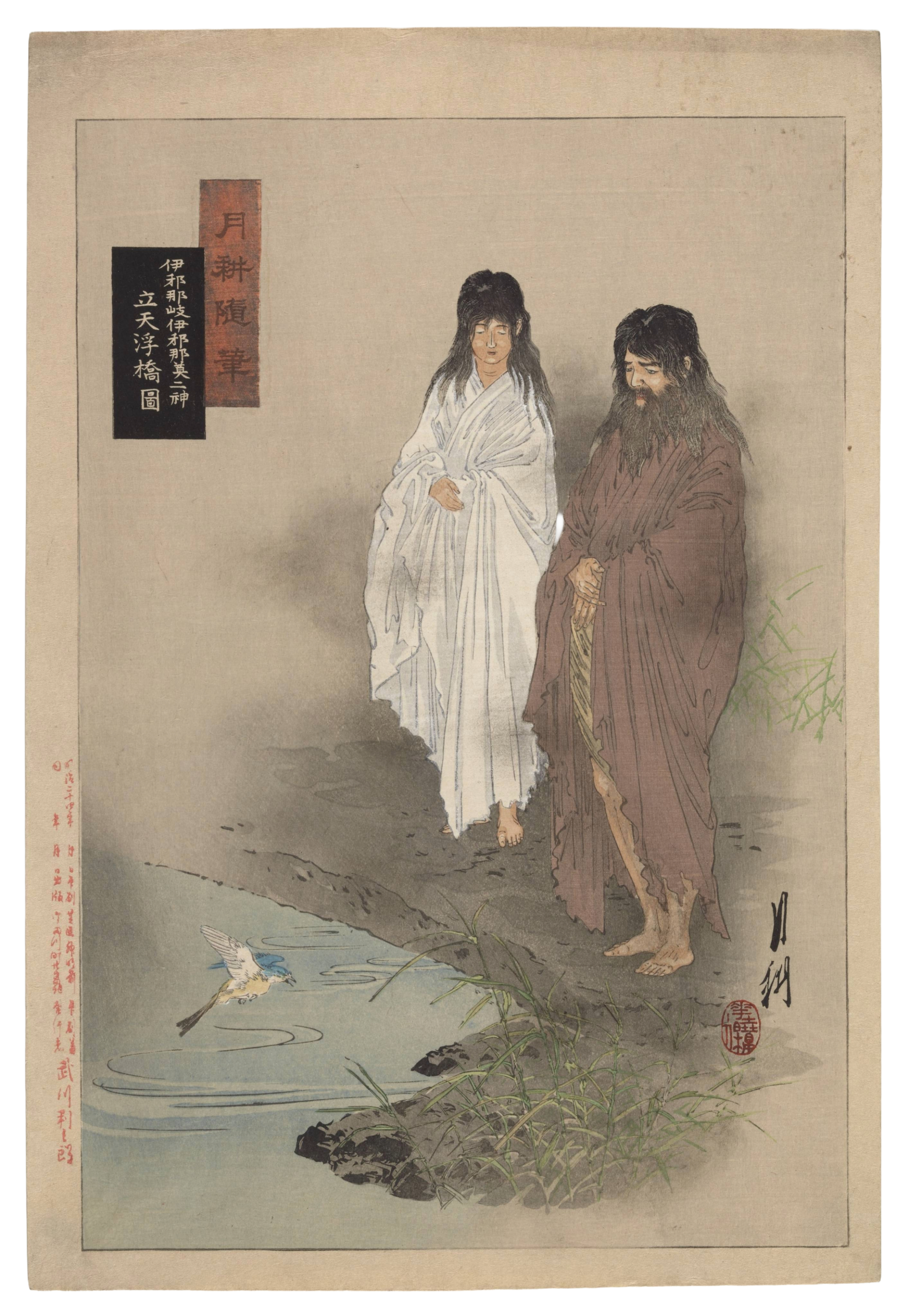
Public-domain art for this book, with credits and downloads
Preface
Volume I The age of the gods · 上巻
- 1 The Beginning of Heaven and Earth
- 2 The Seven Divine Generations
- 3 The Island of Onogoro
- 4 Courtship of the Deities the Male-Who-Invites and the Female-Who-Invites
- 5 Birth of the Eight Great Islands
- 6 Birth of the Various Deities
- 7 Retirement of Her Augustness the Princess-Who-Invites
- 8 The Slaying of the Fire-Deity
- 9 The Land of Hades
- 10 The Purification of the August Person
- 11 Investiture of the Three Deities the Illustrious August Children
- 12 The Crying and Weeping of His Impetuous-Male-Augustness
- 13 The August Oath
- 14 The August Declaration of the Division of the August Male Children and the August Female Children
- 15 The August Ravages of His-Impetuous-Male-Augustness
- 16 The Door of the Heavenly Rock-Dwelling
- 17 The August Expulsion of His-Impetuous-Male-Augustness
- 18 The Eight-Forked Serpent
- 19 The Palace of Suga
- 20 The August Ancestors of the Deity-Master-of-the-Great Land
- 21 The White Hare of Inaba
- 22 Mount Tema
- 23 The Nether-Distant-Land
- 24 The Wooing of the Deity-of-Eight-Thousand-Spears
- 25 The Cup Pledge
- 26 The Deities the August Descendants of the Deity Master-of-the-Great-Land
- 27 The Little-Prince-the-Renowned-Deity
- 28 The August-Luck-Spirit-the-August-Wondrous-Spirit
- 29 The August Children of the Great-Harvest-Deity and of the Swift-Mountain-Deity
- 30 The August Deliberation for Pacifying the Land
- 31 The Heavenly-Young-Prince
- 32 Abdication of the Deity Master-of-the-Great-Land
- 33 The August Descent from Heaven of his Augustness the August Grandchild
- 34 The August Reign in Himuka of His Augustness Prince Rice-ear-Ruddy-Plenty
- 35 The Duchess of Saru
- 36 The Deity Prince of Saruta at Azaka
- 37 The Curse of the Deity Great-Mountain-Possessor
- 38 The August Child-Bearing of Princess-Blossoming Brilliantly-Like-the-Flowers-of-the-Trees
- 39 The August Exchange of Luck
- 40 The Palace of the Ocean-Possessor
- 41 Submission of His Augustness Fire-Shine
- 42 The Parturition-House of Cormorants’ Feathers
- 43 The August Children of His Augustness Cormorant-Thatch-Meeting-Incompletely
Volume II From Emperor Jimmu to Emperor Ōjin · 中巻
- 44 Reign of the Emperor Jim-mu (Part I.—His Progress Eastward, and Death of His Elder Brother)
- 45 Emperor Jim-mu (Part II.—The Cross-sword Sent Down from Heaven)
- 46 Emperor Jim-mu (Part III.—The Gigantic Crow and Gods with Tails)
- 47 Emperor Jim-mu (Part IV.—The Ukashi Brethren)
- 48 Emperor Jim-mu (Part V.—The Earth-spiders of the Cave of Osaka)
- 49 Emperor Jim-mu (Part VI.—The Prince of Tomi and the Shiki Brethren)
- 50 Emperor Jim-mu (Part VII.—The Empire Pacified)
- 51 Emperor Jim-mu (Part VIII.—He Weds I-suke-yori-hime)
- 52 Emperor Jim-mu ( Part. IX —Troubles Which Followed His Decease)
- 53 Emperor Jim-mu (Part X.—Genealogies)
- 54 Emperor Jim-mu (Part XI.—His Age and Place of Burial)
- 55 Emperor Sui-zei
- 56 Emperor An-nei
- 57 Emperor I-toku
- 58 Emperor Kō-shō
- 59 Emperor Kō-an
- 60 Emperor Kō-rei
- 61 Emperor Kō-gen
- 62 Emperor Kai-kuwa
- 63 Emperor Sū-jin (Part I.—Genealogies)
- 64 Emperor Sū-jin (Part II.—A Pestilence is Staid by Oho-tata-ne-ko)
- 65 Emperor Sū-jun (Part III.—Story of Oho-taka-ne-ko’s Birth)
- 66 Emperor Sū-jin (Part IV.—War with King Take-hani-yasu)
- 67 Emperor Sū-jin (Part V.—Peace Restored and Tribute Levied)
- 68 Emperor Sū-jin (Part VI.—His Age and Place of Burial)
- 69 Emperor Sui-nin (Part I.—Genealogies)
- 70 Emperor Sui-nin (Part II.—Conspiracy of King Saho-biko and the Empress Saho-bime)
- 71 Emperor Sui-nin (Part III.—Birth of Prince Homu-chi-wake and Death of the Conspirators)
- 72 Emperor Sui-nin (Part IV.—The Dumb Prince Homu-chi-wake)
- 73 Emperor Sui-nin (Part V.—His Later Wives)
- 74 Emperor Sui-nin (Part VI.—Tajima-mori Brings Back the Orange from the Eternal Land)
- 75 Emperor Sui-nin (Part VII.—His Death and That of the Empress Hibasu .)
- 76 Emperor Kei-kō (Part I.—Genealogies)
- 77 Emperor Kei-kō (Part II.—The Maidens Ye-hime and Oto-hime)
- 78 Emperor Kei-kō (Part III.—Various Deeds)
- 79 Emperor Kei-kō (Part IV.—Yamato-take Slays His Elder Brother)
- 80 Emperor Kei-kō (Part V.—Yamato-take Slays the Kumaso Bravoes)
- 81 Emperor Kei-kō (Part VI.—Yamato-take Slays the Idzumo Bravo)
- 82 Emperor Kei-kō (Part VII.—Yamato-take is Sent to Subdue the East, and Visits His Aunt at Ise)
- 83 Emperor Kei-kō (Part VIII.—Yamato-take Slays the Rulers of Sagamu)
- 84 Emperor Kei-kō (Part IX.—Yamato-take’s Empress Stills the Waves .)
- 85 Emperor Kei-kō (Part X.—Yamato-take Slays the Deity of the Ashigara Pass)
- 86 Emperor Kei-kō (Part XI.—Yamato-take Dwells in the Palace of Sakawori)
- 87 Emperor Kei-kō (Part XII.—Yamato-take Wooes Princess Miyazu)
- 88 Emperor Kei-kō (Part XIII.—Yamato-take Meets the Deity of Mount Ibuki)
- 89 Emperor Kei-kō (Part XIV.—Yamato-take Sickens and Dies)
- 90 Emperor Kei-kō (Part XV.—Yamato-take Turns into a White Bird)
- 91 Emperor Kei-kō (Part XVI.—Yamato-take’s Butler)
- 92 Emperor Kei-kō (Part XVII.—Yamato-take’s Descendants)
- 93 Emperor Kei-kō (Part XVIII.—His Age and Place of Burial)
- 94 Emperor Sei-mu
- 95 Emperor Chiū-ai (Part I.—Genealogies)
- 96 Emperor Chiū-ai (Part II.—The Possession of Korea Divinely Promised)
- 97 Emperor Chiū-ai (Part III.—Preparations for the Conquest of Korea)
- 98 Emperor Chiū-ai (Part IV.—The Empress Jin-gō Conquers Korea)
- 99 Emperor Chiū-ai (Part V.—The Empress Jin-gō Fishes in Tsukushi)
- 100 Emperor Chiū-ai (Part VI.—The Empress Jin-gō Subdues Yamato)
- 101 Emperor Chiū-ai (Part VIII.—The Heir Apparent Exchanges Names with the Great Deity Izasa-Wake)
- 102 Emperor Chiū-ai (Part VIII.—The Empress Jin-gō Presents Liquor to the Heir Apparent)
- 103 Emperor Chiū-ai (Part IX.—His Death and That of the Empress Jin-gō)
- 104 Emperor Ō-jin (Part I.—Genealogies)
- 105 Emperor Ō-jin (Part II.—He Divides the Inheritance Between His Three Sons)
- 106 Emperor Ō-jin (Part III.—He Wooes Princess Miya-nushi-ya-kaha-ye)
- 107 Emperor Ō-jin (Part IV.—He Grants Princess Kami-naga to His Son Oho-sazaki)
- 108 Emperor Ō-jin (Part V.—Songs of the Territorial Owners of Yeshinu)
- 109 Emperor Ō-jin (Part VI.—Various Deeds)
- 110 Emperor Ō-jin (Part VII.—Tribute From Korea)
- 111 Emperor Ō-jin (Part VIII.—The Emperor Intoxicated)
- 112 Emperor Ō-jin (Part IX.—Troubles Which Followed His Decease)
- 113 Emperor Ō-jin (Part X.—Princes Oho-sazaki and Uji-no-waki-iratsuko Cede the Empire to Each Other)
- 114 Emperor Ō-jin (Part XI.—Ama-no-hi-boko Crosses Over to Japan)
- 115 Emperor Ō-jin (Part XII.—Descendants of Ama-no-hi-boko, and Treasures Brought by Him)
- 116 Emperor Ō-jin (Part XIII.—The Youth-of-the-Glow-on-the-Autumn-Mountains and the Youth-of-the-Haze-on-the-Spring-Mountains)
- 117 Emperor Ō-jin (Part XVI.—Genealogies)
- 118 Emperor Ō-jin (Part XV.—His Age and Place of Burial)
Volume III From Emperor Nintoku to Empress Suiko · 下巻
- 119 Emperor Nin-toku (Part I.—Genealogies)
- 120 Emperor Nin-toku (Part II.—Various Deeds)
- 121 Emperor Nin-toku (Part III.—He Remits the Taxes)
- 122 Emperor Nin-toku (Part IV.—He Loves Princess Kuro)
- 123 Emperor Nin-toku (Part V.—The Empress Retires to Yamashiro)
- 124 Emperor Nin-toku (Part VI.—He Follows the Empress Into Yamashiro)
- 125 Emperor Nin-toku (Part VII.—He Loves Yata-no-waki-iratsume)
- 126 Emperor Nin-toku (Part VIII.—Death of King Hayabusa-wake and Queen Medori)
- 127 Emperor Nin-toku (Part VIII .—Queen Medori’s Armlet)
- 128 Emperor Nin-toku (Part IX .—A Wild-goose Lays an Egg)
- 129 Emperor Nin-toku (Part X .—A Vessel is Made Into a Lute)
- 130 Emperor Nin-toku (Part XI .—His Age and Place of Burial)
- 131 Emperor Ri-chiū (Part I.—Genealogies)
- 132 Emperor Ri-chiū (Part II.—He is Taken to Iso-no-Kami)
- 133 Emperor Ri-chiū (Part III.—His Rebellious Brother and the Latter’s Retainer Sobakari are Slain)
- 134 Emperor Ri-chiū (Part IV.—Various Deeds)
- 135 Emperor Ri-chiū (Part V.—His Age and Place of Burial)
- 136 Emperor Han-zei
- 137 Emperor In-giyō (Part I.—Genealogies)
- 138 Emperor In-giyō (Part II.—His Sickness is Cured by a Korean Physician)
- 139 Emperor In-giyō (Part III.—He Rectifies the People’s Names)
- 140 Emperor In-giyō (Part IV.—His Age and Place of Burial)
- 141 Emperor In-giyō (Part V.—Prince Karu Loves His Sister Princess So-tohoshi)
- 142 Emperor In-giyō (Part VI.—War Between Prince Karu and Prince Anaho)
- 143 Emperor In-giyō (Part VII.—Death of Prince Karu and Princess So-tohoshi)
- 144 Emperor An-kō (Part I.—He Slays King Oho-kusaka)
- 145 Emperor An-kō (Part II.—He is Slain by King Ma-yowa)
- 146 Emperor An-kō (Part III.—Prince Oho-hatsuse Slays Princes Kuro-biko and Shiro-biko)
- 147 Emperor An-kō (Part IV.—Death of Prince Ma-yowa and of the Grandee Tsubura)
- 148 Emperor An-kō (Part V.—Prince Oho-hatsuse Slays Prince Oshiha)
- 149 Emperor An-kō (Part VI.—Flight of Princes Ohoke and Woke)
- 150 Emperor Yū-riyaku (Part I.—Genealogies)
- 151 Emperor Yū-riyaku (Part II.—Various Deeds)
- 152 Emperor Yū-riyaku (Part III.—The Roof of the House of the Great Departmental Lord of Shiki)
- 153 Emperor Yū-riyaku (Part IV.—He Wooes Princess Waka-kusaka-be)
- 154 Emperor Yū-riyaku (Part V.—Story of the Woman Akawi-ko)
- 155 Emperor Yū-riyaku (Part VI.—He Makes a Progress to Yeshinu)
- 156 Emperor Yū-riyaku (Part VII.—The Horse-fly and the Dragon-fly)
- 157 Emperor Yū-riyaku (Part VIII.—Adventure with a Wild Boar)
- 158 Emperor Yū-riyaku (Part IX.—Revelation of the Great Deity of Kadzuraki, Lord of One Word)
- 159 Emperor Yū-riyaku (Part X.—The Mound of the Metal Spade)
- 160 Emperor Yū-riyaku (Part XI.—The Leaf in the Cup)
- 161 Emperor Yū-riyaku (Part XII.—Songs by the Emperor and Princess Wodo)
- 162 Emperor Yū-riyaku (Part XIII.—His Age and Place of Burial)
- 163 Emperor Sei-nei (Part I.—Search for a Successor to Him)
- 164 Emperor Sei-nei (Part II.—Princes Ohoke and Woke Are Discovered)
- 165 Emperor Sei-nei (Part III.—The Grandee Shibi)
- 166 Emperor Sei-nei (Part IV.—Prince Ohoke Cedes the Empire to Prince Woke)
- 167 Emperor Ken-zō (Part I.—The Old Woman Oki-me)
- 168 Emperor Ken-zō (Part II.—He Slays the Boar-herd)
- 169 Emperor Ken-zō (Part III.—The Emperor Yū-riyaku’s Mausoleum is Disfigured)
- 170 Emperor Ken-zō (Part IV.—His Age and Place of Burial)
- 171 Emperor Nin-ken
- 172 Emperor Mu-retsu
- 173 Emperor Kei-tai
- 174 Emperor An-kan
- 175 Emperor Sen-kuwa
- 176 Emperor Kim-mei
- 177 Emperor Bi-datsu
- 178 Emperor Yō-mei
- 179 Emperor Su-jun
- 180 Empress Sui-ko
English: Basil Hall Chamberlain, Ko-ji-ki, or Records of Ancient Matters (supplement to the Transactions of the Asiatic Society of Japan, 1882), public domain, text via English Wikisource (proofread from the 1882 printing). Footnotes are Chamberlain’s. Japanese: 太安萬侶『古事記』, public domain, text via Chinese Wikisource (古事記/序文 and 上卷・中卷・下卷), based on the Shinpukuji manuscript; modern editors’ variant notes are left out, and where the source gives a choice of character the first reading is used. Yasumaro’s own phonetic and kun notes are kept in small type. The Japanese is divided to follow Chamberlain’s 180 sections as closely as the sources allow; some passages could not be split any finer, so a short run of sections may share one Japanese column.