
Japanese shelf · Ō no Yasumaro · 古事記 · Volume I · Section 3
The Island of OnogoroChamberlain 1882, vol. I (上巻), sect. III
Public domain. Ō no Yasumaro, 712. Translated by Basil Hall Chamberlain, 1882. Yasumaro’s own notes are in small type in the Japanese column. Chamberlain’s notes follow the English.
Japanese 原文
天神諸命以詔伊耶那岐命、伊耶那美命二柱神:「修理固成是多陀用幣流之國。」賜天沼矛而言依賜也。故二柱神立(訓立云多多志)天浮橋而指下其沼矛以畫者,塩許々袁々呂々迩(此七字以音)畫鳴(訓鳴云那志々)而引上時,自其矛末垂落塩之累積成嶋,是淤能碁吕嶋(自淤以下四字以音)。於其嶋天降坐而見立天之御柱、見立八尋殿。
English Chamberlain 1882
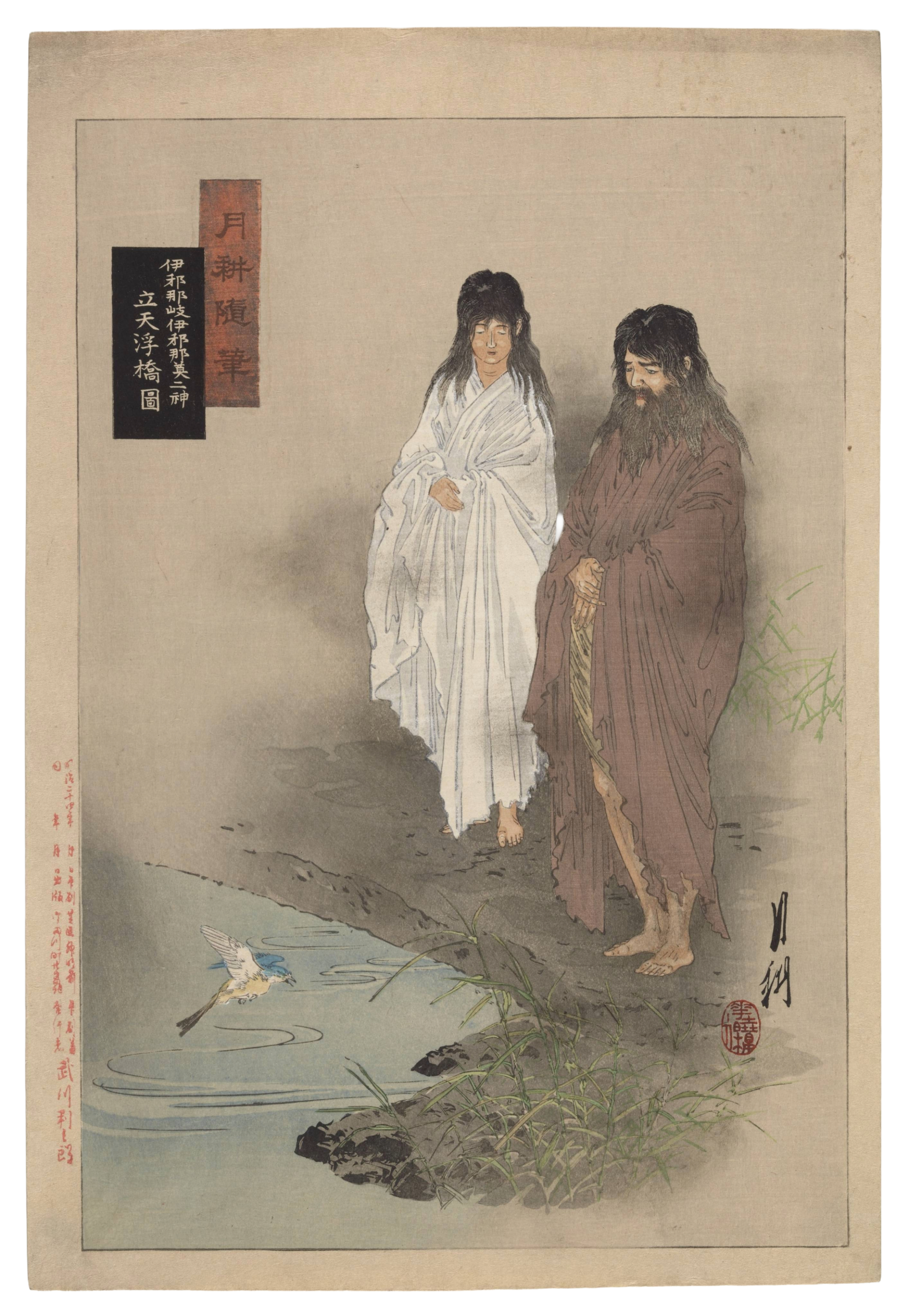
Hereupon all the Heavenly Deities commanded the two Deities His Augnstness[1] the Male-Who-Invites and Her Augustness the Female-Who-Invites, ordering them to “make, consolidate, and give birth to this drifting land.” Granting to them an heavenly jewelled spear,[2] they [thus] deigned to charge them. So the two Deities, standing upon the Floating Bridge of Heaven,[3] pushed down the jewelled spear and stirred with it, whereupon, when they had stirred the brine till it went curdle-curdle[4], and drew [the spear] up, the brine that dripped down from the end of the spear was piled up and became an island. This is the Island of Onogoro[5].
Chamberlain’s notes
- For this rendering of the Japanese title Mikoto see Introduction, p. xvi, last paragraph. ↩
- The characters translated “jewelled spear” are 沼矛, whose proper Chinese signification would be quite different. But the first of the two almost certainly stands phonetically for 瓊 or 玉,—the syllable nu, which is its sound, having apparently been an ancient word for “jewel” or “bead”, the better-known Japanese term being tama. In many places the word “jewel” (or “jewelled”) seems to be used simply as an adjective expressive of beauty. But Motowori and Hirata credit it in this instance with its proper signification, and the translator always renders it literally, leaving the reader to consider it to be used metaphorically if and where he pleases. ↩
- Ama-no-uki-hashi or Ame-no-uki-hashi. The best authorities are at variance as to the nature of this bridge uniting Heaven with Earth. Hirata identifies it with the Heavenly-Rock-Boat (Ame-no-iha-fune) mentioned in some ancient writings, whereas Motowori takes it to have been a real bridge, and finds traces of it and of similar bridges in the so-called “Heavenly Stairs” (Ama-no-hashi-date) which are found on several points of the coast, forming a kind of natural breakwater just above water-level. ↩
- I.e., “till it became thick and glutinous.” It is not easy to find in English a word which will aptly render the original Japanese onomatopoeia koworo-koworo. The meaning may also be “till it made a curdling sound.” But though the character 鳴, “to make a noise,” sanctions this view, it is not the view approved by the commentators, and 鳴 is probably only written phonetically for a homonymous word signifying “to become,” which we find in the parallel passage of the “Chronicles.” ↩
- I.e., “Self-Curdling,” “Self-Condensed.” It is supposed to have been one of the islets off the coast of the larger island of Ahaji. ↩
English: Basil Hall Chamberlain, Ko-ji-ki, or Records of Ancient Matters (supplement to the Transactions of the Asiatic Society of Japan, 1882), public domain, text via English Wikisource (proofread from the 1882 printing). Footnotes are Chamberlain’s. Japanese: 太安萬侶『古事記』, public domain, text via Chinese Wikisource (古事記/序文 and 上卷・中卷・下卷), based on the Shinpukuji manuscript; modern editors’ variant notes are left out, and where the source gives a choice of character the first reading is used. Yasumaro’s own phonetic and kun notes are kept in small type. The Japanese is divided to follow Chamberlain’s 180 sections as closely as the sources allow; some passages could not be split any finer, so a short run of sections may share one Japanese column.