
Mesoamerican shelf · Popol Vuh · Part 1, chapter 1 of 46
Chapter 1The creation and the first peoples
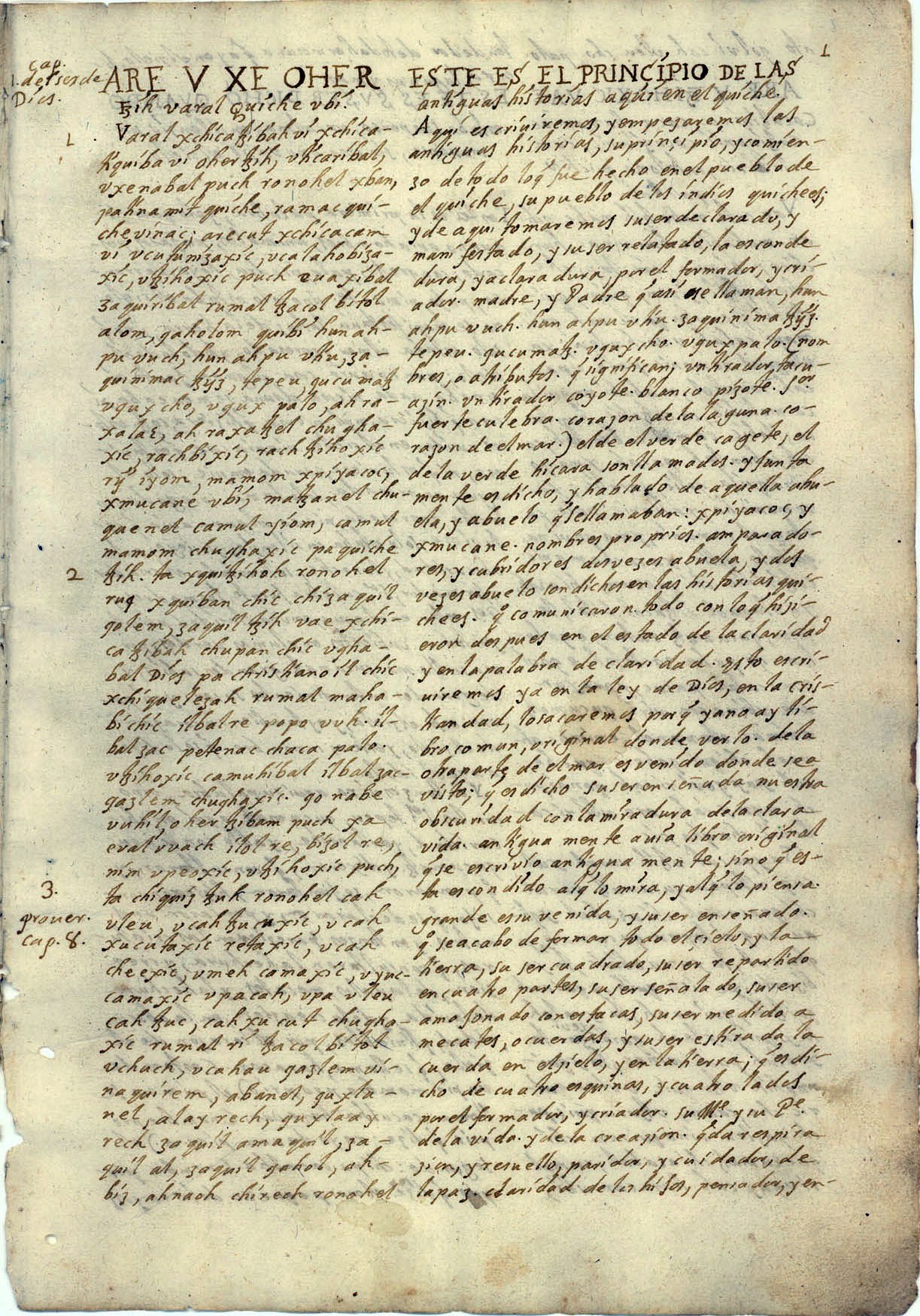
Spanish Ximénez, Scherzer 1857
Este es el principio de las antiguas historias aquí en el Quiche.
Aquí escribiremos y empezaremos las antiguas historias, su principio y comienzo de todo lo que fué hecho en el Pueblo del Quiche, su pueblo de los indios Quichées; y de aquí tomaremos su ser declarado y manifestado, y su ser relatado, la escondedura y aclaradura por el formador y criador, madre y padre, que así se llaman; Hun-ahpu-vuch, Hun-ahpu-uhú, Zaquinimatzyz, Tepeu, Cucumatz, Vguxcho, Vguxpalo, (nombres ó atributos que significan: un tirador tacuasin, un tirador coyote, blanco pizote, Señor, fuerte culebra, corazón de la laguna, corazón del mar, el del verde cagete, el de la verde jicara) son llamados. Y juntamente es dicho y hablado de aquella abuela ó abuelo que se llamaban Xpiyacoc, y Xmucane, nombres propios amparadores y cubridores, dos veces abuela y dos veces abuelo son dichos en las historias quichees, que comunicaron todo con lo que hicieron después en el estado de la claridad y en la palabra de claridad. Esto escribiremos ya en la ley de Dios en la cristiandad, los sacaremos, porque ya no hay
English Guthrie 1905–06
1. This is the origin of the ancient history of the country here called Quiche.
2. We will write here and we will begin the history of early times, the principle and origin of all that occurred in the city of the Quiche, in the tribes of the Quiche Nation.
3. Here then we will manifest, discover and publish what was in darkness, the energizing of its Dawn by the Will of Tzakol the creator, and Bitol the former, of Alom he-who-begets, and Qaholom he-who-gives-being, and whose names are Hun-ahpuvuch the opossum-sabarcan-shooter, Hun-ahpu-utiu the jackal sabarcan-shooter, Zaki-nima-tzigiz the great-white-blood-letter, Tepeu the dominator, Gucumatz the plumed-serpent, Qux-cho the heart-of-the-lakes, and Cux-palo the heart-of-the-sea, Ah-raxa-lak the master-of-the-verdant-planisphere, Ah-raxa-tzel the master-of-the-azure-expanse.
4. Thus are named, thus are sung and celebrated together, those who are the grand-mother and grand-father, whose name is Xpiyacoc the sun-god and Xmucane the moon-goddess, protectress and conserver, twice grand-father and twice grandmother; as it is said in the Quiche histories which completely describe their nature and subsequent actions for prosperity and civilization.
5. This is what we will write since (some one has promulgated) the Word of Dios, and within Christianity; we will reproduce it since the Popol Vuh is no more seen, in which it was clearly seen that men came from the further shore of the sea; the title of which was "The Tale of Human Existence in the Land of Shadows, and, How Man Saw Light and Life." [Guthrie’s notes: Dios is Spanish for God, substituted by missionaries for the Quiché name Cabavil. “Christianity”: literally, “within already the word of God.” “Land of Shadows”: literally, “in the overshadowed Land.”]
House English from Ximénez / Scherzer 1857
This is the beginning of the ancient histories here in the Quiche.
Here we will write and begin the ancient histories, their beginning and commencement of all that was done in the Town of the Quiche, the town of the Quiche Indians; and from here we will take up its being declared and made manifest, and its being told, the hiding and the clearing, by the former and the creator, mother and father, who are so called: Hun-ahpu-vuch, Hun-ahpu-uhú, Zaquinimatzyz, Tepeu, Cucumatz, Vguxcho, Vguxpalo (names or attributes that mean: a shooter of the tacuasin, a shooter of the coyote, white coatimundi, Lord, strong serpent, heart of the lagoon, heart of the sea, he of the green cagete, he of the green gourd) they are called. And together there is spoken and told of that grandmother or grandfather who were called Xpiyacoc and Xmucane, proper names, protectors and coverers; twice grandmother and twice grandfather they are called in the Quiche histories, who communicated all with what they afterward did in the state of light and in the word of light. This we will write now in the law of God, in Christianity; we will bring it out, because there is no longer
Spanish: Francisco Ximénez’s translation, as printed by Carl Scherzer, Las historias del origen de los Indios de esta provincia de Guatemala (Vienna: C. Gerold e hijo, 1857), public domain, from the Library of Congress scan at Internet Archive (lashistoriasdelo00sche) (text layer: djvu.txt; also on Wikimedia Commons). The 1857 text is lightly cleaned from that OCR and does not include Scherzer’s footnotes or Ximénez’s Escolios. English: Kenneth Sylvan Guthrie, The Popol Vuh, or Book of the Holy Assembly, The Word (New York), October 1905–November 1906, public domain, via IAPSOP Guthrie’s publication ends at the announcement of the royal generations; chapter 46 keeps that Guthrie ending in the Guthrie column, and the king-list is in the House English layer. Ximénez did not number these 46 chapters; the breaks follow Guthrie’s English as closely as the 1857 text allows, and may fall a sentence or two earlier or later than Guthrie’s verse 1. House English on chapters 1–46 is a House translation made for the Hall from Francisco Ximénez’s Spanish as printed by Carl Scherzer (Vienna, 1857), and is shown as its own layer beside Guthrie’s English; it is not Guthrie’s translation.Manuscript: Francisco Ximénez, Empiezan las historias del origen de los indios de esta provincia de Guatemala (c. 1701), Newberry Library, via Wikimedia Commons (public domain).
Chapter breaks follow Guthrie’s 1905–06 English as closely as the 1857 Spanish allows. Ximénez did not number these 46 chapters, so a break may fall a sentence or two earlier or later than Guthrie’s verse 1.
House English, where it is present, follows the 1857 Spanish paragraphing of this chapter, and uses the name-forms of that edition. It is a House translation from the public-domain 1857 text, made for the Hall.