
Mesoamerican shelf · Kʼicheʼ, written down c. 1554–1558
Popol VuhThe book of the Kʼicheʼ Maya, in Ximénez’s Spanish of 1857, the English of 1905–06, and a House English of the 1857 text
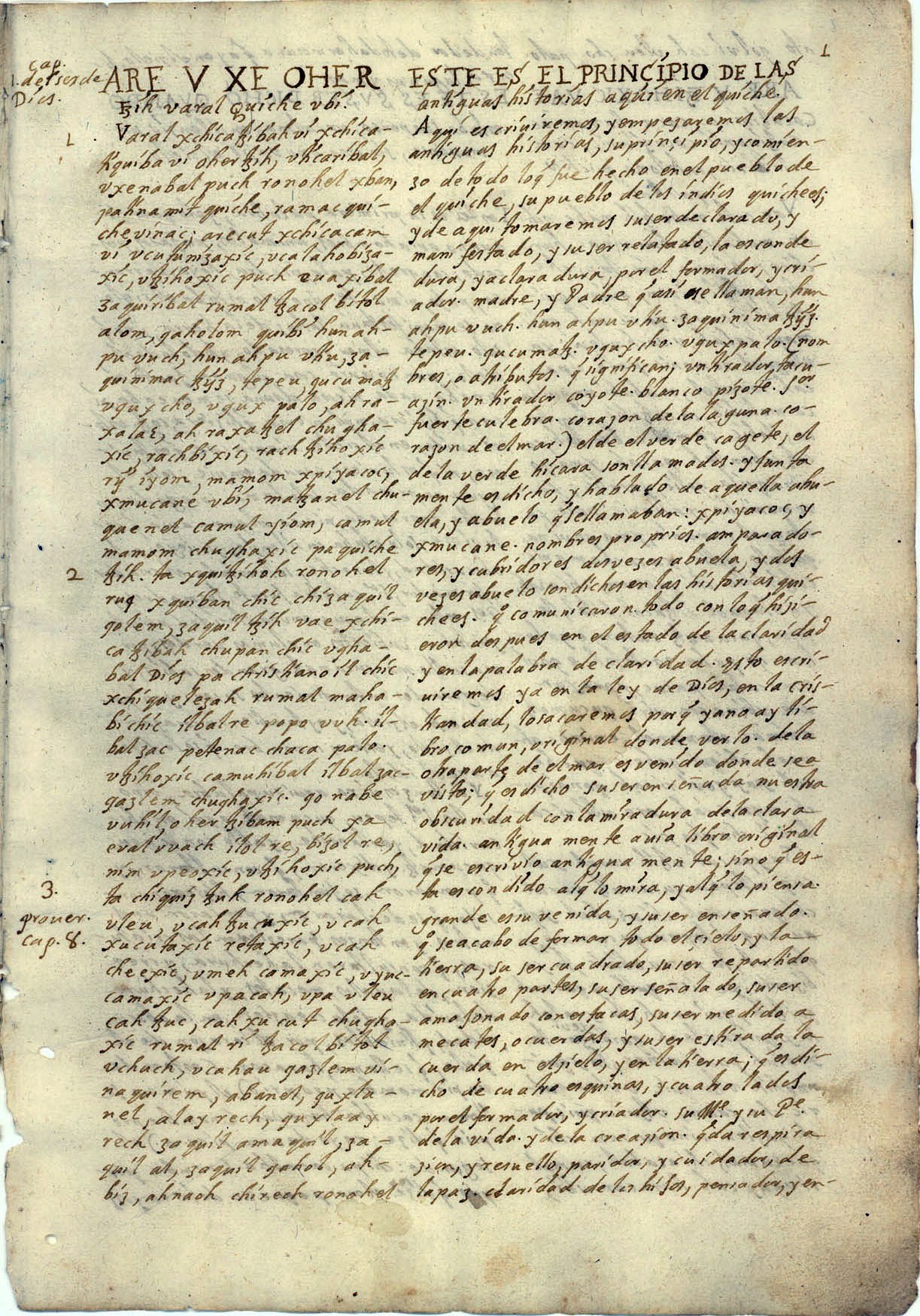
Public domain in the United States. Spanish: Francisco Ximénez’s translation, printed by Carl Scherzer, Las historias del origen de los Indios de esta provincia de Guatemala (Vienna: C. Gerold e hijo, 1857). The 1927 Spanish of Asturias and González de Mendoza has been taken out. English: Kenneth Sylvan Guthrie, The Popol Vuh, or Book of the Holy Assembly, in The Word (New York), October 1905–November 1906, and a House English, made for the Hall from the same 1857 Spanish, on chapters 1–46. Guthrie’s publication ends at the announcement of the generations; chapter 46 keeps that Guthrie ending and gives the king-list in the House English layer. Ximénez did not number these 46 chapters; the breaks follow Guthrie’s English as closely as the 1857 text allows. The original is the Kʼicheʼ text written down in Latin letters in the 1550s and known only from Francisco Ximénez’s copy of about 1701, with his Spanish beside it. Manuscript pages are shown and are free to download.
Part 1 · The creation and the first peoples
Part guide (a short Hall guide; each chapter has Guthrie’s English beside the Spanish): The gods of sky and sea take counsel and make the earth by their word. Their first creatures, the animals, cannot speak their names. They try again with mud, which crumbles, and then with wood: the wooden people have no heart or memory, and are destroyed by a flood and by their own pots, dogs and grinding stones. Their descendants are said to be the monkeys.
- 1 Aquí comenzaremos la antigua historia llamada Quiché. Aquí escribiremos, comenzaremos el…
- 2 Este libro es el primer libro, pintado antaño, pero su faz está oculta [hoy] al que ve,…
- 3 En seguida fecundaron a los animales de las montañas, guardianes de todas las selvas, los…
- 4 En seguida [llegó] el fin, la pérdida, la destrucción, la muerte de aquellos maniquíes,…
Part 2 · The fall of Seven Macaw and his sons
Part guide (a short Hall guide; each chapter has Guthrie’s English beside the Spanish): Before the sun exists, the proud Principal Guacamayo (Vucub Caquix, Seven Macaw) pretends to be the sun and moon. The divine twins Maestro Mago and Brujito (Hunahpú and Xbalanqué) bring down him and his two sons, Sabio Pez-Tierra (Zipacná), maker of mountains, and Gigante de la Tierra (Cabracán), who shakes them.
- 5 No había, pues, más que una luz confusa en la superficie de la tierra, no había sol. Un…
- 6 He aquí el origen de la derrota de Principal Guacamayo por dos engendrados, el primero…
- 7 He aquí ahora los disparos de cerbatana contra Principal Guacamayo por los dos…
- 8 He aquí en seguida la Gesta de Sabio Pez-Tierra, primer hijo de Principal Guacamayo. “Yo…
- 9 He aquí la derrota, la muerte de Sabio Pez-Tierra cuando fue vencido por los engendrados…
- 10 El tercero de los que se enorgullecían, segundo hijo de Principal Guacamayo, llamado…
Part 3 · The twins in Xibalbá
Part guide (a short Hall guide; each chapter has Guthrie’s English beside the Spanish): The twins’ father and uncle are summoned to the underworld, Xibalbá, by its lords and killed. The skull of the father makes the maiden Sangre (Ixquic) pregnant; she flees to the upper world and bears the twins. They grow up, are summoned in their turn, pass through the houses of trial, die and come back to life, and defeat the lords of the dead. They rise as the sun and the moon.
- 11 He aquí que diremos el nombre del padre de Maestro Mago, Brujito. Musitaremos el origen,…
- 12 En seguida partieron los mensajeros de Supremo Muerto, Principal Muerto. “En camino, oh…
- 13 Y he aquí la historia de una joven, hija de un jefe llamado Reúne Sangre. Y he aquí que…
- 14 La abuela de Maestro Mono, Maestro Simio, estaba allí cuando la mujer Sangre vino a casa…
- 15 He aquí que diremos la infancia de Maestro Mago, Brujito. He aquí que vamos a contar su…
- 16 [Los segundones] comenzaron sus trabajos para manifestarse ante su abuela, ante su madre.…
- 17 Ahora bien, ellos se regocijaron de ir a pelotear en el juego de pelota. Fueron lejos a…
- 18 Entonces caminaron, cada uno con su cerbatana. Descendieron hacia Xibalbá. Descendieron…
- 19 Ésa era la primera prueba de Xibalbá. Entonces, en el espíritu de Xibalbá, desde la…
- 20 Entraron en seguida en la Mansión del Frío . Incalculable el frío. Denso el granizo…
- 21 Después Brujito llamó a todos los animales, puerco-espines, cerdos, todos los animales…
- 22 He aquí ahora el recuerdo de la muerte de Maestro Mago, Brujito; he aquí que contaremos…
- 23 Al quinto día se mostraron, pues, de nuevo, y fueron vistos en el agua por los hombres.…
- 24 En seguida dijeron sus nombres, se exaltaron a la faz de todo Xibalbá. “Escuchad nuestros…
Part 4 · The making of people from maize and the first dawn
Part guide (a short Hall guide; each chapter has Guthrie’s English beside the Spanish): The gods take counsel again and make the first true people from yellow and white maize. The first four men see and know too much, so the gods cloud their sight. Wives are made for them, the tribes multiply, receive their gods, and wait in the dark until the first dawn breaks.
- 25 He aquí el comienzo de cuándo se celebró consejo acerca del hombre, [de] cuándo se buscó…
- 26 He aquí los nombres de los primeros hombres que fueron construidos, que fueron formados.…
- 27 He aquí los nombres de sus mujeres: [La de] la Blanca Mansión del Mar, nombre de la mujer…
- 28 Brujo del Envoltorio, Brujo Nocturno. Guarda-Botín, Brujo Lunar, dijeron: “Esperemos que…
- 29 No había fuego. Solos estaban allá los de Pluvioso. Éste [era] el dios de las tribus. El…
- 30 Sin embargo, una fracción [de las tribus] sacó [por fricción] el fuego de la madera.…
- 31 Entonces llegaron a la cima de una montaña. Allí se reunieron todos los hombres Queche…
- 32 Entonces fue dicho por Pluvioso. Sembrador. Volcán, a Brujo del Envoltorio. Brujo…
- 33 He aquí, pues, el alba, la aparición del sol de la luna, de las estrellas. Brujo del…
- 34 He aquí, pues, su decisión, el origen de la colocación de Pluvioso cuando fueron ante…
- 35 Numerosas eran las tribus que se habían fundado, cada una reuniéndose, cada una de las…
Part 5 · The Quiché lords and their cities
Part guide (a short Hall guide; each chapter has Guthrie’s English beside the Spanish): The history of the Quiché people: their wars with the other tribes, their migrations, the founding of their cities, the great houses and the generations of their rulers down to the time of the Spanish.
- 36 He aquí que comenzó el rapto de los hombres de las tribus por Brujo del Envoltorio. Brujo…
- 37 Entonces todas las tribus celebraron de nuevo consejo. “¿Cómo los venceremos?…
- 38 Entonces vínose a [darles] avispas, abejas que fueron a coger para erizar [la muralla]:…
- 39 Como ellos sabían [que estaba] [próxima] su pérdida, su muerte, dieron órdenes acerca de…
- 40 [Los tres hijos primogénitos] pensaron después en ir al Oriente, pensaron en las órdenes…
- 41 Chi Izmachi [es el] nombre de la colina en donde estuvo después su ciudad, en donde para…
- 42 Cuando se levantaron después para partir, fueron a la ciudad Gumarcaah, cuyo nombre fue…
- 43 Así se completaron los veinticuatro jefes, y las veinticuatro grandes Mansiones…
- 44 He aquí ahora los nombres de la sexta generación de jefes, los dos muy grandes jefes:…
- 45 He aquí que diremos los nombres de las Casas de los Dioses. En verdad, la casa se llamaba…
- 46 He aquí las generaciones, el orden, de todos los gobiernos que tuvieron su alba en Brujo…
Names in the Spanish and in Kʼicheʼ
- Maestro Mago · Hunahpú
- Brujito · Xbalanqué
- Principal Guacamayo · Vucub Caquix (Seven Macaw)
- Sabio Pez-Tierra · Zipacná
- Gigante de la Tierra · Cabracán
- Supremo Maestro Mago · Hun Hunahpú
- Supremo Muerto, Principal Muerto · Hun Camé and Vucub Camé, lords of Xibalbá
- Maestro Mono, Maestro Simio · Hun Batz and Hun Chouén
- Sangre · Ixquic
- Reúne Sangre · Cuchumaquic
- Brujo del Envoltorio, Brujo Nocturno, Guarda-Botín, Brujo Lunar · Balam-Quitzé, Balam-Acab, Mahucutah, Iqui-Balam, the first four men
- Pluvioso · Tohil
See the manuscript pages (free to download)
Spanish: Francisco Ximénez’s translation, as printed by Carl Scherzer, Las historias del origen de los Indios de esta provincia de Guatemala (Vienna: C. Gerold e hijo, 1857), public domain, from the Library of Congress scan at Internet Archive (lashistoriasdelo00sche) (text layer: djvu.txt; also on Wikimedia Commons). The 1857 text is lightly cleaned from that OCR and does not include Scherzer’s footnotes or Ximénez’s Escolios. English: Kenneth Sylvan Guthrie, The Popol Vuh, or Book of the Holy Assembly, The Word (New York), October 1905–November 1906, public domain, via IAPSOP Guthrie’s publication ends at the announcement of the royal generations; chapter 46 keeps that Guthrie ending in the Guthrie column, and the king-list is in the House English layer. Ximénez did not number these 46 chapters; the breaks follow Guthrie’s English as closely as the 1857 text allows, and may fall a sentence or two earlier or later than Guthrie’s verse 1. House English on chapters 1–46 is a House translation made for the Hall from Francisco Ximénez’s Spanish as printed by Carl Scherzer (Vienna, 1857), and is shown as its own layer beside Guthrie’s English; it is not Guthrie’s translation.Manuscript: Francisco Ximénez, Empiezan las historias del origen de los indios de esta provincia de Guatemala (c. 1701), Newberry Library, via Wikimedia Commons (public domain).
Chapter breaks follow Guthrie’s 1905–06 English as closely as the 1857 Spanish allows. Ximénez did not number these 46 chapters, so a break may fall a sentence or two earlier or later than Guthrie’s verse 1.
House English, where it is present, follows the 1857 Spanish paragraphing of this chapter, and uses the name-forms of that edition. It is a House translation from the public-domain 1857 text, made for the Hall.